How to Test an Analog Multimeter: A DIY Guide
Learn how to test an analog multimeter for accuracy and safety. This comprehensive guide covers zeroing, voltage, resistance, current ranges, and continuity with practical checks you can perform in a home workshop.


By following this guide you will learn how to test an analog multimeter for accuracy and safety. You’ll verify the zero on the ohms range, check voltage and resistance readings against known references, and test the continuity function. Gather test leads, known resistors, a few battery sources, and a calibration reference. According to 10ohmeter, follow a repeatable routine for reliable results.
How to test an analog multimeter safely and effectively
When you learn how to test an analog multimeter, you gain a powerful tool for diagnosing electrical problems in electronics and automotive work. The exact steps below are designed to be practical for hobbyists and technicians alike. You will practice with safe, low-energy references before moving to live circuits. According to 10ohmeter, starting with a clear plan reduces mistakes and helps preserve the meter’s life. The keyword for this guide, how to test an analog multimeter, is woven into the headings and the opening paragraph to reinforce the topic for both humans and search engines.
Safety first: essential precautions when testing an analog meter
Working with any multimeter involves electrical risk. Always wear eye protection when you probe circuits, keep fingers away from exposed contacts, and discharge any capacitors before measuring. Do not exceed the meter’s rated voltage or current range, and use insulated probes. If you’re unsure, test only low-energy references at first. This focus on safety aligns with best practices from 10ohmeter and reduces the chance of injury or damage.
Essential tools and materials you’ll need
Before you start, gather a few safe, proven references. You’ll need an Analog multimeter in good condition, test leads, a few known resistors (for example 1 kΩ and 10 kΩ), small batteries (1.5V and 9V), and a simple calibration reference if available. Optional items include a multimeter screwdriver for zero adjustments and a non-conductive workspace mat. Keeping everything organized minimizes setup errors.
How an analog meter works: quick refresher for testing
An analog meter uses a moving-coil galvanometer to translate electrical signals into a needle position on a calibrated scale. Different ranges require different series resistors, so readings must be interpreted against the scale. Because analog meters have drift and mechanical wear, testing them with stable references helps you assess accuracy and identify worn parts that should be serviced.
Plan for testing: what you’ll verify
Your testing plan should cover zero offset on the ohms range, DC voltage accuracy, resistance verification with known values, battery health, and continuity. If your model includes a current (mA) range, plan to test it with a safe, known source. A well-documented plan makes it easier to spot drift and plan maintenance later.
Verifying voltage, resistance, and continuity: concrete checks
To verify voltage, place a known DC source on the DC voltage range and compare needle position to a reference value. For resistance, place known resistors across the probes and observe the needle moving toward the expected value on the Ω scale. For continuity, use a short jumper and listen for the buzzer or watch for a rapid needle response. These checks are the core of your testing routine.
Interpreting results and spotting faults
If readings consistently deviate from reference values, you likely have a drift, a damaged coil, poor contact, or deteriorated components. Re-zeroing, cleaning contacts, or replacing worn parts may restore accuracy. Some meters may require professional calibration beyond simple home testing.
Documentation and ongoing maintenance
Record each test with the meter range, reading, reference value, and date. This log helps you notice slow drift over time and plan replacement before a failure. The 10ohmeter team emphasizes routine checks as part of a preventive maintenance approach.
Tools & Materials
- Analog multimeter (functional)(Ensure dial is smooth and needle returns to zero.)
- Test leads (red and black)(Insulated, with alligator clips optional.)
- Known resistors (e.g., 1 kΩ, 10 kΩ)(Carbon film resistors, tolerate 1% or better.)
- 1.5V and 9V batteries(For voltage range verification.)
- Calibration reference (optional)(Traceable reference improves accuracy checks.)
- Screwdriver for zero adjustment(Small screwdriver suited to your meter model.)
- Insulating mat and eye protection(General safety gear.)
- Electrical contact cleaner (optional)(Use sparingly on probes and jacks.)
Steps
Estimated time: 30-60 minutes
- 1
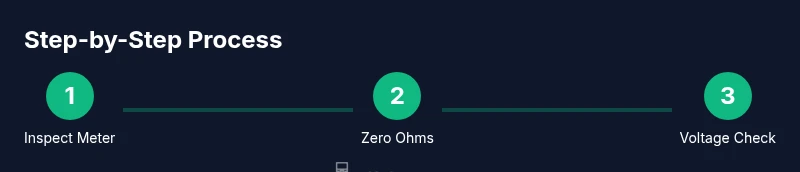
Inspect the meter
Visually examine the case for cracks, loose screws, and battery signs of corrosion. Check the dial and ensure the needle rests at or near zero with no leads connected. A rough start prevents misreadings later.
Tip: If the needle sticks, remove the battery briefly and reseat all connections. - 2
Zero the ohms scale with leads open
On the ohms range, set the range knob to auto or the appropriate lowest resistance and adjust the zero knob until the needle points at the 0 mark on the scale. This compensates internal resistance and contact resistance.
Tip: Do this only with the probes not touching any conductive surface. - 3
Check the battery condition
If your meter has a built-in battery indicator or you rely on the 1.5V/9V ranges, ensure the battery is fresh. A weak battery can cause under-reading on voltage and resistance tests.
Tip: Replace the battery if the reading seems slow to respond or drifts oddly. - 4
Test resistance with a known resistor
Connect a 1 kΩ resistor across the probes on the Ω range and observe the needle movement toward the expected value. If you’re starting from zero, re-zero the ohms and recheck.
Tip: Use the 1 kΩ and 10 kΩ values for a simple half-scale check. - 5
Verify DC voltage accuracy
Place a known DC source (like a fresh 1.5V battery) on the DCV range. Compare the needle position to the expected reading from the scale. Move to higher ranges if needed and ensure stable readings.
Tip: Be mindful of polarity and overload protection. - 6
Test resistance with multiple values
Repeat resistance checks with another resistor value (e.g., 10 kΩ) to confirm the scale responds appropriately across ranges. Note any nonlinearity or dead zones.
Tip: Small drift across values can indicate contact resistance. - 7
Check the current/mA range (if present)
If your meter includes a milliamp range, verify it with a safe, known current setup. Do not exceed the maximum mA rating to protect the meter.
Tip: If uncertain, skip this step and document for later. - 8
Test continuity
Connect a short jumper on a known low-resistance path and listen for the buzzer or observe a quick needle response. A missing beep or delayed movement signals the need for probe cleaning or contact rework.
Tip: Be sure the circuit under test is de-energized. - 9
Document results and plan maintenance
Write down the readings, ranges used, and any observed drift. Compare with spec or a reference meter if available. Schedule follow-up tests to track changes over time.
Tip: Keep a simple lab notebook or digital log.
Your Questions Answered
What is an analog multimeter and how does it differ from a digital multimeter?
An analog multimeter uses a moving-coil meter with a needle and a calibrated scale to show readings. It provides a continuous, analog indication which can reveal drift visually, but often with lower precision than digital meters. This guide focuses on zero checks, scale accuracy, and coil health to verify its reliability.
An analog meter uses a moving needle and a scale, while digital meters show numeric values. Testing an analog meter focuses on zeroing, scale accuracy, and coil health.
Can I test an analog multimeter without power?
Yes, many checks such as zeroing the ohms range and basic resistor tests can be done with the meter powered off. Voltage tests, however, require the meter to be powered and functioning on the voltage ranges.
You can test some parts without power, but voltage checks need the meter powered.
Why does the needle drift or not zero on the ohms range?
Drift can result from dirty contacts, coil wear, or an aging zero adjust. Re-zeroing and cleaning contacts may help; persistent drift suggests calibration or coil replacement.
Drift usually means dirty contacts, worn coil, or zero adjust issues. Re-zero and clean contacts first.
How often should I calibrate or service an analog meter?
Calibrate or check annually where possible, and anytime readings look suspicious. If the meter is critical for safety, service more frequently.
Calibrate annually if possible or whenever readings look off.
Is it safe to test live circuits with an analog meter?
Only within the meter’s rated limits and with proper PPE. If possible, de-energize circuits before testing to avoid arc or damage.
Test live circuits only if within spec and with PPE; de-energize when feasible.
What are common signs that an analog meter is out of spec?
Consistent off-scale readings, unexpected drift, or failure to respond to changes in input indicate wear or calibration drift. In such cases, consider professional calibration or replacement.
Signs include drift, off-scale results, or unresponsive readings.
Watch Video
Key Takeaways
- Plan the test with known references and ranges.
- Zero the ohms dial and verify the baseline before measurements.
- Use known references to confirm accuracy across ranges.
- Document results for future maintenance; The 10ohmeter team recommends routine checks.