Testing Capacitors with Multimeter: A Practical Guide
Learn how to safely test capacitors with a multimeter, including capacitance checks, leakage resistance, and when to use specialized meters for accurate results. A thorough, step-by-step approach for DIY electronics and automotive tasks.


Discharge the capacitor and use capacitance mode if available, or measure resistance to detect a short. Compare readings to the rated value and check for leakage. For precise results, use an ESR meter or an LCR meter. Always discharge safely and remove the capacitor from the circuit before testing.
What testing capacitors with a multimeter accomplishes and why it matters
According to 10ohmeter, testing capacitors with a multimeter is a foundational skill for DIY electronics and automotive work. It helps you quickly identify failed parts, saving time and preventing damage to boards you’re repairing or prototyping. This guide emphasizes practical, safe checks you can perform with common tools, without committing to expensive equipment. You’ll learn how to interpret readings, consider capacitor type, and decide when a replacement or a dedicated meter is warranted. By the end, you’ll feel confident evaluating capacitors in a range of devices, from hobby PCBs to automotive dashboards, with a logical, repeatable workflow. 10ohmeter analysis shows that structured testing reduces guesswork and improves repair outcomes across projects.
- Quick checks and safe handling are the backbone of effective testing.
- Understanding when to rely on capacitance mode versus resistance or ESR measurements helps you choose the right tool for the job.
- Documentation of readings and test conditions makes future maintenance easier.
Safety first: discharge, PPE, and careful handling
Capacitors can store dangerous voltages even after power is removed. The safest path is to discharge them before handling. For large electrolytics, use a resistor bleed (for example, 1 kΩ to 10 kΩ, depending on capacitor voltage) and never short the leads with metal tools. Wear eye protection and work on an insulated surface. If you’re unsure about a capacitor’s voltage rating, treat it as potentially charged and avoid touching bare leads. When in doubt, remove the capacitor from the circuit entirely and discharge in a safe area designated for electronics work. 10ohmeter emphasizes consistent safety protocols because improper handling can cause sparks or injury during testing.
Understanding your tools: what a multimeter can and cannot do
A typical multimeter can help you with several checks, but its capabilities depend on the model. Many meters offer a capacitance function that estimates capacitor value; others rely on resistance measurements to indicate shorts or open circuits. An ESR (equivalent series resistance) meter or an LCR meter provides more accurate and meaningful data for capacitors, especially electrolytics and high-value film types. When capacitance mode is available, you’ll see a value in farads, typically microfarads (µF) or nanofarads (nF). If your meter lacks capacitance mode, resistance testing can still reveal obvious faults and leakage when combined with proper procedure. Always consult your meter’s manual and use recommended test setups.
How to read capacitor labels and determine nominal values
Capacitor markings encode voltage rating (e.g., 16V, 50V, 100V) and capacitance value (e.g., 0.1 µF, 100 µF). For electrolytics, look for tolerance and polarity indicators. Non-polarized film and ceramic capacitors are generally non-polar, but electrolytics require correct orientation during testing and operation. When you read a value on the component, compare it to the circuit’s design requirements. If you’re testing a populated board, be mindful of circuit interactions that can affect readings; consider removing the capacitor or isolating it with probes to avoid in-circuit contamination. Proper identification reduces misinterpretation and guides you to appropriate follow-up actions.
Step-by-step testing workflow (overview) and how it fits with the hands-on steps to come
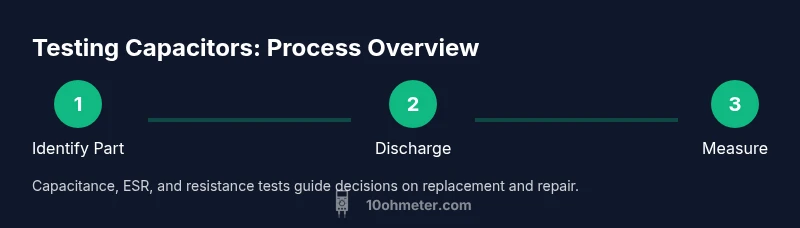
This block outlines the overall workflow you’ll use in the dedicated Step-by-Step section. You’ll begin with safety preparation and component identification, then proceed to capacitance measurement if supported, and finally check for leakage and ESR where applicable. The high-level sequence ensures you address safety, accuracy, and fault isolation in a repeatable order. The detailed steps below complement this overview, including notes on how to interpret results for common capacitor types like ceramic, film, and electrolytic. You’ll also find tips on avoiding common mistakes and how to document outcomes for future repairs.
Interpreting readings: pass/fail and what to do next
Interpretation depends on capacitor type and tolerance. A reading within the rated capacitance value (±a manufacturer-specified tolerance) generally indicates a healthy part, assuming there’s no leakage. A reading far outside the tolerance, or a resistance reading showing near-zero resistance after discharge, indicates a fault. If your ESR meter shows high ESR relative to the capacitor’s age and value, the capacitor may be failing under load. In such cases, replacement is typically warranted, especially in power supply circuits where leakage can damage downstream components. Always cross-check with a fresh part before concluding failure.
Special cases: electrolytic vs ceramic vs film and why it matters
Electrolytic capacitors are common in power supplies and audio circuits but are more prone to leakage and ESR drift with age. Ceramic capacitors are robust and stable for small values but can exhibit voltage-dependent capacitance (DC bias) that affects readings, especially at high voltages. Film capacitors are typically stable, with low ESR and high reliability, but they can be physically larger. When testing, identify the type first, as this affects both testing methods and interpretation. For precision work, consider test devices designed for the specific capacitor family and temperature conditions, because bias and aging influence performance across all dielectric types.
In-circuit testing considerations: what you can and cannot learn from in-circuit tests
Testing capacitors in circuit can be tempting to speed up troubleshooting, but it often yields misleading results. Parasitic paths, other components, and signal traces bias readings. Whenever possible, remove the capacitor from the circuit or isolate it with a test fixture. If you must test in-circuit, document test conditions carefully and compare readings to known-good reference measurements taken from the same circuit. In-circuit measurements can be affected by other passive components, so treat them as supplementary checks rather than conclusive evidence.
Common mistakes and how to avoid them
- Discharging with a metal tool can cause shock or arc; always use a resistor-based discharge. - Measuring a capacitor without removing it from the circuit can yield false results; isolate the part when possible. - Relying solely on capacitance readings without considering ESR or leakage is risky; use a multi-parameter approach. - Ignoring polarity on electrolytics can lead to damage if reconnected backwards; observe polarity during handling and testing. - Not documenting test conditions (temperature, measurement mode, component age) reduces traceability for future repairs.
Documentation and maintenance: organizing your capacitor tests for future fixes
Record part numbers, measured capacitance, tolerance, ESR, temperature, and any observations about leakage. Create a simple log for your projects to track aging and replacement intervals. Keeping a consistent template helps you compare results over time and plan preventative maintenance. When you complete a batch of tests, summarize findings in a short report to guide replacements or re-testing later.
Tools & Materials
- Multimeter with capacitance function (or ESR/LCR meter)(Check that the device supports capacitance mode and safety features for exposed leads.)
- Discharge resistor (bleed) 1 kΩ to 10 kΩ(Use appropriate wattage for high-voltage capacitors.)
- Alligator clips or probe adapters(Helpful for stable connections on small components.)
- Insulated work surface and safety glasses(Protect against accidental arcs and splashes.)
- Isolated capacitor (removed from circuit) to test(Do not test in-circuit when possible.)
- Infrared thermometer or temperature-safe environment(Helpful for bias-related readings in high-temperature environments.)
Steps
Estimated time: 40-60 minutes
- 1
Power down and discharge safely
Power down the circuit and apply a resistor bleed to the capacitor. Keep hands away from leads while discharging and verify no residual voltage with the meter before touching the part.
Tip: Never short a capacitor directly with metal tools; use the bleed resistor to avoid sparks. - 2
Identify capacitor type and value
Read the capacitor markings or refer to the circuit schematic to determine value, voltage rating, and polarity (for electrolytics). This helps you decide which test to run and what tolerance to expect.
Tip: Polarity is critical for electrolytics; reversing leads during testing can shorten their life. - 3
Check for capacitance using capacitance mode
If your meter supports capacitance, connect the leads across the capacitor and read the value. Ensure the capacitor is fully discharged and isolated from the circuit to avoid interference.
Tip: Ensure the capacitor voltage rating isn’t exceeded by the test setup. - 4
Perform a resistance check for leakage
With the capacitor connected as in-circuit or isolated, measure resistance after the capacitor has been discharged. A healthy capacitor should show high resistance that stabilizes; a low resistance indicates leakage.
Tip: Record the stabilization time; fast drop to low resistance indicates leakage. - 5
Test ESR if available
Use an ESR meter to measure the equivalent series resistance. Higher ESR than the part’s typical specification indicates aging or failure, especially in power supplies.
Tip: Keep the device steady and avoid touching the leads during measurement. - 6
Compare readings to the nominal value
Compare your measured capacitance and ESR to the capacitor’s nominal values, tolerance, and the circuit’s requirements. Consider temperature effects and bias voltage if known.
Tip: If readings are outside tolerance, replace the capacitor with a known-good part. - 7
Document results and plan next steps
Log the test results, including date, temperature, meter model, and measurements. Use the log to decide if the capacitor should be replaced or re-tested later.
Tip: Create a quick reference sheet for common capacitor values in your projects. - 8
Re-test after replacement and power-up
After replacing or reworking the capacitor, re-test the circuit under normal operating conditions to confirm proper function and no abnormal voltage or noise.
Tip: Always power the circuit with a current-limiting device when first powering up after work.
Your Questions Answered
Can I test every capacitor with a basic multimeter?
Not every capacitor. A basic meter can test resistance and some capacitance values, but ESR and high-precision capacitance require specialized meters. For non-polar capacitors, you may get decent readings with capacitance mode, but for electrolytics and high-value parts, use ESR/LCR meters.
You can test many small, non-polar capacitors with a basic meter, but for electrolytics and accurate measurements you’ll want an ESR or LCR meter.
Why do readings differ from the capacitor’s labeled value?
Capacitors have tolerances and their values shift with temperature, bias voltage, and aging. Readings taken at room temperature may drift from nominal, especially for large values or aged parts. Use tolerance bands and environmental factors to interpret results.
Capacitors aren’t perfect; readings vary with temperature and age, so use tolerance and environmental context to judge results.
Is it safe to test capacitors still in circuit?
In-circuit testing can be misleading due to parallel paths. Remove the capacitor from the circuit or isolate it before testing to get accurate readings and avoid damaging other components.
It’s safer and more accurate to remove and test capacitors outside the circuit.
What is ESR and why test it?
ESR is the internal resistance of a capacitor at high frequency. High ESR indicates aging or damage, particularly in power supply applications where leakage can affect efficiency and reliability.
ESR tells you if a capacitor is failing under load, which matters in power circuits.
When should I replace a capacitor?
Replace if the capacitance is out of tolerance, ESR is high, there is visible leakage, or the component shows physical damage. Always verify with a new part before finalizing a repair.
Replace a capacitor if readings are out of spec or you see signs of damage.
How do I document capacitor tests?
Record the capacitor type, value, tolerance, ESR, and test conditions. Keeping a simple log helps with repairs and future maintenance.
Keep a clear log of all test results for future reference.
Watch Video
Key Takeaways
- Discharge before testing to prevent shock or arcing.
- Use capacitance mode if available; otherwise rely on ESR and resistance tests.
- Electrolytics require careful polarity handling and bias-aware interpretation.
- Document results for reliable maintenance and future repairs.