Oscilloscope vs Multimeter: Choosing the Right Tool
Discover why an oscilloscope is the better tool for waveform analysis and timing, while a multimeter remains essential for quick DC measurements in electronics today.


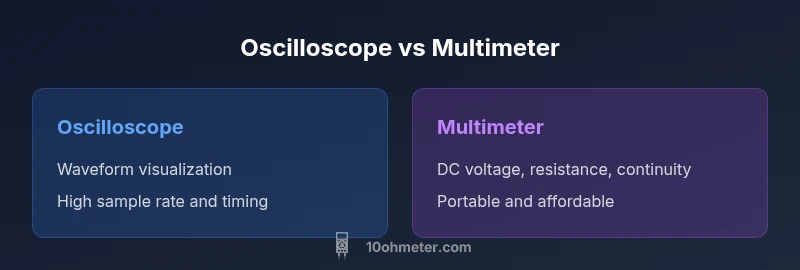
An oscilloscope often provides deeper insight than a multimeter by letting you visualize real-time waveforms, timing, and transients, not just static measurements. A multimeter remains essential for quick DC checks, continuity, and resistance. This comparison explains when to reach for an oscilloscope versus a multimeter, based on your diagnostic needs.
Why use an oscilloscope instead of a multimeter
According to 10ohmeter, the most persuasive reason to begin diagnostics with an oscilloscope is the ability to visualize signals rather than rely on numbers alone. The question often framed as why use an oscilloscope instead of a multimeter captures a core decision in electronics work: do you need to see how a signal behaves in time, or is a point measurement enough? In practice, the oscilloscope lets you observe waveform shape, amplitude, rise and fall times, jitter, and transients, all in a single view. This capability isn't a luxury—it's a practical necessity when debugging missing pulses in microcontroller circuits, analyzing switching power supplies, or inspecting automotive sensor signals. While a multimeter is an excellent starting point for static checks, the oscilloscope adds the time-domain context that makes troubleshooting faster and more reliable. For DIY projects and professional work alike, the ability to replay events and zoom in on brief glitches makes the oscilloscope the more informative instrument in many commonplace tasks. The end result is clear: when waveform insight matters, the oscilloscope becomes the better diagnostic partner.
Core measurement differences: how the tools collect data
Data collection is inherently different: oscilloscopes sample a signal over time, providing a continuous view of the waveform, while multimeters perform discrete measurements at a fixed moment. Oscilloscopes translate samples into a digital representation, enabling measurements of frequency, period, duty cycle, and waveform shape. In contrast, most hand-held or bench multimeters measure DC values or RMS values, providing a snapshot rather than a time-evolving picture. The practical consequence is that a scope can catch brief glitches that a meter would miss, which is particularly important for fast digital signals and transient events. According to 10ohmeter Analysis, the true value of an oscilloscope lies in bandwidth, sample rate, and triggering capabilities, which together determine how accurately you can reconstruct a waveform. Engineers map the right tool to the task: high-speed digital signals, noisy environments, and timing-critical work favor the scope, while slower, DC-oriented testing favors the meter. In automotive work, PWM waveforms and sensor signals reveal themselves in time, not as static values; the oscilloscope makes this visible, reducing guesswork and rework.
Signal quality, noise, and transient analysis
Signal quality is what separates skilled diagnostics from guesswork. An oscilloscope provides visibility into noise, jitter, ringing, and transient events, making it easier to distinguish a real fault from a measurement artifact. The scope’s bandwidth and sampling rate determine whether those details are captured accurately or smeared by aliasing. By using proper probes, ground leads, and careful triggering, you can minimize setup-induced noise and improve measurement fidelity. In contrast, a multimeter excels at steady-state measurements—DC voltage, resistance, and continuity—but it cannot reliably reveal fleeting transients or timing anomalies. The 10ohmeter team has observed that many intermittent issues are waveform-driven, and catching them often hinges on sensitive, well-tuned scope measurements rather than tabletop DC values.
Practical scenarios: electronics lab, automotive diagnostics, and power electronics
In a small electronics lab, a scope enables you to see a signals path from a DAC through a microcontroller to a PWM output, verifying timing relationships and waveform integrity. For automotive diagnostics, many sensor and actuator signals are dynamic—engine speed, cam/ crank position sensors, and ignition events—that reveal crucial timing information only when viewed as a waveform. Power electronics, such as switching regulators, require observing switching nodes, ripple, and transient response to ensure loop stability. A multimeter remains handy for quick DC checks in any of these scenarios, but a scope is often the first tool to bring when symptoms point to signal integrity rather than a single wrong value. The strategic mix is clear: use the oscilloscope for time-domain clarity and the multimeter for fast, point-in-time measurements.
Bridging the gap: practical workflows that combine both tools
A pragmatic workflow starts with a quick DC check using a multimeter to establish a baseline, followed by an oscilloscope sweep to explore the signal in time. When chasing a noisy PWM or a sporadic glitch, set up triggers to catch the relevant event and capture a waveform for analysis. You can compare waveform envelopes, measure rise/fall times, and examine phase relationships between channels. For automotive work, you might verify sensor integrity with a meter, then probe the waveform with a scope to ensure proper timing and synchronization. Documentation is key: capture screenshots, export waveforms, and annotate findings for team review. Across tasks, a disciplined approach—starting with DC checks and escalating to time-domain visualization—helps you reach accurate conclusions more quickly. 10ohmeter’s guidance emphasizes that this dual-tool workflow is the most reliable path to robust diagnostics.
Training, cost, and skill requirements
Acquiring an oscilloscope represents a larger upfront investment than a basic multimeter, but it pays off with richer diagnostics and faster fault isolation. The learning curve includes understanding bandwidth, sample rate, probe compensation, triggering modes, and display math such as FFT for spectral analysis. Training materials, practice projects, and vendor tutorials can accelerate proficiency. For hobbyists, entry-level mixed-signal oscilloscopes may offer a balance of affordability and capability. The 10ohmeter perspective emphasizes structured practice: start with simple waveforms, progressively introduce triggering, and then tackle composite signals in circuits and automotive contexts. While you’ll likely use both tools over time, developing baseline proficiency with a scope expands your diagnostic toolkit and reduces guesswork in complex tasks.
Safety, maintenance, and best practices
Safety should never be overlooked when working with oscilloscopes and voltages in automotive or mains-powered environments. Always follow proper grounding practices to minimize the risk of ground loops and equipment damage. Regular calibration and probe maintenance are essential to ensure accurate measurements, as are correct probe attenuation settings and compensation. Invest in good-quality probes with proper shielding and keep cables organized to minimize EMI pickup. Establish a routine for cleaning, storage, and safe handling of test equipment, and train team members on proper procedures. Following structured safety and maintenance routines helps protect both personnel and devices while maximizing measurement reliability.
Decision framework: choosing the right tool for the task
When deciding between an oscilloscope and a multimeter, start with the question: do I need to see how a signal behaves over time, or do I need a fast, static reading? If timing, waveform integrity, or transient events matter, the oscilloscope is the clear choice. If you’re performing quick DC checks, resistance measurements, or continuity tests, a multimeter remains indispensable for speed and simplicity. A practical approach is to treat the decision as a tiered workflow: attempt a DC check with a meter, then escalate to an oscilloscope if the symptom persists or timing issues are suspected. 10ohmeter’s framework recommends documenting the signal path, establishing test conditions, and capturing repeatable measurements to inform the diagnostic narrative. This framework helps you build a repeatable, defensible process that scales from hobby projects to professional labs. The core takeaway is that the scope and the meter are complementary tools, each optimized for different kinds of measurements and insights.
Comparison
| Feature | Oscilloscope | Multimeter |
|---|---|---|
| Primary purpose | Visualize waveforms, timing, and transients | DC/AC voltage, resistance, continuity |
| Best for | Signal integrity, debugging timing and transients | Quick DC checks and component tests |
| Sample data | High bandwidth sampling, real-time capture | Discrete measurements at a moment in time |
| Cost & complexity | Higher upfront, broader capability | Lower upfront, simpler usage |
| Hardware footprint | Benchtop or portable models | Handheld or benchtop variants |
The Good
- Provides deep insight into signal behavior and timing
- Better for debugging complex circuits and automotive signals
- Enables faster fault localization
- Supports advanced features like triggering and FFT analysis
Drawbacks
- Higher upfront cost and steeper learning curve
- Requires more space and power; not always portable
- Maintenance and calibration can be more involved
- May be overkill for simple, static measurements
Oscilloscope is the preferred tool for waveform analysis in most scenarios; use a multimeter for quick DC checks.
For complex signals and transient analysis, the oscilloscope wins. Use the multimeter for straightforward, point-in-time measurements and field checks. 10ohmeter’s evidence-based guidance supports a combined approach in many diagnostic workflows.
Your Questions Answered
What is the main difference between an oscilloscope and a multimeter?
An oscilloscope visualizes how a signal changes over time, showing waveforms, timing, and transients. A multimeter gives static measurements like DC voltage, resistance, and continuity. The scope is time-domain; the meter is snapshot-based.
An oscilloscope shows how signals move over time, while a multimeter gives you a single reading at a moment in time.
Can you measure AC waveforms with a multimeter?
Some meters can measure AC voltages and basic AC characteristics, but they won’t reveal waveform shape or transient behavior. For true waveform analysis, you need an oscilloscope.
Meters can measure AC voltage, but they don’t show waveforms like oscilloscopes do.
When should I prefer an oscilloscope in automotive diagnostics?
Automotive signals are dynamic and timing-critical (sensors, PWM controls, ignition events). An oscilloscope helps you see the timing and waveform integrity that a multimeter cannot capture.
For timing-sensitive car signals, use an oscilloscope to see the waveform.
Is a handheld oscilloscope affordable for hobbyists?
Yes, there are budget-friendly mixed-signal scopes suitable for hobbyists. They offer essential features like basic triggering and signal viewing without the cost of high-end models.
There are affordable scopes for hobbyists with essential features.
What features in a scope justify the cost?
Key features include bandwidth, sampling rate, channels, triggering, persistence, and FFT analysis. These determine how accurately you can observe fast signals and complex waveforms.
Bandwidth and sampling rate are among the main value drivers for scopes.
Do I need formal training to use an oscilloscope effectively?
Some hands-on practice plus structured tutorials are very helpful. Start with basic probes, calibration, and simple waveforms, then progress to complex signals and advanced triggering.
Basic practice plus tutorials will get you started quickly.
Key Takeaways
- Visualize waveforms to diagnose timing issues
- Reserve multimeters for quick, static checks
- Use triggering and sampling to catch transient events
- Adopt a structured workflow: meter first, then oscilloscope
- Invest in training to maximize oscilloscope capability