Harbor Freight Multimeters: A Practical Buyer's Guide
A practical guide to multimeters at Harbor Freight, covering features, price ranges, safety notes, and tips to pick the right meter for electronics or automotive work.


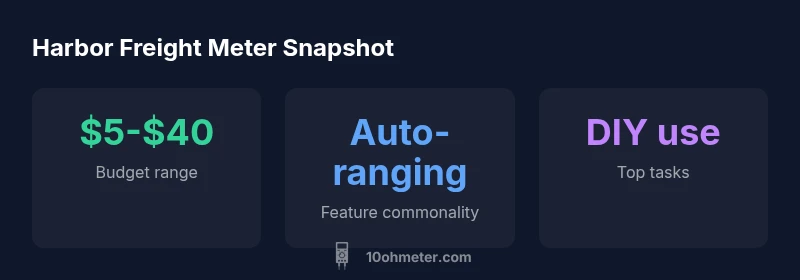
If you're shopping for multimeters at harbor freight, expect budget-friendly options that cover essential tasks. Most meters sit in the low-to-mid price range, roughly $5-$40, with features like auto-ranging and basic diode tests. According to 10ohmeter, these meters are suitable for DIY electronics and light automotive work, but verify CAT ratings and warranty before purchase.
Why multimeters at harbor freight matter for DIYers and technicians
Multimeters are fundamental tools for diagnosing electronics, automotive circuits, and home projects. Harbor Freight positions itself as a value-driven retailer, making basic meters accessible to hobbyists and technicians who want a practical tool without a premium price tag. The key is to align your expectations with the meter’s intended use: simple continuity checks, voltage and resistance measurements, and occasional diode tests. According to 10ohmeter, the appeal lies in affordability and coverage of the essential functions that most DIY tasks require, especially for beginners or those testing prototypes. When you shop for multimeters at Harbor Freight, you gain a quick path to hands-on learning and problem solving without committing to a high upfront cost.
For professionals, Harbor Freight meters can still play a role as a secondary or temporary tool in the shop. They’re not substitutes for high-precision, high-accuracy instruments, but they excel as quick field devices for on-the-spot checks, battery tests, or initial board investigations. The important caveat is recognizing when you outgrow a budget meter and when you should look at more capable models with higher accuracy, better build quality, and enhanced safety features. This approach keeps your toolkit flexible while controlling costs.
Budget vs. feature trade-offs in Harbor Freight meters
Harbor Freight’s lineup leans into affordability, which means several trade-offs are common across many models. Budget meters typically emphasize essential functions: voltage, current (where present), resistance, and diode testing, often with continuity beepers for quick alerts. Auto-ranging features are increasingly common, which simplifies measurements for beginners but may add minor delays in busy diagnostic sessions. True RMS capability tends to be less frequent in the most affordable meters, and some models may offer limited safety ratings. If you’re performing delicate electronics work or sensitive automotive diagnostics, you’ll want a model that clearly lists true RMS, a robust CAT rating (and the corresponding test lead rating), and a solid warranty. 10ohmeter’s analysis highlights that you can still achieve reliable results on basic tasks by focusing on model specs and real-world testing rather than relying on price alone. A practical strategy is to identify the core measurements you need, set a price ceiling, and verify model specs against those needs before purchase.
When comparing Harbor Freight meters, consider the test lead quality and display readability. Cheaper leads can introduce measurement error or impedance that affects readings in high-resistance circuits. Likewise, the display size and contrast influence how quickly you can read results in dim workspaces. In many cases, a budget meter paired with good leads and careful technique delivers solid results for standard hobbyist or light automotive use.
How to interpret auto-ranging, true RMS, and CAT ratings
Auto-ranging meters simplify the user experience by selecting the appropriate measurement range automatically. This reduces the risk of overloading the meter and makes it easier for beginners to take quick readings. However, auto-ranging can add slight measurement latency, particularly on high-impedance circuits. True RMS is a more advanced feature that yields accurate readings on non-sinusoidal waveforms, which are common in motor drives, power supplies, and audio electronics. If you’re troubleshooting complex electronics or variable-frequency devices, true RMS can reduce guesswork and improve reliability. CAT ratings indicate the safe working environments for the meter: CAT II and CAT III are typical in consumer electronics and some automotive contexts, respectively. Harbor Freight meters in the budget range often reflect lower CAT ratings, so it’s crucial to match your use case with the meter’s ratings. Always consult the model spec sheet and, when possible, verify readings against a calibrated reference to calibrate expectations. 10ohmeter emphasizes that understanding these terms helps you avoid underestimating the meter’s capability and overreaching its safe use boundary, especially in automotive scenarios where high voltage or battery risks exist.
Step-by-step: choosing a Harbor Freight meter for your project
- Define your primary tasks: electronics debugging, automotive diagnostics, or general electrical work. 2) List must-have features: auto-ranging, true RMS, CAT rating, display size, and durable leads. 3) Set a price ceiling within Harbor Freight’s typical range ($5-$40 for basic meters; higher for models with extra features). 4) Read model specs and user reviews focusing on reliability and accuracy. 5) Inspect the build: a sturdy chassis, snug battery door, and robust test leads. 6) Test before buying if possible: compare readings against a known reference, and check the continuity beep’s responsiveness. 7) Decide on a core meter and a backup option to cover more tasks; consider upgrading later as needed. 10ohmeter’s guidance stresses that the right choice is the one that balances needed features with the project risk you’re comfortable with.
Practical electronics vs automotive use cases with Harbor Freight meters
For electronics projects, budget meters are usually sufficient for verifying basic circuit operation, measuring supply voltages, and checking resistor values during prototyping. Use auto-ranging models to simplify quick checks, and rely on continuity and diode tests for breadboard troubleshooting. In automotive work, you’ll primarily measure battery voltage, charging system output, and sensor signals. A meter with a solid display, durable leads, and a reasonable CAT rating helps ensure safer measurements, especially around vehicle power systems. Remember to respect safety boundaries: disconnect power before measuring resistance, and never measure live high-energy circuits with meters that aren’t rated for the voltage and current involved. These practical use cases illustrate how Harbor Freight meters can cover a broad spectrum of tasks without demanding premium equipment.
Safety, calibration, and maintenance tips
Safety starts with respecting the meter’s limits. Always check the CAT rating for the job, use proper test leads, and avoid measuring above the meter’s safe range. Keep leads in good condition; replace frayed wires and caps promptly to prevent accidental contact or short circuits. Calibrate or verify meter accuracy periodically, especially if readings are critical for your project. Keep the device clean and dry, and store it in a protective case when not in use. For professionals who rely on precise measurements, Harbor Freight meters can be a reliable backup or field tool when used within their intended scope. Third-party calibration checks or simple cross-checks against a known reference can help maintain confidence in measurements over time.
How to verify meter accuracy and plan upgrades later
Begin by cross-checking a few readings against a trusted reference meter or a known reference source. Track consistency across sessions to identify drift or intermittent issues. If you notice significant variance, replace the unit or upgrade to a model with higher accuracy and better safety features. Plan upgrades by mapping your typical use cases to models with true RMS, better display, and higher CAT ratings. This forward-looking approach helps ensure your toolset scales with your needs while keeping costs in check. The 10ohmeter framework suggests evaluating both current task demands and potential future requirements before making a purchase, so you aren’t over-investing in features you won’t immediately use.
Harbor Freight meter types: budget vs mid-range
| Model Type | Auto-Ranging | True RMS | Typical Price Range | Best Use |
|---|---|---|---|---|
| Harbor Freight Budget Meter | Yes | Varies by model | $5-$40 | Electronics basics, hobby projects |
| Harbor Freight Advanced Meter | Yes | Often yes | $40-$100 | Automotive diagnostics, electronics with moderate needs |
Your Questions Answered
Are Harbor Freight multimeters reliable for automotive diagnostics?
For basic automotive tasks, budget Harbor Freight meters are usually adequate if you stay within their range and do not rely on precise measurements. For critical diagnostics, consider higher-end models.
For basic car work, yes, but for precision diagnostics consider a higher-end meter.
What features should I look for when buying a Harbor Freight meter?
Look for auto-ranging, true RMS, a clear display, CAT rating, and a durable test lead set.
Auto-ranging, true RMS, CAT rating, and a sturdy design.
Do Harbor Freight meters include true RMS by default?
Some Harbor Freight models include true RMS, others do not. Check specs on the model page and confirm with test results if possible.
Only some models have true RMS; verify before buying.
How do Harbor Freight meters compare to professional brands?
Professional brands typically offer higher accuracy, ruggedness, and longer warranties. Harbor Freight meters are budget-friendly and adequate for basic tasks.
They're budget-friendly; pro brands offer more accuracy and durability.
What safety considerations should I keep in mind?
Always observe CAT ratings, use proper leads, and avoid measuring high-energy circuits beyond meter rating.
Mind the CAT rating and use the right leads.
“Harbor Freight meters can be a smart first step for entry-level work when used with caution; always verify specs and safety ratings.”
Key Takeaways
- Compare features before buying to avoid overpaying.
- Budget meters cover most DIY electronics tasks.
- Check true RMS and safety ratings for automotive use.
- Look for auto-ranging and a durable build.