Difference Between Multimeter and Megger: An Analytical Guide
Explore the difference between multimeters and megger insulation testers, with use cases, safety considerations, and practical buying tips for DIY enthusiasts and technicians.


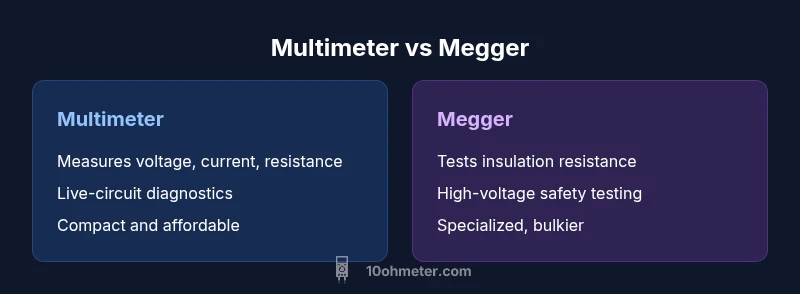
The difference between multimeter and megger comes down to purpose and measurement range. A multimeter is a general-purpose tool for voltage, current, and resistance, plus basic continuity checks. A megger, or insulation tester, measures insulation resistance at higher voltages to detect leaks and potential faults. Use a multimeter for everyday diagnostics; reserve a megger for insulation tests and safety checks.
Understanding the difference between multimeter and megger
For DIY enthusiasts and technicians, understanding the difference between multimeter and megger is foundational. The difference between multimeter and megger signals two core capabilities: a general-purpose measurement tool and a specialized insulation tester. In practice, the two devices serve complementary roles in electronics, automotive diagnostics, and electrical maintenance. According to 10ohmeter Analysis, 2026, many common faults involve insulation integrity and basic circuit parameters, so knowing when to reach for each tool saves time and reduces risk. A well-equipped workshop typically includes both instruments, enabling quick parameter checks with a multimeter and targeted insulation testing with a megger when needed. This article uses a practical, task-based framework to help you decide which instrument to pull off the shelf in various scenarios.
As you read, keep in mind that the primary distinction is not just the signals measured, but the safety and test voltages involved. While a multimeter lets you probe live circuits at low to moderate voltages, insulation testing with a megger involves higher voltages and stricter safety protocols. The goal is to pair the right tool with the task, ensuring accuracy while minimizing risk.
Core measurement capabilities
General-purpose meters (multimeters) excel at measuring voltage (AC/DC), current (AC/DC), and resistance, with additional features such as continuity checks, diode tests, and basic capacitance or frequency readings on many models. They are designed for quick diagnostics, troubleshooting, and field work where speed and versatility matter. In contrast, insulation testers (megger) are specialized instruments that apply a high voltage across equipment insulation to measure insulation resistance and leakage. They are built to test the integrity of cables, motors, windings, and transformers where insulation health is critical. The megger’s output is not intended for live-circuit analysis; it is used after de-energizing equipment to assess the probability of insulation failure.
Megger basics: insulation resistance and test voltages
A megger, or insulation tester, provides a controlled, high-voltage stimulus to an insulation barrier and measures how much current leaks across that barrier. The core metric is insulation resistance, usually expressed in megaohms (MΩ). Meggers come in different voltage classes (low, medium, and high voltage) and offer ranges such as tens to thousands of volts depending on the model. Applications include testing winding insulation in motors, cable insulation in electrical installations, and transformer insulation integrity. Interpretation requires context: a higher resistance indicates better insulation, while rising leakage, moisture ingress, or aging insulation lowers resistance. Always select a megger with the appropriate voltage rating for the equipment under test.
Multimeter basics: ranges, safety, and features
Modern digital multimeters (DMMs) provide robust functionality with auto-range capabilities, live-voltage measurement, resistance testing, and sometimes more advanced features like capacitance, temperature, or diode checks. Safety considerations include using correct test leads, ensuring the device under test is within the meter’s voltage rating, and avoiding exposure to electric shock hazards. Auto-ranging models simplify operation, but you should still understand the fundamental limits: measuring high voltages or currents without proper protection can damage the meter and pose personal risk. For automotive tasks, a DMM with a robust safety category and automotive accessories expands capabilities without sacrificing portability.
Safety considerations when testing with a megger
Insulation testing introduces high voltages and potential transient surges. Before using a megger, ensure equipment is de-energized, discharge any residual energy, and use properly rated test leads and PPE. Verify the insulation test voltage matches the component’s rating to prevent damage or injury. Keep bystanders at a safe distance and avoid touching energized parts. Calibration and periodic verification of insulation testers are important because a drift in test voltage or meter accuracy can lead to misleading results. If you work with energized systems regularly, develop a safety checklist that covers lockout/tagout procedures, test lead inspection, and safe storage.
Safety considerations when testing with a multimeter
While multimeters are generally safer for live-circuit measurements, you must still observe basic electrical safety practices. Use the lowest practical input setting, verify the meter’s input jacks are appropriate for the measurement (e.g., mA vs A), and avoid measuring across a transformer windings or high-energy sources if the meter is not rated for such use. Inspect leads for insulation wear, and replace damaged leads immediately. When testing in automotive or industrial environments, wear eye protection, work in a dry environment, and never rely on a single tool for high-risk diagnostics. Regular calibration helps prevent drift that can mask dangerous faults.
Practical testing scenarios in electronics
In electronics work, a multimeter is your first line for diagnosing components and boards: check supply voltage, verify ground references, confirm resistor values and circuit continuity, and test diodes. For insulation health, especially in powered-wiring or cable assemblies, a megger can reveal insulation degradation before a fault occurs. A typical workflow might begin with a multimeter to identify a power issue, followed by insulation testing with a megger on suspect cables or windings to confirm insulation integrity before powering the system back up.
Practical testing scenarios in automotive settings
Automotive diagnostics often require quick voltage and continuity checks, for which a multimeter is ideal. Use it to verify battery voltage, alternator output, and sensor signals. Meggers are used less frequently in routine maintenance but become crucial when diagnosing insulation faults in wiring harnesses, high-voltage battery systems, or newly installed cables in electric vehicles. In EV and hybrid work, insulation testing helps detect moisture ingress and degraded insulation that could lead to arcing or insulation breakdown under load.
Selecting the right tool for the job: decision criteria
To decide between a multimeter and megger, start with the task’s objective. If you need to measure voltage, current, resistance, or perform quick in-circuit checks, a multimeter is your go-to tool. If the goal is to assess insulation health, leakage currents, or to confirm insulation integrity under stress, a megger is required. Consider the environment, required voltage range, and the acceptable risk level. For most workshops, a reliable multimeter paired with a dedicated megger provides comprehensive coverage for electronics and electrical maintenance tasks.
Understanding specifications and models
Model selection should align with the measurement range, safety category, display readability, and battery management. Look for features such as auto-ranging, true RMS, data hold, and low-battery indicators for convenience. When choosing a megger, examine insulation resistance ranges, test voltage options (DC voltages), leakage current measurement capabilities, and safety ratings for the intended use (e.g., motor insulation, cable insulation, or transformer windings). Budget and reliability often guide the final choice; both tools exist across a spectrum from entry-level to professional-grade instruments.
Maintenance, calibration, and care
Regular maintenance preserves accuracy. Keep test leads clean and free of nicks, store meters in a protective case, and perform periodic calibration checks if your work requires high precision. Meggers benefit from recalibration of voltage output and resistance measurement accuracy, especially after heavy use in harsh environments. For electronics enthusiasts, a simple maintenance routine that includes lead inspection and battery checks can reduce unexpected downtime and misreads. Record calibration dates to ensure you’re working with validated equipment.
Final thoughts: building a practical toolkit
A well-rounded workshop typically benefits from both a multimeter and a megger. The multimeter handles everyday diagnostics, troubleshooting, and rapid measurements across electronics and automotive projects. A megger adds depth by validating insulation integrity, preventing hidden faults that could cause future failures. The most effective toolkit pairs both instruments with clear safety procedures and regular maintenance. In the end, the goal is reliable diagnostics, safer work practices, and informed decision-making based on clear measurements.
Comparison
| Feature | Multimeter | Megger (Insulation Tester) |
|---|---|---|
| Primary purpose | General electronics measurements (voltage, current, resistance, continuity) | Insulation resistance testing and high-voltage integrity for wiring insulation |
| Measurement types | Voltage, current, resistance, continuity, diode test (model dependent) | Insulation resistance, leakage current, polarization index (where supported) |
| Test voltage range | Typically up to 1000V AC/DC (model-dependent) | Insulation test voltages commonly range from tens to hundreds of volts DC (model-dependent) up to higher ranges |
| Safety considerations | Lower-risk, user-friendly for beginners | Requires strict safety protocols and PPE for high-voltage insulation tests |
| Portability | Generally compact and portable | Often bulkier due to insulation testing circuitry |
| Price range | Low to mid-range for basic units | Mid to high for insulation testers (depending on specs) |
| Best for | General electronics, DIY diagnostics | Insulation integrity in motors, cables, and electrical equipment |
The Good
- Versatile for everyday electronics work
- Quick checks and troubleshooting
- Megger provides reliable insulation resistance data
- Helps prevent insulation failures and shock risks
- Compact meters available for portable use
Drawbacks
- Megger tests require higher voltage and can feel intimidating
- Megger units are typically more expensive
- Not suitable for live-circuit measurements without proper setup
- Some models require training to interpret results accurately
Both tools are essential, but use the right instrument for the task: multimeters for general measurements; megger for insulation testing.
A multimeter covers everyday diagnostics with ease and safety. For insulation health checks and high-voltage integrity, a megger is indispensable. Together, they form a robust toolkit for electronics and electrical maintenance.
Your Questions Answered
What is the main difference between a multimeter and a megger?
A multimeter provides general measurements such as voltage, current, and resistance for electronics and automotive work. A megger tests insulation resistance at higher voltages to assess insulation health. The two tools serve different safety-critical roles and are often used together in comprehensive diagnostics.
A multimeter checks basic electrical values, while a megger checks insulation quality at higher voltages. Use both for complete diagnostics.
Can I use a multimeter to test insulation?
Some multimeters offer limited insulation resistance tests, but they are not as accurate or safe for insulation health as a dedicated megger. For serious insulation assessment, use a megger following proper safety protocols.
Some meters can test insulation spaces, but for reliable insulation health, prefer a megger.
Is insulation resistance testing dangerous?
Yes, insulation testing involves higher voltages. Proper PPE, equipment rated for the test voltage, and strict safety practices are essential. Always de-energize equipment before testing when possible.
Insulation testing uses higher voltages and requires safety gear and careful procedures.
What tests does a megger perform?
A megger measures insulation resistance and leakage currents at specified test voltages. It helps identify degraded insulation in cables, motors, and windings, indicating potential future faults.
Megger tests insulation health by measuring resistance and leakage at set voltages.
Do I need both instruments in a workshop?
For most electronics and electrical maintenance tasks, yes. A multimeter handles everyday checks, while a megger adds insulation health verification, preventing hidden faults.
Most shops benefit from having both tools for comprehensive diagnostics.
What safety practices should I follow when using these tools?
Always inspect leads, wear PPE as needed, and follow device ratings. De-energize circuits when possible, and work with a partner for high-voltage tests. Calibrate and maintain gear regularly.
Inspect tools, wear PPE, and follow ratings; de-energize when possible.
Key Takeaways
- Use multimeters for everyday measurements and quick diagnostics
- Rely on megger insulation testers for insulation resistance checks
- Follow strict safety protocols for high-voltage insulation testing
- Invest in both tools for a complete workshop setup