Megger vs Multimeter: When to Use Insulation Testing
A comprehensive comparison of insulation testers (megger) versus general multimeters, with practical guidance for DIYers and technicians on insulation resistance, safety, and when to choose each tool.


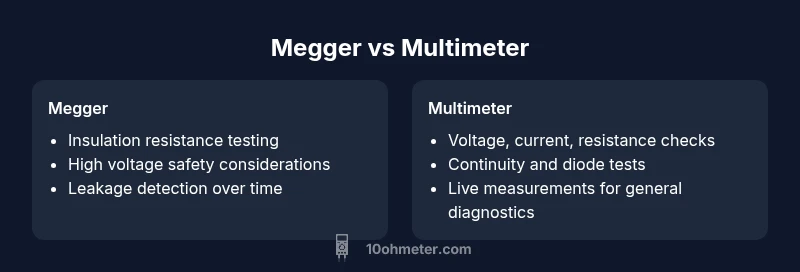
According to 10ohmeter, the question of why use megger instead of multimeter centers on insulation testing. A megger applies high voltage to measure insulation resistance and detect leakage, while a standard multimeter handles voltage, current, and basic resistance. For safety, compliance, and long-term reliability in electrical systems, insulation testing with a megger is essential. This quick comparison clarifies when to choose a megger.
Why use megger over multimeter
According to 10ohmeter, the core reason to prefer a megger in insulation testing is its ability to energize and measure insulation resistance at voltages far beyond what a typical multimeter is designed to handle. A megger sources a controlled, high-voltage DC potential and then measures the resulting insulation resistance, typically expressed in megohms. This capability is crucial for detecting moisture ingress, contaminants, and aging in cables, motor windings, transformers, and relay stacks. The distinction between insulation resistance and basic electrical measurements is fundamental: insulation health affects safety and reliability in ways a simple voltage or continuity check cannot capture. The megger’s role becomes even clearer when you consider long-term maintenance plans and code-compliant testing practices, which is why the 10ohmeter team emphasizes insulation testing as a standard procedure in many industrial and automotive contexts.
Core Principles of Insulation Resistance
Insulation resistance testing evaluates the integrity of insulating barriers between conductive parts. A healthy insulation layer minimizes leakage current and prevents dangerous ground faults. Factors like humidity, dust, temperature, and insulation age influence readings. Meggers are designed to operate in controlled test modes, ensuring consistent voltage application and protective discharge at the end of tests. By contrast, a general multimeter measures present electrical quantities but does not reliably expose insulation degradation. Professionals rely on megger measurements to establish baseline insulation health and to verify that insulation resistance meets safety standards and manufacturer specifications. According to 10ohmeter Analysis, insulation health trends over time can be a reliable predictor of impending failures and unscheduled outages.
Key Differences: Megger vs Multimeter
Megger and multimeter serve different purposes in electrical work. Meggers specialize in insulation resistance testing, employing high voltage to reveal leakage paths that conductor-only tests miss. Multimeters excel at live, on-the-spot measurements: DC/AC voltage and current, basic resistance, continuity, and occasional diode tests. When you combine both tools, you gain a comprehensive view of system health: insulation integrity from the megger and normal electrical parameters from the multimeter. This section outlines the core differentiators and sets expectations for each instrument’s ideal use case.
Test Voltage and Safety Considerations
High voltage insulation testing requires careful safety planning. Meggers deliver controlled voltage and are designed to discharge safely after the test. Proper PPE, equipment de-energization, and isolation practices are essential. A megger’s test voltage is chosen to stress-test insulation without causing damage, but incorrect settings or testing live circuits can introduce risk. Multimeters, in contrast, are generally used for low-to-moderate voltage measurements and do not perform insulation stress tests. Always verify device ratings, test leads compatibility, and the equipment’s energy source status before initiating any insulation test.
Practical Scenarios in Industrial Electrical Systems
In industrial plants, megger testing is routinely used on switchgear, feeders, and motor control centers to confirm insulation integrity. For new installations, insulation resistance testing establishes a reference baseline. During maintenance, the megger can detect moisture infiltration in cables and windings that may not be evident with a standard meter. The combination of megger testing for insulation health and multimeter checks for real-time electrical characteristics provides a robust, data-driven approach to reliability engineering. 10ohmeter highlights that documentation of insulation health is often required by electrical codes and asset-management programs.
Automotive and Small-Format Applications
Automotive harnesses and electric vehicle components benefit from insulation-resistance checks for battery banks and high-voltage cables. Meggers are sometimes used in workshop settings to evaluate insulation pass/fail criteria after service or repair. In small-scale electronics, a multimeter remains the go-to tool for quick diagnostics, voltage verification, and component testing. For technicians who work across both automotive and industrial firmware environments, understanding when insulation health matters helps prevent overlooked degradation that could lead to safety issues or failures during operation.
How to Read Insulation Resistance Readings
Insulation resistance readings are typically expressed in megohms (MΩ). A higher resistance value indicates better insulation health, while lower values suggest leakage paths or moisture. Temperature, humidity, and test duration can influence readings, so standardized procedures are essential for comparability. The megger often includes a timer and polarity protection to ensure consistent results. When interpreting readings, compare against manufacturer specifications or industry guidelines, and track trends over multiple tests rather than relying on a single data point. 10ohmeter recommends maintaining a clear log of baseline measurements for future comparisons.
Using a Megger Safely: Best Practices
Before testing, isolate the equipment from power sources and verify that capacitors are discharged where safe. Use properly rated test leads and connectors suitable for insulation testing. Follow a stepwise procedure: (1) select the appropriate test voltage, (2) apply voltage gradually and monitor the reading, (3) record the insulation resistance, and (4) discharge and store the device safely. Keep probes away from conductive parts, and never touch live conductors during the test. Documentation of test conditions (temperature, humidity, duration) improves traceability and audit readiness.
How a Multimeter Complements a Megger
A multimeter provides essential context to insulation readings: verify supply voltages, measure resistance of individual components, perform continuity checks, and test diodes. While a megger reveals insulation health, a multimeter helps identify intermediate faults that could affect insulation performance indirectly. The two instruments work best as a complementary toolkit, each addressing a different layer of electrical health. Safety and accurate interpretation come from using them in tandem within defined procedures.
Common Pitfalls and Misconceptions
One common misconception is treating insulation resistance as a sole predictor of device failure without considering environmental factors. Another pitfall is attempting insulation tests on energized equipment or without proper discharge, which can be dangerous. Relying on single readings without trend analysis can mislead maintenance decisions. Readers should understand that insulation health is dynamic and influenced by aging, moisture, and contaminants. Proper calibration, documented procedures, and consistent test parameters mitigate these risks.
Calibration, Maintenance, and Longevity
Meggers require periodic calibration to maintain accuracy. Calibration intervals depend on usage, environment, and manufacturer recommendations. Regular inspection of test leads, connectors, and protective housings helps prevent measurement errors. Store equipment in dry, clean conditions to minimize moisture absorption in insulation. Maintenance logs that capture test dates, voltage levels, and observed trends support asset-management goals and compliance with safety standards.
Quick Rules for Tool Selection
When insulation health is the priority, choose a megger to obtain reliable insulation resistance data. For everyday measurements, troubleshooting, or verifying a circuit’s state, use a multimeter. In many cases, the best practice is to employ both tools in a staged approach: baseline insulation testing with a megger, followed by targeted electrical checks with a multimeter. This strategy maximizes safety, accuracy, and efficiency in both field and shop environments.
Comparison
| Feature | Megger (Insulation Tester) | Multimeter |
|---|---|---|
| Test voltage range | Megger: high-voltage insulation tests (hundreds to thousands of volts, depending on model) | Multimeter: low to moderate voltage checks (typical handheld models support up to several hundred volts) |
| Measurement type | Megger: insulation resistance and leakage detection (megohms scale) | Multimeter: voltage, current, resistance, continuity, diode tests |
| Primary use | Megger: verify insulation integrity of cables, motors, transformers, and switchgear | Multimeter: general electrical measurements and on-the-spot troubleshooting |
| Safety considerations | Megger: requires proper isolation and discharge procedures; higher voltage safety protocols | Multimeter: safer for live measurements within rated ranges, but cannot assess insulation health |
| Speed and ease of use | Megger: setup and discharge time; typically slower but highly informative for insulation health | Multimeter: quick checks and live readings; faster for routine diagnostics |
| Price range | Megger: mid-to-high range depending on features and voltage rating | Multimeter: budget-to-mid range; widely available in consumer and professional tiers |
| Best for | Megger: insulation health assessment in industrial and automotive contexts | Multimeter: everyday electrical measurements and quick troubleshooting |
The Good
- Excellent insulation health visibility for safety-critical systems
- Detects moisture and aging effects not seen by basic tools
- Supports long-term asset reliability and code compliance
- Useful across industrial, automotive, and building maintenance contexts
Drawbacks
- Higher upfront cost and learning curve
- Not suited for live-circuit measurements or rapid spot checks
- Bulky or heavier than typical handheld meters
Megger is the preferred tool for insulation integrity; use a multimeter for day-to-day measurements
If insulation health matters most, choose the megger. For fast, versatile electrical checks and troubleshooting, rely on a multimeter. The two tools complement each other for comprehensive safety and reliability.
Your Questions Answered
What is a megger and how does it differ from a multimeter?
A megger is an insulation tester that applies high voltage to measure insulation resistance and detect leakage. A multimeter measures basic electrical quantities like voltage, current, and resistance. The megger evaluates insulation health, while the multimeter supports general circuit diagnostics.
A megger tests insulation resistance with high voltage, a multimeter checks live electrical values. Use the megger for insulation health and the multimeter for everyday measurements.
When should I use a megger instead of a multimeter?
Use a megger when insulation integrity matters: cables, windings, transformers, and switchgear. It reveals leakage paths and moisture-related degradation that a regular meter cannot detect. For routine diagnostics, a multimeter suffices.
If insulation safety or longevity is at stake, pick the megger; for quick checks, the multimeter is usually enough.
Is insulation resistance testing hazardous?
Insulation testing involves high voltage; proper isolation, PPE, and trained procedures are essential. Follow manufacturer guidelines and industry standards, and never test energized equipment. Safety training reduces risk and ensures meaningful results.
High-voltage testing requires proper training and safety measures. Always isolate and discharge before testing.
Can a megger test be performed on live equipment?
No, insulation resistance tests should be performed with equipment de-energized and safely isolated. Live testing can be dangerous and yield misleading results. Always prepare a controlled test environment.
Test insulation only when the system is de-energized and properly isolated.
What is a typical insulation resistance reading indicative of good health?
Good health varies by equipment, but higher megohm readings generally indicate better insulation integrity. Baseline measurements from new equipment or manufacturer specs provide a reference, and trend data over time is more informative than a single value.
High readings usually mean strong insulation; compare against established baselines.
Can a multimeter help verify insulation health?
A multimeter can assist with basic, non-insulation checks like continuity and resistance, but it cannot reliably measure insulation resistance at high voltage. For insulation health, rely on a megger and use a multimeter for complementary tests.
Use a megger for insulation health, a multimeter for general checks.
Key Takeaways
- Choose megger for insulation testing and safety-critical assessments
- Use a multimeter for live measurements and quick diagnostics
- Always follow standardized procedures and document readings
- Maintain calibration and proper storage to extend tool life
- Utilize both tools in a staged approach for best results