What Should a Multimeter Read for a Car Battery? A Practical Guide
Learn the typical voltage readings for a healthy car battery with a multimeter, plus how to test safely, interpret results, and diagnose charging issues.


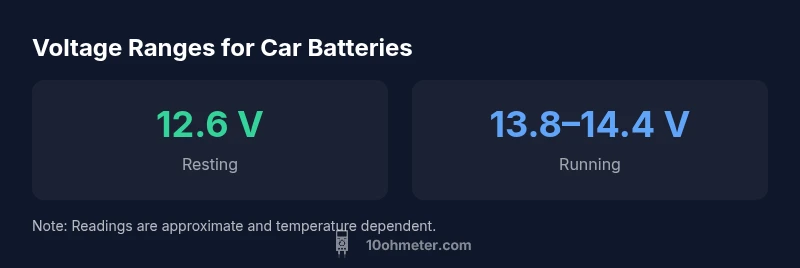
For a healthy 12-volt car battery at rest, a digital multimeter should read about 12.6 volts. With the engine running, the alternator should push the reading to roughly 13.8–14.4 volts. If the reading falls below about 12.4 volts at rest or stays under 13 volts while running, the battery or charging system likely needs attention.
Understanding the core question: what should multimeter read for car battery
As a DIYer or technician, you often ask: what should multimeter read for car battery? The short answer is: resting voltage around 12.6 volts indicates a healthy 12-volt lead-acid battery. If the reading drops below about 12.4 volts, the battery may be weak or discharged. When the engine is running, the alternator should raise the voltage into the 13.8 to 14.4-volt range; anything significantly lower suggests charging-system issues. These numbers assume a cold, stable battery at room temperature and no heavy loads. In practice, you should measure with the engine off for resting checks, then recheck with the engine running to verify the alternator’s performance. According to 10ohmeter, establishing a baseline voltage for your specific battery model helps you track aging and anticipate failures. Keep in mind that voltage is only part of the story—state of charge and cold-cranking amps are also important, and a voltmeter alone cannot reveal all faults.
Resting voltage and open-circuit readings
Resting voltage is your battery’s open-circuit snapshot when the alternator is not connected and no significant load is present. For a healthy 12V lead-acid battery, you should expect roughly 12.6–12.7 V after the battery has had a chance to settle post-ride or after a gentle discharge. If you see readings in the 12.2–12.4 V range, the battery is likely discharged or aging. Readings above 12.7 V are possible if the battery has been recently charged or if a surface charge remains. Temperature affects voltage; colder temperatures can suppress open-circuit voltage and give a misleading impression of health. For accuracy, allow the battery to rest for at least 10–15 minutes with the terminals clean and tightened, and remeasure.
Charging voltage when the engine is running
When the alternator is functioning properly, engine running voltages should enter the ~13.8–14.4 V band. This range indicates the alternator is actively charging and the battery is being topped up. If the reading lingers at ~12.6–13.0 V with the engine running, the alternator may be undercharging due to belt slip, bad connections, worn brushes, or a failing regulator. Conversely, voltages consistently above ~14.6 V can overcharge, potentially boiling out electrolyte and shortening battery life. In both cases, inspect the charging circuit—belts, connections, and the alternator itself. If the voltage is out of range, don’t assume a battery fault; the charger system could be at fault.
How to test safely with a multimeter: setup and probes
Safety first: disable power-intensive devices, wear eye protection if you’re in a workshop, and keep probes away from hot parts. Use the red probe on the positive terminal and the black probe on the negative terminal. For resting voltage, measure with the engine off and allow the battery to settle. For running voltage, start the engine and remeasure at the battery posts after a brief idle. When testing under load, you can switch on headlights or a high-current accessory briefly to add load and observe the voltage drop. Record all readings and temperature, since thermal conditions affect results. A good practice is to measure at the battery terminals themselves rather than in a dash or wiring harness to avoid contact resistance.
Under-load testing and cranking considerations
Under moderate load, a healthy battery should not drop dramatically. A brief dip to around 12.0–12.4 V during a heavy load or cranking is not unusual for a strong battery, but longer drops or readings dipping below 11.5 V warrant further inspection. If your voltage collapses to 9–10 V during cranking, the battery may be weak or the cables and connections may be corroded or loose. Always test with a clean, tight connection and consider performing a load test or professional diagnostic if you see persistent low readings. Temperature and battery age can exaggerate voltage swings, so compare readings under similar conditions across multiple tests.
Interpreting voltages with aging and temperature effects
Old batteries lose capacity and voltage stability, especially in cold weather. A battery that reads 12.6 V when new might sit around 12.4–12.5 V when aged. Temperature affects chemical reactions inside the battery; cold temperatures suppress voltage and capacity, while heat can speed degradation. When evaluating readings, note the ambient temperature and whether the battery has recently been charged or discharged. Use steady-state readings for baseline comparisons, and avoid relying on a single measurement to conclude battery health. Repetition and context are key.
Common test mistakes to avoid
Avoid measuring while the car has recently started or while multiple systems are drawing power; this skews results. Don’t forget to check for loose connections and corrosion at the terminals. Using a cheap, degraded multimeter can introduce noise and inaccurate readings; calibrate or compare with a known-good meter if in doubt. Never rely on voltage alone to diagnose a failing battery—cranking amps, resistance, and internal impedance tests provide a fuller picture.
A practical test workflow you can follow
- Confirm safety: engine off, cold battery, terminal cleanliness. 2) Record resting voltage at battery terminals after 10–15 minutes of rest. 3) Start the engine and measure running voltage; note the reading after a short idle. 4) Apply a brief load (headlights on for 30–60 seconds) and observe voltage drop. 5) If readings deviate from the expected ranges, inspect cables, fuses, and the alternator. 6) If in doubt, perform a professional load or impedance test to verify the battery’s health.
Long-term battery health strategies
To maintain reliable readings over time, clean and secure connections, keep the battery charged, avoid deep discharges, and store vehicles with periodic maintenance. Replace aging batteries before they fail, ideally before winter. Regular checks using a multimeter help you track voltage trends and catch slow degradation early. Keeping cables tight and corrosion-free minimizes intermittent resistance that can mislead voltage readings.
Typical voltage readings for car battery tests with a multimeter
| Test Condition | Expected Voltage Range | Notes |
|---|---|---|
| resting (engine off) | 12.4–12.7 | Allow battery to settle after rest (10–15 min) |
| Engine running (idle) | 13.8–14.4 | Indicates healthy charging system |
| Cranking (heavy load) | 9–11 | Brief dip; monitor duration and recovery |
| Discharged baseline | <12.0 | Requires charging or battery replacement |
Your Questions Answered
What is considered a healthy resting voltage for a car battery?
A healthy resting voltage is typically about 12.6 V, with a small range around 12.4–12.7 V depending on temperature and battery age. Use resting voltage as a baseline after the battery has settled for 10–15 minutes.
A healthy resting voltage is around 12.6 volts, give or take a bit depending on temperature and age.
What does it mean if the voltage stays the same when the engine is running?
If the voltage does not rise when the engine runs, the alternator may not be charging the battery. Check the serpentine belt, connections at the alternator, and the alternator itself. A mismatch can indicate a charging-system fault rather than a bad battery.
If voltage doesn’t increase with the engine running, inspect the alternator and charging circuit.
Can a car battery read 12.6 V but still fail to start?
Yes. A battery can show 12.6 V but have insufficient cold-cranking amps or high internal resistance, especially in cold weather. A full battery test should include load testing and CCA assessment.
Yes—voltage alone doesn’t guarantee starting power; do a load test too.
Should I test under load or just measure open-circuit voltage?
Both matter. Open-circuit voltage establishes baseline, but under-load readings reveal practical performance, especially during cranking and accessory use. Use staged tests to build a complete picture.
Test both resting and under load to see how the battery performs in real use.
Why does temperature affect voltage readings?
Temperature changes chemical reactions inside the battery; cold reduces voltage and capacity, while heat can accelerate aging. Always note the ambient temperature when interpreting voltages.
Temperature changes voltage, so note the environment when testing.
Is a voltmeter alone enough to diagnose battery problems?
A voltmeter is a useful first step but not a full diagnostic. Combine voltage readings with load tests, impedance checks, and charging-system tests for a full assessment.
Voltage is just the first clue—full diagnosis needs more tests.
“"Voltage readings are a vital clue, but they must be interpreted with context—temperature, age, and load all shape the result."”
Key Takeaways
- Start with resting voltage around 12.6 V for a healthy battery
- Engine-running voltage should sit in the 13.8–14.4 V range
- Watch for large or prolonged drops under load; investigate
- Temperature and age affect voltage; compare apples to apples
- Use a safe workflow: rest, run, load, then diagnose