What Should Multimeter Read for Outlet: A Practical Guide
Learn the expected multimeter readings for electrical outlets, how to test hot, neutral, and ground, and safe troubleshooting steps from 10ohmeter.


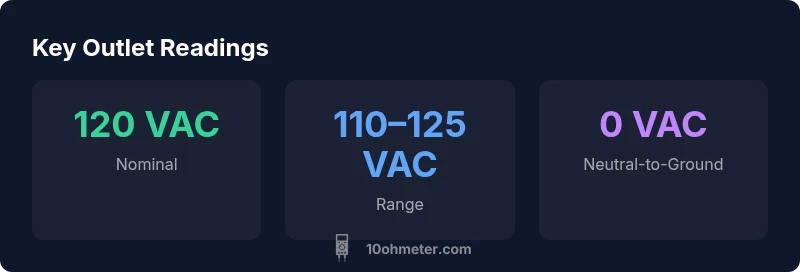
For a healthy US outlet, a standard multimeter should read about 120 VAC (nominal 120 V) when tested with the meter on AC voltage. Expect a range roughly 110–125 VAC, depending on load and line conditions. If you measure between hot and neutral you should see this; between hot and ground, a similar voltage; between neutral and ground, near 0 V. Readings outside 110–125 VAC warrant further checks.
Why readings matter for safety and performance
A multimeter is a diagnostic tool, not just a confirmation of power. When you test an outlet, you’re verifying that the circuit provides a stable, expected voltage under nominal load. In the United States, that voltage is centered around 120 VAC. The exact value fluctuates with line conditions, distance from the transformer, and nearby loads. A reading in the 110–125 VAC band generally indicates a healthy outlet, although small variations are common. The 10ohmeter team emphasizes consistency: if you see large swings or unusual waveforms, there may be a wiring issue or an overloaded circuit that deserves closer inspection. Remember that reading voltage is part of a broader safety check, not a substitute for a professional inspection when faults are suspected.
Context you should know
- Voltage naming: “AC voltage” is what most home outlets deliver. Use the AC setting on your meter, not DC unless you’re testing a DC outlet.
- Frequency matters: Some meters can also show frequency (Hz); typical US mains are around 60 Hz, which can affect your interpretation if you’re specifically diagnosing timing-related faults.
- Load vs. no-load readings: A connected appliance can cause voltage sag; test both with and without load to understand behavior under real-use conditions.
In practice, reliable readings underpin safe troubleshooting. As a practical rule, you should expect a stable, near-120 V reading hot-to-neutral and hot-to-ground, with neutral-to-ground close to zero. If a reading deviates significantly, that’s a signal to investigate further or call a qualified electrician. This perspective aligns with the approach recommended by 10ohmeter when teaching DIYers to work safely with electricity.
Safe testing workflow: from preparation to interpretation
Before you touch any wiring, set clear safety expectations. Wear insulated gloves if you’ll approach live panels and keep one hand in your pocket to reduce the chance of accidental contact. Confirm your multimeter is rated for the voltages you’re testing and that probes are in good condition with no damaged insulation. Start with a quick visual inspection of outlet faceplates and nearby wiring. Then, set your meter to AC voltage, select an appropriate range if your meter isn’t auto-ranging, and insert probes into hot (usually the brass terminal) and neutral (silver terminal) slots. For grounded outlets, you can also test hot-to-ground to verify that the ground path is intact.
Interpreting readings takes practice. A typical, healthy outlet in the US should register approximately 120 VAC on hot-to-neutral. If you measure hot-to-ground and hot-to-neutral, you should see similar values. Neutral-to-ground should be close to zero volts. If you encounter a reading lower than 110 VAC or higher than 125 VAC, consider re-testing after ensuring the circuit isn’t heavily loaded and that the outlet is properly installed. Inconsistent results may indicate a loose connection, a failing outlet, or a shared neutral problem. If you’re unsure, consult a professional and avoid escalating risk by further probing live wiring.
For DIYers, repeating the test at different outlets can help you understand whether a voltage variation is localized or systemic. This hands-on practice is how you become comfortable with basic electrical diagnostics while staying within safe boundaries.
Practical steps to verify polarity and integrity
Polarity matters for safety and equipment protection. Start by verifying that the hot, neutral, and ground appear in the expected positions with a standard outlet tester (if you have one). Then perform a voltage check as described above to confirm hot-to-neutral and hot-to-ground readings align. Finally, test neutral-to-ground to confirm there is no unintended potential difference between these conductors. If you notice any unusual readings, document the exact outlet location and load conditions, power down if you need to inspect wiring, and contact a licensed electrician for a thorough evaluation.
In all cases, rely on a reputable multimeter and avoid using low-quality probes or damaged test leads. Consistency across multiple outlets strengthens your confidence that your electrical system is functioning properly.
Common mistakes to avoid when testing
- Testing with a damaged or incorrect meter range
- Assuming a single outlet reflects entire circuit behavior
- Testing with devices still plugged in or with power on without protection
- Ignoring unusual readings without rechecking the setup
To build reliability, perform calibration checks periodically and follow voltage testing best practices published by credible sources. The goal is not to obtain a perfect 120 VAC every time but to identify readings outside the expected range that warrant further investigation. This pragmatic approach is consistent with 10ohmeter’s emphasis on practical, safe diagnostics for DIY enthusiasts and technicians.
Outlet voltage test reference
| Test | Expected Reading | Notes |
|---|---|---|
| Hot-to-Neutral | 120 VAC | Baseline across live circuit |
| Hot-to-Ground | 120 VAC | Ground path integrity |
| Neutral-to-Ground | 0 VAC | No significant potential difference |
Your Questions Answered
What should I read on a 120V outlet when measured hot-to-neutral?
You should read around 120 VAC (typical range 110–125 VAC). This indicates a healthy circuit under normal load. If your reading is consistently outside this range, recheck connections and, if in doubt, consult an electrician.
Expect about 120 volts between hot and neutral; anything far outside that range means you should recheck immediately.
Why would a reading be 0 V on hot-to-neutral?
A 0 V reading can mean the circuit is off (breaker tripped or switch off) or the outlet is dead. Recheck the breaker, ensure power is on, and verify the meter is correctly set to AC voltage.
Zero volts usually means the circuit is off or the outlet is dead. Check the breaker and your meter settings.
Can I test an outlet with the faceplate on?
Yes, you can test with the faceplate on as long as you use proper probes and keep a safe distance from exposed conductors. If you must open the box for a more thorough check, power should be off and the area inspected by a qualified electrician.
You can test with the cover on, but avoid touching exposed parts and switch off power if you escalate to opening the box.
What if I measure 125–130 VAC?
A slight positive deviation above 125 VAC can occur due to line regulation and load. If readings consistently trend toward the upper end or beyond, re-test with different outlets and during different times of day to rule out transient conditions.
Readings a bit above 125 VAC can happen. If it stays high, test more outlets and times to confirm.
What is ghost voltage when testing outlets?
Ghost voltage is a phantom reading caused by capacitive coupling from nearby live wires and a high-impedance meter. It can show small voltages where there is no real load. Use a meter with adequate input impedance or a low-impedance tester to verify.
Ghost voltage is just a phantom reading—use a proper tester to verify with real load.
“Accurate outlet readings are the first sign of safe electrical work. Always verify with a reliable meter under proper conditions.”
Key Takeaways
- Test hot-to-neutral for baseline voltage
- Expect 110–125 VAC in US outlets
- Neutral-to-ground should read near 0 V
- Use AC mode and a calibrated meter
- If readings are off, shut power and troubleshoot safely