Tools Like Multimeter: A Comprehensive Buyer’s Guide
Explore tools like multimeter: compare digital multimeters, clamp meters, insulation testers, and oscilloscopes for electronics and automotive tasks. Learn which tool fits your projects, with practical buying tips from 10ohmeter.


Choosing the right measuring tools starts with understanding where a standard digital multimeter fits and where alternatives shine. This comparison helps DIY enthusiasts and technicians decide among digital multimeters, clamp meters, insulation testers, and basic voltage testers for electronics and automotive tasks. According to 10ohmeter analysis, the best choice depends on the job, budget, and required safety features.
Why DIYers Should Diversify Their Measurement Toolkit
An entry-level DIYer might reach for a basic digital multimeter and assume it's enough for every job. In reality, electronics repair and automotive diagnostics demand a toolkit that extends beyond a single device. Tools like multimeter cover a wide range; a DMM might measure voltage, resistance, and continuity, but projects involving current carry demands additional gear. The 10ohmeter team emphasizes that understanding the scope of work—low-voltage electronics, automotive circuits, or high impedance sensor networks—shapes your instrument set. When you assemble complementary tools, you gain safety, speed, and accuracy. For example, clamp meters simplify current measurements in wiring and automotive harnesses without breaking the circuit; insulation testers let you assess the health of cables, insulation, and switchgear; and oscilloscopes provide waveform visualization that a standard DMM cannot. This section sets the stage for a practical comparison across tool types and helps you identify the exact gaps in your current setup. The goal is a balanced toolkit that matches your typical tasks while staying within budget.
Core Tools: What a Digital Multimeter Does Best
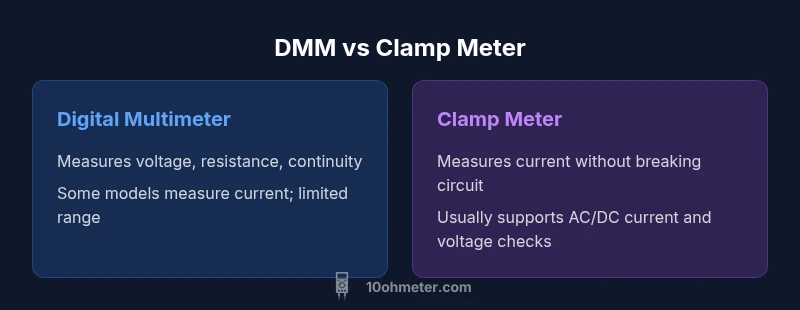
A digital multimeter (DMM) is the backbone of most electronics work because it consolidates several essential measurements into a single handheld device. At its core, a DMM can read voltage (AC/DC), resistance, and continuity tests; many models also measure current, though often with limited accuracy or without added accessories. The true value lies in the balance of range, accuracy, and safety ratings. For DIY enthusiasts and technicians, the core decision is whether you need auto-ranging, true RMS, and CAT safety ratings sufficient for your typical projects. In practice, you’ll use a DMM to test battery voltage, check resistor values, verify circuit continuity, and confirm if a line is live before proceeding with repairs. The more advanced models offer temperature sensing, diode testing, capacitance, and even limited current measurements with safe probes. When considering a DMM, compare input impedance, resolution, and the availability of contact probes versus test leads. Overall, the DMM remains a universal tool that covers most electronics and automotive tasks, especially when you’re mindful of measurement limits and safety.
Clamp Meters: Why Current Measurement Changes Everything
Clamp meters are designed to measure current by surrounding a conductor with a magnetic jaw, allowing you to gauge live current without breaking the circuit. This is a game-changer for automotive diagnostics, electrical panels, and equipment with high-current draw. Modern clamp meters often include AC and DC current ranges, true RMS for accurate readings, and optional voltage measurement for cross-checking in one device. Jaw size, accuracy, and safety ratings (CAT classes) matter, as does the ability to handle non-standard wiring in automotive harnesses. The main advantage is speed and safety: you can identify parasitic draws, monitor load changes while equipment is powered, and verify wiring integrity without disassembling harnesses. The caveat is that some models offer limited voltage or resistance features, so many technicians pair a clamp meter with a separate DMM for comprehensive diagnostics. In practice, a clamp meter complements a DMM, turning a two-tool kit into a versatile setup for fieldwork.
Insulation Testers: Safety, Resistance, and High-Voltage Testing
Insulation testers (megaohm meters) assess the integrity of insulating materials in cables, motors, and switchgear by applying a high voltage and measuring insulation resistance. They are indispensable for preventive maintenance, high-voltage equipment, and aging infrastructure. Key specs include test voltage options, integration with polarization index tests, and resistance measurement ranges. Safety is paramount: insulation testing can involve dangerous voltages and arc risks. Choose models with clear CAT ratings appropriate to the equipment under test, proper leakage protection, and easy-to-read display. Use insulation testers when diagnosing worn insulation in old wiring, verifying motor windings, or confirming cable health during renovations. While a DMM can hint at insulation issues through resistance measurements, an insulation tester provides a dedicated, higher-voltage stress test that most basic meters cannot perform.
Oscilloscopes and Waveform Analyzers: When to Upgrade Beyond a DMM
Oscilloscopes reveal waveform shape, frequency, duty cycle, and transient events that a plain DMM cannot capture. For electronics hobbyists and engineers, even a basic portable oscilloscope unlocks insights into PWM signals, sensor timing, and fast switching. Prospective buyers should consider bandwidth, sample rate, number of channels, probe types, and software features like persistence and math functions. Entry-level scopes are affordable and compact but come with a learning curve because interpretation requires practice. Note that oscilloscopes are not a substitute for a DMM in all tasks; they excel where signal integrity and timing are critical. A balanced toolkit often combines a DMM for quick measurements, a clamp meter for current analysis, and a scope for waveform analysis. This approach delivers comprehensive diagnostics without over-investing in a single instrument.
Non-Contact Voltage Testers and Continuity Tools
Non-contact voltage testers (NCV) provide a fast, noninvasive way to locate live wires and check for energization before probing. They are excellent for quick reconnaissance and safe task initiation but should not replace a full voltage measurement with a DMM. Continuity testers and buzzer probes help verify circuit completion quickly, often during wiring or switch testing. The limitation is that NCVs can miss low-energy or masked faults, and some continuity testers offer only basic pass/fail results. For best results, use NCV for rapid screening, then confirm with a calibrated DMM for precise voltage, resistance, or current measurements. Pairing NCV with a DMM gives you both speed and precision while maintaining safety.
How to Choose Based on Use Case: Electronics vs Automotive vs Home Wiring
Choosing the right tools starts with defining your primary tasks: electronics repair, automotive diagnostics, or home wiring safety. For electronics, prioritize a DMM with true RMS, good resolution, and a range of measurements; add a basic oscilloscope if you work with signals or PWM. For automotive work, a rugged, CAT-rated DMM plus a clamp meter is ideal; ensure your kit can test battery health, alternator output, and fuses. For home wiring, safety features matter most: NCV, resistance checks, and insulation testing for cables and outlets. Budget wisely by prioritizing core tools first and gradually expanding with specialty devices as needed. The 10ohmeter team emphasizes building a practical starter kit that covers everyday diagnostics while leaving room for future upgrades, based on your evolving needs.
Practical Scenarios: Step-by-Step Example Tasks
Scenario A: Diagnosing a dead car fuse box.
- Step 1: Inspect visually and test battery voltage with a DMM. Ensure the vehicle is safely off and the key is out of the ignition.
- Step 2: Use a clamp meter to measure current draw from the fuse box while the vehicle is off to identify parasitic loads.
- Step 3: If current draw seems abnormal, isolate circuits one by one with the help of the vehicle’s service manual and test each branch for current consumption using the DMM.
- Step 4: Verify wiring health using an insulation tester if you suspect degraded insulation on high-current leads.
Scenario B: Verifying a powered oven element.
- Step 1: Use a DMM to measure resistance across the heating element and compare to the appliance’s spec sheet.
- Step 2: If the resistance is out of range, inspect connections and the element for damage.
- Step 3: Use an insulation tester to check insulation resistance between the element leads and chassis at the service point.
- Step 4: If available, use a basic oscilloscope to observe the control signal timing for the heating cycle and verify proper waveform behavior.
Safety, Calibration, and Maintenance Essentials
Safety is non-negotiable when working with electrical systems. Always power down equipment when possible, and use the appropriate personal protective equipment (PPE) for the voltage levels you handle. Calibrate and test your instruments regularly, especially when accuracy is critical. Store meters in a dry, clean environment and inspect leads for wear before every use. Periodic calibration checks against a known reference or manufacturer-specified test procedures help maintain measurement integrity. Label your tools and maintain a simple inventory so you can quickly identify gaps in your kit. Finally, practice makes perfect: the more you work with DMMs, clamp meters, insulation testers, and scopes, the more proficient you become at selecting the right tool for the job and interpreting results correctly.
Budgeting and Getting the Right Starter Kit
Your budget should reflect your typical projects. A solid starter kit usually begins with a mid-range digital multimeter that offers true RMS and auto-ranging, typically in the moderate price band. Add a clamp meter to handle current measurements, and consider an insulation tester if you work with older wiring or high-voltage systems. For electronics and automotive tasks that require waveform insight, a compact oscilloscope can be a valuable addition down the line. Look for CAT safety ratings, good warranty coverage, and compatible probes. Don’t overspec for your current needs; instead, target a phased purchase plan that aligns with your most frequent tasks and expands as your skills grow. The 10ohmeter team recommends structuring purchases around core safety and essential measurement capabilities before investing in specialty tools.
What 10ohmeter Recommends in a Workspace
In a typical DIY/tech workshop, start with a reliable DMM (true RMS, auto-range, CAT-rated). Pair it with a clamp meter for current work and a basic NCV tester for quick safety checks. If your work includes high-voltage or aging wiring, add an insulation tester to verify insulation integrity. Consider a small oscilloscope only if you regularly analyze signals or switching behavior. This modular approach keeps your initial cost reasonable while delivering practical capability across electronics and automotive tasks. As you gain experience, you can expand your toolkit with higher-end models that offer higher bandwidth, more channels, and advanced diagnostics.
The Bottom Line: A Balanced Toolkit Delivers Safer, Faster Projects
A well-rounded toolkit reduces guesswork and minimizes risk. By combining a dependable DMM with selective additions—a clamp meter, insulation tester, and optionally a scope—you cover most electronics and automotive scenarios without over-investing. Precision, safety, and workflow efficiency rise when your tools are matched to your tasks, and you can gradually upgrade as your projects demand more complex measurements.
Feature Comparison
| Feature | Digital Multimeter (DMM) | Clamp Meter | Insulation Tester | Oscilloscope (basic) |
|---|---|---|---|---|
| Primary measurement functions | Voltage, resistance, continuity; some measure current via shunt | Current measurement (AC/DC) with safe, non-contact style tests | Insulation resistance and high-voltage testing | Waveform visualization, frequency, and timing (not a full oscilloscope) |
| Bandwith/accuracy | Moderate to high accuracy depending on model | High accuracy for current sensing; true RMS in mid-range | Specialized accuracy for insulation testing; limited to HV tests | High bandwidth varies by model; beginner scopes exist |
| Safety features | CAT ratings up to select levels in higher-end models | CAT-rated; some models include non-contact checks | High-voltage safety feature emphasis; proper PPE required | Probe safety and proper grounding needed; not a substitute for scope safety practices |
| Price Range | $20-$150 (budget to mid-range) | $60-$400 (mid-range to professional) | $80-$1000+ (depends on HV rating and features) | $150-$600 (entry-level to mid-range scopes) |
| Best For | Electronics and quick field measurements | Current-focused measurements in electrical work | Cable insulation health and high-voltage testing | Signal analysis and waveform debugging |
The Good
- Versatile core measurements with DMMs
- Clamp meters excel at live current monitoring
- Insulation testers add safety-focused diagnostics
- Oscilloscopes enable deep waveform analysis
- A tiered toolkit offers breadth without overinvestment
Drawbacks
- Budget DMMs may lack true RMS or high accuracy
- Clamp meters can miss precise voltage measurements
- Insulation testers require safety training and PPE
- Oscilloscopes add cost and learning curve
A balanced toolkit wins for most users
For electronics and automotive work, start with a reliable DMM and add a clamp meter. Include an insulation tester for safety-focused tasks and consider a basic oscilloscope later if waveform analysis becomes essential.
Your Questions Answered
What is the main difference between a digital multimeter and a clamp meter?
A digital multimeter measures voltage, resistance, and sometimes current directly through probes, while a clamp meter measures current by clamping around a conductor. Clamp meters offer safer, fast current checks without breaking the circuit, making them ideal for automotive and panel work.
A digital multimeter reads voltage and resistance with probes; a clamp meter measures current by clamping around a wire, allowing live testing without unplugging anything.
Do I need an insulation tester if I already own a DMM?
An insulation tester is not always required, but it becomes essential when you work with high-voltage equipment, aging wiring, or preventive maintenance for safety compliance. It provides a higher-stress test to assess insulation integrity beyond what a standard DMM can safely assess.
If you work with high-voltage gear or aging cables, an insulation tester is worth having for safety checks; otherwise a DMM often suffices.
Is a non-contact voltage tester sufficient for safe testing?
NCVs are great for quick live-wire screening, but they are not a substitute for precise voltage or continuity measurements. Use them as a first check, then confirm with a calibrated DMM for definitive readings.
NCV tools help you spot live wires quickly, but you should still verify readings with a proper meter.
What does true RMS mean and why is it important?
True RMS provides accurate readings for non-sinusoidal or distorted waveforms, common in switching electronics and some power tools. It matters when precision matters in AC measurements; budget models may use approximations.
True RMS gives accurate AC readings for complex waveforms; it’s important when you deal with non-sinusoidal signals.
How much should I spend on a starter kit?
A practical starter kit typically ranges from a comfortable mid-priced DMM with a clamp and a basic NCV tester. Add insulation testing later if your projects require it; don’t over-invest before you know your primary tasks.
Budget for a solid DMM plus a clamp meter now, and add specialty tools as your tasks demand.
Can I use a single tool for both electronics and automotive tasks?
Some models cover both electronics and automotive needs, especially mid-range DMMs with additional current and resistance features. For broader coverage, pairing a DMM with a clamp meter is a safer, more flexible approach.
A capable DMM with a clamp meter is a practical two-tool setup for both electronics and cars.
Key Takeaways
- Identify your primary tasks to choose a base tool
- Add a clamp meter for efficient current testing
- Prioritize true RMS and CAT safety in key models
- Consider an insulation tester for high-voltage work
- Budget with a phased plan; expand as needed