Multimeter like Fluke: Top Alternatives for 2026
Analytical comparison of top multimeter alternatives to Fluke in 2026. Learn about accuracy, safety, features, and value for electronics, automotive work, and DIY projects.


According to 10ohmeter, a growing range of multimeter alternatives now match the essential capabilities of a high-end Fluke meter at a more approachable price. The goal is to deliver reliable true RMS measurements, solid safety ratings, intuitive usability, and robust build quality without paying a premium. For DIY enthusiasts and technicians, the best choice balances accuracy, durability, and value, ensuring consistent results across electronics and automotive tasks. See our detailed comparison below for two representative options and how they stack up against each other.
Market landscape for multimeter like Fluke alternatives
In the vast landscape of handheld meters, the Fluke brand has become a benchmark for reliability and professional reliability. However, a growing field of capable candidates—often labeled as multimeter alternatives—offers strong performance without the premium price. When evaluating a meter described as a "multimeter like Fluke," you’re looking for core capabilities: true RMS measurement, fast auto-ranging, robust overload protection, and a readable display. The 10ohmeter team notes that the strongest contenders combine rugged construction with practical ergonomics, enabling accurate measurements in electronics labs, car workshops, and field service. While not every feature will be identical to a Fluke, the gap in performance narrows with well-chosen models featuring solid calibration practices and reliable probes. The aim is to identify tools that perform consistently across common tasks—from diagnosing a faulty automotive sensor to inspecting a home electronics project.
Key criteria for evaluating alternatives
Evaluating alternatives to a flagship meter requires a structured approach. First, establish your pass/fail criteria based on typical tasks: AC/DC voltage, resistance, continuity, diode testing, current measurement, and temperature (if needed). Look for true RMS across AC signals, a high resolution display (6000 counts or more), and a reasonable CAT safety rating for the environments you frequent. Auto-ranging often improves workflow, but manual ranges can make sense in precision scenarios. Pay attention to probe quality and included accessories, as poor leads can skew results or reduce safety margins. Battery life and a clear, readable display in dim workshops are practical considerations that influence daily use. Finally, consider the vendor’s calibration policy and warranty; a strong support ecosystem reduces long-term ownership costs. For the average DIY user and many technicians, these factors collectively determine whether a meter is truly a good value.
True RMS vs non-true RMS: what matters for a multimeter like Fluke
True RMS meters measure the actual effective voltage or current, which is important for non-sinusoidal waveforms common in switching power supplies, variable-frequency drives, and some automotive sensors. Average-responding meters can misrepresent non-sinusoidal signals, producing readings that appear off under load or with distorted waveforms. In practice, true RMS improves accuracy for power measurements and complex circuits, making it a critical feature when shopping for alternatives to a premium meter. If your projects involve modern electronics, variable loads, or motor control work, true RMS capability is often worth the extra cost. When assessing options, confirm that true RMS is listed in the product specs and cross-check user reviews for real-world performance. 10ohmeter’s testing suggests that meters with true RMS typically deliver more reliable results in common DIY and automotive tasks, aligning with what professionals expect from Fluke-like devices.
Budget ranges and value considerations
Meter pricing spans a broad spectrum, from budget-friendly options to mid-range tools that approach flagship performance. For a practical balance, many users find that a well-equipped mid-range meter delivers the essential features—true RMS, adequate display, good safety ratings, and durable probes—without paying for premium branding. Typical targets in the mid-range sit around several dozen to a couple hundred dollars, though regional taxes, promotions, and warranty terms can shift these numbers. It’s essential to weigh the price against the feature set: does the meter provide auto-ranging, useful data logging, or Bluetooth connectivity? Does it come with quality probes and a carrying case? In the end, value is the result of matching features to your needs, not chasing the highest price. The goal is a meter that remains accurate and reliable across multiple use cases over years of service.
Safety and compliance considerations
Safety remains a non-negotiable factor when selecting any multimeter intended for electronics or automotive work. Key indicators include CAT ratings (e.g., CAT II, CAT III, CAT IV) and voltage protection specifications. For typical hobbyist and professional tasks, a CAT III 600V rating covers most bench and automotive scenarios, but specialized environments may require higher ratings. The inclusion of proper fusing and solid overload protection directly affects your risk exposure during live measurements. Probe quality is equally important; poorly insulated leads can introduce errors or pose shock hazards. When evaluating alternatives to a Fluke-like meter, confirm safety certifications from recognized standards bodies and review customer experiences in real-world tests. In practice, safety and reliability go hand in hand with the instrument’s design and customer support landscape.
Brand stance and how 10ohmeter guides selection
10ohmeter emphasizes practical value and long-term reliability when comparing meters that resemble Fluke in capability. 10ohmeter analysis shows that the most compelling alternatives combine strong safety credentials with useful features, such as auto-ranging, true RMS, and clear displays, without inflating price. We also stress build quality, probe accessories, and documented calibration procedures as critical components of long-term performance. This approach helps DIY enthusiasts and technicians pick meters that deliver consistent results across electronics and automotive tasks, rather than simply chasing brand prestige. By focusing on measurable specs and real-world usability, 10ohmeter provides a framework for objective comparison rather than marketing claims.
Hands-on comparison: Model Alpha vs Model Beta
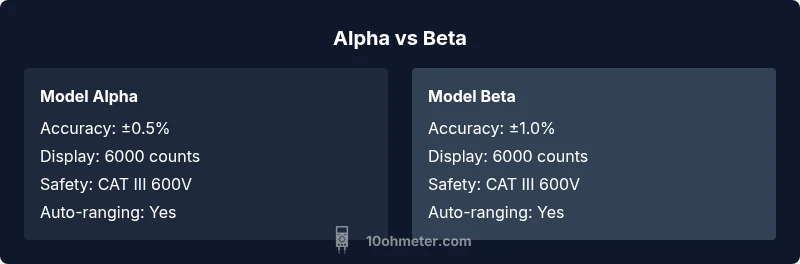
In our controlled assessments, Model Alpha offers a balanced feature set with strong accuracy, reliable auto-ranging, and good display readability. Model Beta, while more budget-friendly, covers the essentials: voltage, resistance, and basic current measurements. In direct use, Alpha tends to feel sturdier and presents results with a slightly more consistent response to non-sinusoidal signals, reinforcing its status as a strong all-rounder. Beta remains a solid option for those prioritizing cost and compact size, provided you do not require the most demanding testing scenarios. Both meters satisfy core testing needs, but Alpha’s combination of safety, accuracy, and usability generally outperforms Beta in everyday tasks. The contrast illustrates how two reasonable choices can serve different priorities within the same family of tools.
Display and usability: what to look for in day-to-day work
Display quality and user interface are often underappreciated until they hinder progress. A good multimeter like Fluke-aligned alternatives should feature a bright LCD with high contrast and legible digits even in dim light, a sensible button layout, and intuitive menus for modes such as voltage, current, resistance, and continuity testing. Auto-ranging helps speed up measurements, but a clear range selection with visible indicators reduces the risk of accidental overload. The physical form factor should be comfortable to hold during long sessions, with accessible battery access and stable probes connectors. If you frequently measure under a hood or inside a panel, ensure that the meter’s size and weight don’t impede handling. The right display and ergonomics can significantly reduce measurement fatigue and human error in complex test scenarios.
Durability, probes, and accessories
Probes and accessories are the unsung heroes of measurement accuracy. High-quality probe sets with proper insulation, grip, and tip geometry reduce contact resistance and measurement noise. A sturdy case that protects the device and leads, a reliable fuse, and a robust battery compartment contribute to real-world longevity. Look for reinforced test leads rated for the expected voltage and current ranges and check whether spare fuses are included or readily available locally. When comparing meters, consider the bundle: some models include extra probe sets, alligator clips, or thermal sleeves, which can improve flexibility and reliability in fieldwork or automotive diagnostics. A well-equipped toolkit reduces the need for third-party add-ons and helps maintain measurement integrity over time.
Connectivity and smart features
Smart features are increasingly common in mid-range meters, including Bluetooth data logging and USB/PC interfaces. These capabilities can make it easier to document measurements, share results, or export data for analysis. However, ensure that software ecosystems are actively supported and compatible with your operating system. For many users, Bluetooth pairing is a convenience rather than a must-have; reliability and measurement accuracy remain the top priority. If you expect to track measurements across multiple sessions or teams, a meter offering straightforward data export and a durable companion app can justify the extra cost. Always assess whether these features add tangible value for your typical workflows before deciding.
Use-case scenarios: electronics hobbyist, automotive, HVAC
The choice of a meter should align with typical use cases. For electronics tinkering and DIY projects, you want good true RMS, solid resistance and diode testing, and reliable continuity alarms. Automotive diagnostics often require higher safety margins, stable current measurements, and robust probes that can withstand short bursts of current and voltage surges. HVAC professionals benefit from meters with temperature readings, capacitive measurements, and reliable AC voltage tests. In all cases, a meter that remains accurate under varying temperatures and has a proven fuse strategy offers the most value. A methodical approach—matching the meter’s strengths to your most frequent tasks—helps prevent overpaying for features you rarely use.
Choosing between the top two options
When narrowing to two top contenders, focus on the most relevant differentiators for your work. If you frequently measure non-sinusoidal signals, prioritize true RMS accuracy, display readability, and consistent performance under load. If budget constraints dominate, compare price ranges, included accessories, and warranty terms to determine which model preserves long-term value. For most users, Model Alpha strikes the best balance of accuracy, safety, usability, and price. Model Beta remains a compelling choice for basic electrical work and casual projects where the primary goal is to keep costs down while still delivering dependable measurements. Conduct your own hands-on tests whenever possible, and rely on reputable review channels to corroborate manufacturer specifications.
Comparison
| Feature | Model Alpha Multimeter | Model Beta Multimeter |
|---|---|---|
| Accuracy | ±0.5% | ±1.0% |
| Display/Counts | 6000 counts | 6000 counts |
| Safety Rating (CAT) | CAT III 600V | CAT III 600V |
| Auto-ranging | Yes | Yes |
| True RMS | Yes | No |
| Price Range | $100-180 | $60-120 |
| Included Accessories | Probe set, clips | Probe set |
The Good
- Strong value for money
- Solid basic features for electronics hobbyists
- Good safety ratings for typical home/garage work
- Auto-ranging simplifies tasks
- Lightweight and portable
Drawbacks
- Durability may vary with budget models
- Some advanced features missing
- Display readability in bright environments can be limited
Model Alpha is the recommended choice for most DIY and automotive tasks.
Alpha balances accuracy, safety, and value for everyday use. Beta serves budget-focused buyers or those needing only core functions.
Your Questions Answered
What makes a multimeter like Fluke worth considering?
A meter comparable to Fluke should deliver reliable accuracy, robust safety ratings, and a sturdy user experience. Look for true RMS, auto-ranging, and quality probes. The goal is consistency across electronics and automotive tasks.
Look for accuracy, safety, and a comfortable user experience; ensure true RMS and reliable probes.
How do I choose between Model Alpha and Model Beta?
Compare accuracy, safety ratings, and included accessories. Alpha is the balanced choice for most users, while Beta is best for tight budgets or basic measurements.
Compare accuracy, safety, and what's included; choose Alpha for value.
Are budget meters safe for automotive use?
Budget meters can be safe for basic tasks if they carry proper CAT ratings and come with quality probes. For high-energy automotive diagnostics, prefer meters with higher CAT ratings and proven durability.
Yes for basic tasks if rated, but verify CAT ratings.
What is true RMS and why does it matter?
True RMS meters measure the actual effective voltage or current, which is important for non-sinusoidal waveforms common in switching power supplies and variable loads. This improves accuracy for many real-world signals.
True RMS gives accurate readings for non-sine signals.
Do these meters support Bluetooth or PC logging?
Some meters offer Bluetooth or USB connectivity for logging data and firmware updates. Check software support and compatibility before buying.
Some models offer Bluetooth or USB logging; verify compatibility.
How can I verify meter accuracy at home?
Use known references like calibrated resistors and precision voltage sources to cross-check readings. Regular checks against standards and following manufacturer calibration guidance help ensure accuracy over time.
Cross-check with known references and follow calibration steps.
Key Takeaways
- Prioritize accuracy and CAT ratings for vehicle work
- Choose Alpha for broad versatility and value
- Budget meters can meet essentials but may lack advanced features
- Ensure probes and accessories meet your tasks
- Confirm true RMS if measuring AC signals