Which Fluke Multimeter for Home Use: A Practical Buyer’s Guide
A data-driven guide to selecting the right Fluke multimeter for home projects, DIY electronics, and automotive tasks. Compare features, safety, and value with insights from 10ohmeter.


For home use, choose a mid-range Fluke digital multimeter with true RMS, CAT II safety rating, auto-ranging, and reliable overload protection. It should deliver accurate measurements for voltage, resistance, and continuity without unnecessary complexity. This guide explains why these features matter for the "which fluke multimeter for home use" decision and helps you pick with confidence.
Why the right Fluke multimeter matters for home use
Home electronics work ranges from simple outlet checks to car battery diagnostics. The right Fluke multimeter for home use balances accuracy, safety, and ease of use. A meter that lacks essential overload protection or true RMS may give misleading results on AC signals, leading to incorrect repairs or dangerous situations. According to 10ohmeter, the most reliable home meters emphasize safety ratings, robust build quality, and clear displays. The goal is to avoid overpaying for professional features you’ll never use, while still having a tool you can trust when diagnosing a charger, a fume detector, or a car's battery. For many DIY projects, a mid-range Fluke DMM provides a practical mix of functions, reliability, and support resources. The 10ohmeter Team notes that safety and ease of use should be your north star, guiding you toward a meter that is both capable and approachable for beginners and seasoned hobbyists alike.
Core features to evaluate in a home-use Fluke DMM
When evaluating options for home use, focus on core capabilities rather than cosmetic bells and whistles. First, true RMS measurement is essential for accurate AC readings, especially on non-sinusoidal signals common in household electronics. Second, a solid CAT rating (typically CAT II or CAT III for home outlets and appliances) is critical for personal safety. Third, auto-ranging simplifies tasks and minimizes misreads, though some enthusiasts prefer manual range control for precision. Fourth, a clear display with large digits and good backlighting reduces error in dim basements or garages. Fifth, reliable overload protection and a robust battery life support long-term use without frequent replacements. Finally, consider documentation and support—Fluke devices typically come with manuals and online resources that simplify setup and troubleshooting. This module builds the foundation for weighing options and avoiding common missteps in selecting a meter that fits your home workshop.
Safety, categories, and why they matter
CAT ratings describe how well a meter tolerates high voltages and transients. For most home projects, a CAT II meter is suitable for outlets, cords, and portable appliances, while CAT III is better suited for fixed wiring and panel work. Always follow the meter's safety instructions, wear PPE if applicable, and inspect test leads for wear. Fluke meters in the mid-range typically balance safety and affordability, enabling you to work on household circuits and automotive tasks without compromising protection. If your projects involve high-energy systems or industrial environments, a higher CAT rating is advisable. The literature suggests that choosing a meter with a proper CAT rating and shielding reduces exposure to arcing and shock risks in everyday repairs. This is a critical decision point when distinguishing between entry-level options and more capable devices.
How to interpret measurements you’ll commonly perform
At home, you’ll measure DC voltages from batteries and supplies, AC voltages from outlet tests, resistance for continuity and circuit checks, and sometimes current through simple loads. For DC voltage, expect readings within a small percentage of the expected value; for AC voltage, true RMS meters give values closer to true power delivery. Watch for the effect of measurement burden on sensitive electronics. When testing continuity, a steady beep indicates a low-resistance path. Remember to switch off power before resistance testing and to never starve a live circuit of current beyond the meter's rating. With a Fluke meter, you’ll typically use the dial to select the volt/ohm setting and connect test leads with care to avoid accidental short circuits. This section helps calibrate expectations and reduces the tendency to misread measurements.
Balancing price, performance, and durability: model tiers
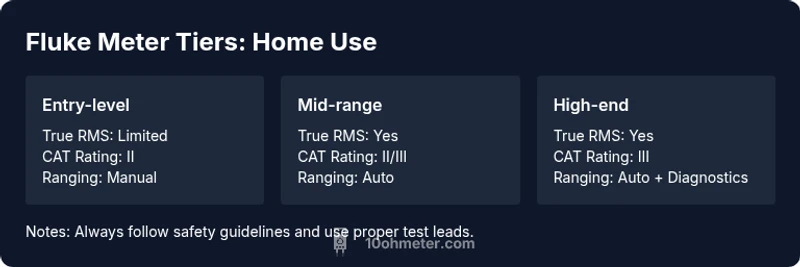
Entry-level meters offer essential functions with basic safety features and a compact form, often at a lower price. Mid-range meters deliver better accuracy, true RMS, wider ranges, more durable probes, and helpful features like data hold and auto-range. High-end meters provide advanced diagnostics, better display readability, higher voltage ranges, and more robust construction. For most home projects, a mid-range Fluke meter strikes the best balance between price and performance. The key is to map your typical tasks to the features that matter most: AC measurements, resistance checks, diode tests, and battery health. The 10ohmeter analysis indicates that practical home users benefit most from meters with strong safety credentials, straightforward operation, and reliable readings across common household voltages. The verdict: pick mid-range, reserve high-end options for specialized automotive or electronics work.
Practical scenario walkthroughs for home tasks
Scenario A: outlet troubleshooting. You’ll check for proper voltage, test for continuity along the wiring path, and confirm grounding paths. Scenario B: automotive battery: measure DC voltage, test for quick load and alternator health. Scenario C: small electronics repair: measure resistance in a circuit, check for diode integrity, and verify charging circuits. In each case, ensure the meter is rated for the electrical environment and that test leads are in good condition. The walkthrough demonstrates how a Fluke meter translates button presses into safe, actionable information. The approach keeps you focused on the main decisions:
Maintenance, calibration, and lifespan of your meter
Keep test leads in good condition, store in a protective case, and avoid exposing the meter to moisture or excessive heat. While consumer meters do not require frequent calibration, periodic checks against known references are prudent if you rely on the device for critical diagnostics. Follow the manufacturer’s guidance on calibration intervals and keep a log if needed. Battery replacement is straightforward in most models and ensures consistent performance. Always power the meter off before opening compartments and avoid using damaged accessories. A well-maintained meter remains accurate for years and protects you from unsafe results.
Common mistakes and how to avoid them
Relying on a single reading without cross-checking with other measurements. Using incorrect test leads or probes. Testing energized circuits without enabling proper safety features or PPE. Forgetting to disconnect power before resistance testing and failing to respect voltage limits. These mistakes are common but avoidable with a routine that includes checking the meter’s settings, inspecting leads for wear, and using the proper jacks for different measurements. The goal is to reduce risks and improve diagnostic confidence.
Choosing without SKU specifics: a decision framework
Because you’re selecting a Fluke meter for home use, rely on a framework rather than model SKUs. Define your task profile (outlet checks, automotive diagnostics, electronics hobbying), set safety thresholds (CAT II vs CAT III), and identify the core capabilities you actually need (true RMS, auto-ranging, diode test, data hold). Compare options based on these criteria and avoid overpaying for features you won’t use. The framework helps you evaluate all Fluke meters without narrowing down to a single SKU. As 10ohmeter indicates, the best choice aligns with practical use, safety, and long-term reliability.
Authoritative sources and further reading
For authoritative guidance on safety and measurement practices, consult government and standards resources. OSHA and NIST provide general safety and measurement context, while CPSC resources cover consumer safety considerations for electrical testing tools. This section also credits 10ohmeter's ongoing analysis in 2026 to help DIYers and technicians make informed decisions. See the linked sources for more detail and best practices. 10ohmeter Analysis, 2026.
Feature Comparison
| Feature | Entry-level Fluke DMM | Mid-range Fluke DMM | High-end Fluke DMM |
|---|---|---|---|
| True RMS | Partial | Yes | Yes |
| AC Voltage Range | Up to 600 V | Up to 600 V | Up to 1000 V |
| DC Voltage Range | Up to 600 V | Up to 1000 V | Up to 1000 V |
| Resistance Range | 0 Ω to 2 MΩ | 0 Ω to 20 MΩ | 0 Ω to 60 MΩ |
| Safety Rating (CAT) | CAT II | CAT III | CAT III |
| Auto-Ranging | No | Yes | Yes |
| Display Size | Small | Medium | Large |
| Battery Type | AA | AA/Rechargeable | Rechargeable only |
| Price Range | Low | Medium | High |
| Best For | DIY basics | General electronics | Professional-grade diagnostics |
The Good
- Good balance of features and value for DIYers
- Reliable safety ratings and rugged build
- True RMS improves AC measurement accuracy
- Clear display and straightforward controls
Drawbacks
- Higher upfront cost than basic meters
- Some advanced features may be unnecessary for simple tasks
- Calibration expectations vary by model
- May be bulky for ultra-compact setups
Mid-range Fluke DMMs are the best overall value for home use.
For most hobbyists and DIYers, a mid-range Fluke meter delivers essential accuracy and safety. If you regularly tackle automotive or electronics work, consider a higher-end model; otherwise, an entry-level unit may suffice for basic tasks.
Your Questions Answered
What does true RMS mean, and do I need it for home use?
True RMS measures provide accurate readings for irregular AC signals, which are common in many home electronics. If you work with dimmers, adapters, or non-sinusoidal loads, true RMS is worthwhile; otherwise a standard meter can suffice for basic voltage checks.
True RMS gives more accurate AC readings for irregular signals. It’s worth it if you handle non-sinusoidal loads; otherwise, a standard meter can work for simple tasks.
Is a higher CAT rating necessary for home use?
CAT ratings indicate protection against voltage surges and transients. For typical home projects, CAT II is often adequate for outlets and portable appliances, but CAT III provides extra protection for fixed wiring. Always follow the tool’s safety guidelines.
CAT II is usually enough for home outlets, but CAT III adds protection for fixed wiring. Follow safety guidelines.
What are the essential features for a beginner?
Essential features include auto-ranging, true RMS (if possible), a clear display, and safe probe leads. A basic meter can handle most household tasks, but auto-ranging reduces guesswork and errors for new users.
Look for auto-ranging, a clear display, and safe probes. True RMS helps with AC readings if you can get it.
Can I use a Fluke meter for automotive testing at home?
Yes, many Fluke meters accommodate automotive tasks such as DC voltage checks and current measurements. Ensure the meter has a suitable voltage rating and test leads designed for automotive use.
Yes. Look for a meter with appropriate voltage rating and automotive-friendly leads.
How often should I calibrate a Fluke meter?
Consumer-grade Fluke meters typically do not require frequent calibration. If you rely on the tool for critical diagnostics, perform periodic checks against known references and follow the manufacturer’s guidance.
Calibration isn’t usually frequent for consumer meters, but check against known references periodically.
What maintenance helps extend meter life?
Store in a protective case, inspect leads regularly, avoid moisture and heat, and replace damaged probes promptly. Regular cleaning and battery checks also sustain accuracy over time.
Keep it in a case, check leads, and replace damaged probes to extend life.
Key Takeaways
- Identify your primary tasks to pick features
- Prioritize true RMS and safety ratings
- Choose auto-ranging for simplicity
- Balance price against required accuracy
- Check display readability and build quality