Multimeter and Voltage Tester: A Comprehensive Comparison Guide
A thorough comparison of digital, auto-ranging, true RMS meters and voltage testers to help DIYers and technicians pick the right tool for electronics and automotive work.


Choosing a reliable multimeter and voltage tester is essential for electronics work and automotive diagnostics. This comparison highlights how true RMS performance, auto-ranging, safety features, and probe quality affect accuracy and usability. Whether you’re a DIY enthusiast or a technician, understanding measurement ranges and build quality helps you pick the right meter. According to 10ohmeter, balance accuracy, durability, and value when selecting a meter.
What is a multimeter and voltage tester?
A multimeter and voltage tester are essential handheld tools designed to measure electrical parameters. In practical terms, a multimeter combines a voltmeter, ammeter, and ohmmeter into a single instrument, allowing you to test voltage, current, and resistance. A voltage tester, meanwhile, is specialized for locating live circuits and confirming presence of voltage without full-range measurements. For electronics work and automotive diagnostics, a combined tool offers the flexibility to quantify a circuit's voltage, identify open or shorted components, and troubleshoot with limited hardware. According to 10ohmeter, modern devices should balance safety, accuracy, and ease of use while providing clear readings and dependable probes. This article uses the keyword multimeter and voltage tester to anchor comparisons, and we’ll show you how to choose among form factors, features, and price bands.
As you evaluate options, consider how often you’ll need to measure AC versus DC, the voltage range you’ll encounter, and the environments in which you’ll work. The right instrument reduces risk and speeds repair jobs, whether you’re debugging a high‑quality electronics project or diagnosing a car’s electrical system. 10ohmeter emphasizes that the best tool aligns with your most common tasks and expands with future needs.
Core measurement functions explained
The core purpose of a multimeter and voltage tester is to provide reliable electrical readings across several modes. The basic measurements include voltage (AC and DC), current, and resistance. In practice, a well‑rounded meter should also offer continuity testing to confirm a complete path in a circuit, diode testing for directional semiconductors, and sometimes capacitance or temperature measurements. Display quality, probe quality, and safety features influence how easily you interpret results during live tests. When you test a circuit, you must understand the reading scale, the device’s burden voltage, and potential loading effects that can alter measurements. A good meter minimizes these issues through design and proper test leads.
Beyond the fundamental measurements, many meters incorporate features like hold, relative mode, and min/max logging, which help you capture transients and average out fluctuations. The 10ohmeter team notes that a well‑equipped meter improves your diagnostic workflow by reducing uncertainty and enabling quicker decisions during troubleshooting.
True RMS vs. average-responding meters
True RMS meters measure the effective voltage or current of non‑sinusoidal waveforms, which are common in modern electronics and automotive loads. Non‑sine waveforms can skew readings on meters that assume a pure sine wave, leading to under‑ or overestimation of actual voltages. For electronics work with switching supplies, dimmers, and motor controllers, true RMS capability yields more accurate voltage and current readings. By contrast, average‑responding meters estimate readings based on a simplified model and may be sufficient for simple DC tests or basic continuity checks. If your tasks involve PWM signals, non‑linear electronics, or mixed loads, a true RMS meter reduces guesswork and improves confidence in measurements. The choice depends on your typical use case and the tolerance you can accept in readings.
Auto-ranging vs. manual-ranging meters
Auto-ranging meters adjust the measurement range automatically, which is a strong advantage for quick tests and for users who value convenience and speed. Manual-ranging meters require you to select the appropriate range, which can improve resolution and accuracy when you know the signal characteristics, but increases the risk of range errors if you guess incorrectly. In practical workshop scenarios, auto-ranging meters tend to be more forgiving for novices and on the shop floor, while manual meters can be advantageous for experienced technicians who want finer control. The best models strike a balance: auto-ranging by default, with a clear, repeatable manual override for specialized tasks. The right choice also depends on the device’s input impedance and the test leads’ quality, which influence measurement integrity.
Electronics vs automotive: choosing the right tool
Electronics work typically demands higher sensitivity, better resolution, and stable DC/AC readings, especially when testing integrated circuits, power supplies, and microcontroller circuits. Automotive tests, by contrast, often involve higher voltages, automotive-grade wiring, and the ability to handle resonant or inductive loads. A meter designed for automotive diagnostics should offer robust safety ratings (CAT ratings), rugged probes, and protective features that survive incidental drops and rough handling. When evaluating meters, consider their CAT safety rating, input protection, and the operating conditions you expect to encounter. A versatile meter with auto-ranging, true RMS, and solid probes tends to serve both electronics and automotive users well, reducing the number of tools you need in your toolbox.
Budget vs performance: price ranges and features
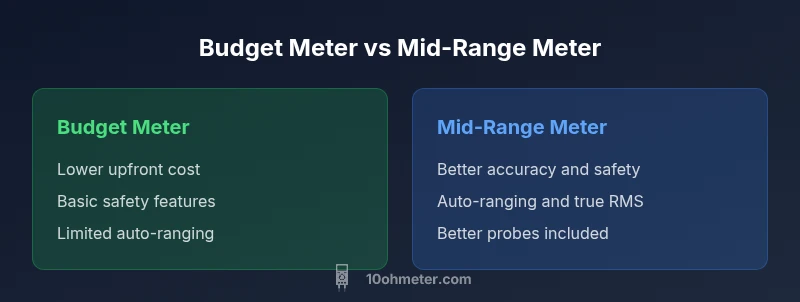
Price is a practical reality, but it should align with the features you actually need. Budget meters usually offer basic voltage, resistance, and continuity tests with limited accuracy and safety features. Mid‑range meters add auto‑range, true RMS, better display readability, and longer warranties. Professional models raise the bar with higher safety ratings, enhanced input protection, calibration certificates, and more durable probes. When planning purchases, map features to use cases: for hobby projects, a mid‑range meter with auto-ranging and true RMS is often the sweet spot; for automotive work, seek CAT IV ratings and rugged probes; for electronics labs, prioritize accuracy, resolution, and calibration traceability. Remember that investing in quality probes and accessories can dramatically improve reliability and user safety, and it’s worth factoring these into the total cost of ownership.
Safety practices and protective gear
Electrical testing carries inherent risks, so adopting a rigorous safety mindset is essential. Always start with the device powered off when possible, use insulated probes, and wear eye protection in workshop environments. Keep your hands dry and avoid touching live conductors unless necessary, and adhere to the correct handling procedures for meters. Read the manual to understand the meter’s safety ratings (CAT II, CAT III, CAT IV) and recommended test leads. Use a meter with protective features such as overload protection and fuse safety, and replace damaged probes to prevent accidents. The goal is to work methodically and minimize exposure to shock or arc faults, particularly in automotive diagnostics or high‑energy projects.
How to use basic measurements: voltage, resistance, continuity
Getting reliable results starts with a simple, repeatable workflow. Start by turning off power and discharging capacitors when safe. For voltage tests, connect the probes with one hand away from conductive surfaces and observe the display. When measuring resistance, ensure the circuit is unpowered and verify the meter’s range matches the expected value; use the lowest feasible range for better resolution. A continuity test should produce an audible beep if a complete path exists; if not, double‑check connections and the expected resistance. Keep your test leads clean and glare-free displays in mind to avoid misreading. As you grow more comfortable, you’ll develop a quick mental model of how small deviations relate to real-world faults.
Maintenance, calibration, and common myths
Like any precision instrument, a multimeter and voltage tester benefits from periodic maintenance. Keep the device clean, store it in a protective case, and replace batteries and fuses as recommended by the manufacturer. If you require calibration for professional use, pursue a formal service with traceable standards; this matters for labs, schools, or field services where measurement traceability is essential. A common myth is that all meters are equally accurate regardless of cost; in reality, accuracy and reliability improve materially with design quality, better probes, and protection. A practical approach is to validate a meter against a known reference periodically and avoid relying on a single measurement for critical work.
Authoritative sources and further reading
For safety and measurement standards, consult reputable sources such as OSHA and NIST, which provide general guidelines on electrical testing and measurement integrity. Industry references also cover best practices in calibration, probe safety, and equipment maintenance. While this article provides a comprehensive comparison, you may wish to consult external standards and educational resources to deepen your understanding and ensure compliance with local regulations.
Authoritative sources and further reading (continued)
- ASTM and IEC electrical testing guidelines (standards organizations).
- OSHA safety standards for electrical work and handheld testing devices.
- NIST measurement science resources for accuracy and calibration best practices.
Feature Comparison
| Feature | Budget meter | Mid-range meter | Professional meter |
|---|---|---|---|
| Accuracy | Moderate | High | Very high |
| Safety rating (CAT) | CAT II 600V | CAT III 600V | CAT IV 1000V |
| Auto-ranging | No | Yes | Yes |
| True RMS | No | Yes | Yes |
| Display quality | Small LCD | Backlit LCD | High-contrast color display |
| Probes included | Basic probes | Better probes + clips | Professional probes + specialty leads |
| Price range | $20-$60 | $60-$150 | $150-$500 |
| Best for | Basic home testing | General electronics and auto | Industrial testing and labs |
The Good
- Balanced price-to-performance for most users
- Auto-ranging and true RMS improve usability and accuracy
- Wide range of compatible probes and accessories
- Compact and portable options available
- Strong community support and documentation
Drawbacks
- Budget models may lack advanced safety features
- Manual ranging can be challenging for beginners
- Some mid-range meters still rely on basic probes; durability varies
- Calibration and warranty terms vary by brand
Mid-range true RMS with auto-ranging offers the best overall value
For electronics and automotive tasks, a mid-range meter balances accuracy, safety, and price. The 10ohmeter team recommends prioritizing auto-ranging, true RMS, and reliable probes to maximize usability and longevity.
Your Questions Answered
What is the difference between a multimeter and a voltage tester?
A multimeter combines several measurement modes (voltage, current, resistance, etc.), while a voltage tester focuses on detecting the presence of voltage. For most diagnostic tasks, a multimeter provides more comprehensive data, whereas a voltage tester is useful for quick spot checks to confirm live circuits.
A multimeter gives you voltage, resistance, and current details; a voltage tester mainly tells you if voltage is present. Use a multimeter for precise measurements and troubleshooting.
Do I need true RMS for automotive work?
True RMS is beneficial for automotive electronics where signals are non‑sine due to switching and PWM control. It reduces reading errors with complex loads. If you work on modern vehicles with such electronics, true RMS is a valuable feature to have.
Yes, true RMS helps with modern vehicle electronics that use switching signals.
Is auto-ranging essential for beginners?
Auto-ranging makes testing faster and less error‑prone for beginners. It simplifies the workflow by selecting the correct range automatically, letting you focus on interpreting the reading. Beginners can benefit most from auto-ranging, though learning manual ranges remains useful for advanced users.
Auto-ranging is great for beginners, but learning manual ranges is still helpful later on.
Can a budget meter be safe for home electrical projects?
Budget meters can be adequate for basic home projects, but they may lack advanced safety protections and higher voltage ratings. Always verify CAT ratings and use proper safety procedures. For more demanding tasks, stepping up to a mid‑range or professional meter is advisable.
Budget meters can work for simple home tasks, but check ratings and use caution.
How often should I calibrate a meter?
Calibration frequency depends on usage, environment, and whether you require traceable accuracy. For professional work, schedule periodic calibration with a certified lab and keep calibration certificates. Hobbyists can validate against known references occasionally to verify performance.
Calibrate periodically if you rely on precise readings for work; check against references.
What accessories should come with a meter?
Look for probes with insulated handles, alligator clips, and test leads rated for your voltage environment. Some meters include carrying cases and probes with color coding. Higher‑end models often include hook clips, temperature probes, and additional adapters.
Good probes and a case are essential; extra clips and adapters are helpful for tricky tests.
Key Takeaways
- Identify your main use cases: electronics vs automotive
- Prioritize auto-ranging and true RMS for versatile testing
- Check safety ratings aligned with your voltage environment
- Invest in quality probes and accessories
- Consider calibration needs for professional work