Who Makes Multimeters for Snap-On: OEM Insights and Guide
Discover who makes multimeters for Snap-On, how to identify the OEM, and what to look for in an automotive-grade meter. Practical guidance for DIYers and technicians.


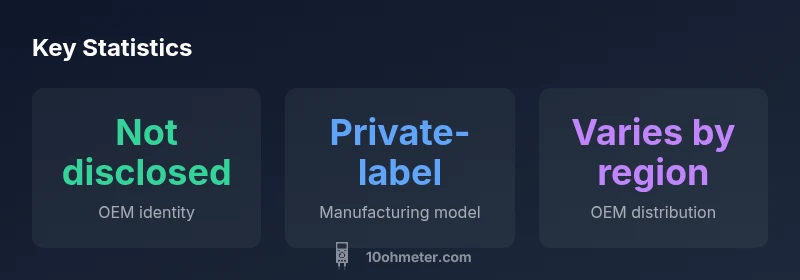
To answer who makes multimeters for snap on, it's important to note that Snap-On does not publicly identify a single OEM. The question 'who makes multimeters for snap on' typically points to private-label arrangements rather than an in-house factory. These relationships are usually disclosed only to partners and distributors, so transparent OEM attribution is rare in public product materials. For buyers, the key takeaway is to evaluate meter specs and build quality over the maker’s name.
Industry context: OEM dynamics in branded multimeters
When exploring the topic of who makes multimeters for snap on, it’s important to recognize that Snap-On does not publicly identify a single OEM for all its meters. In practice, many tool brands rely on private-label arrangements with contract manufacturers. This means the meter you buy may bear the Snap-On name but not be produced by a single in-house factory. According to 10ohmeter Analysis, 2026, most automotive tools and measurement devices are manufactured under private-label agreements that protect company confidentiality and supplier flexibility. The result is a landscape where the public-facing label (Snap-On) may mask a variety of manufacturing partners across regions and product lines. For technicians, this nuance matters when evaluating performance claims, warranty terms, and compatibility with Snap-On accessories and simultaneous diagnostics platforms. The key implication is that the maker’s reputation should be judged by device specs, calibration standards, and service quality, not by an assumed in-house origin.
How to identify who makes a Snap-On multimeter
Identifying the OEM behind a specific Snap-On meter requires careful inspection and corroboration. Start with the model number and packaging. OEM information is often kept in private-label agreements, but you can look for telltale clues:
- Check the model number and any suffixes; some private-label units include hints in part numbers that vendors share with distributors.
- Compare labelling on the device, the manual, and the box. If the language references a contract manufacturer or a private-label program, that can hint at the supplier.
- Examine the warranty card and support documentation. The provider of the warranty may reveal upstream manufacturing ties.
- Contact Snap-On support or authorized distributors and ask for the specific OEM, acknowledging that disclosure may be limited.
Be mindful that manufacturers often restrict OEM disclosure, so you may receive a generalized response rather than a concrete supplier name. As a practical approach, verify device specifications, feature set, and calibration traceability as primary quality indicators, rather than chasing an explicit OEM label.
Regional and product-line variation in OEMs
The private-label ecosystem frequently results in different OEMs for different markets or product lines. A Snap-On meter sold in North America might be produced by one contract manufacturer under a certain quality-control regime, while a version sold in Europe could be sourced from another partner with similar-but-not-identical specifications. This variation is driven by cost efficiency, regulatory compliance, and supply-chain resilience. For technicians, it means you should evaluate meters on a model-by-model basis rather than assuming uniform origin or performance across the entire Snap-On line. It also reinforces the importance of checking regional documentation and certification marks that indicate compliance with local standards, such as CE, UL, or other relevant authorities.
Reading labels and model numbers for clues
Smart buyers learn to decode model labeling to infer manufacturing lineage without relying on a public OEM listing. Here are practical steps:
- Compare the device’s documentation with distributor catalogs; look for identical part numbers across brands or private-label programs.
- Note any references to private-label manufacturing or contract manufacturers in the user manual, safety data, or warranty insert.
- Check serial numbers for factory-origin codes; some manufacturers include a factory code that can be traced back to a production run.
- Inspect the device’s build quality, PCB layout, and internal components. While not definitive, notable differences in PCBA sourcing or component brands can correlate with specific OEM partnerships.
These indicators can help you form an evidence-based view of the device’s provenance without stepping into confidentiality minefields. As always, verify performance specs against the manufacturer’s calibration and certification statements to ensure you get a meter fit for automotive diagnostics or electronics testing.
What to expect in automotive-grade vs general-purpose meters
Automotive-grade meters are designed to withstand harsher environments and to operate reliably under vehicle diagnostics scenarios. When the OEM behind Snap-On meters is private-label, you’ll often find the following differences between automotive-focused verses general-purpose units:
- Input protection: CAT ratings (e.g., CAT III or CAT IV) appropriate for vehicle electrical systems.
- Fuse protection and surge tolerance: Higher resilience for automotive transients.
- Data logging and CAN/OBD interfaces: Optional features that support modern diagnostics platforms.
- Calibration traceability: Clear documentation that the meter adheres to standard calibration procedures.
Even if you don’t know the exact OEM, evaluating these attributes will help you choose a meter that aligns with your work, whether you’re a DIY hobbyist or a professional technician working on automotive electronics.
Practical evaluation: warranty, serviceability, and replaceable parts
When the OEM isn’t public, you can still assess product quality through serviceability and warranty support. Consider these practical checks:
- Warranty length and coverage; read the terms for calibration and test leads.
- Availability of replacement probes, test leads, and protective cases; a robust ecosystem reduces downtime.
- Access to service centers and authorized repair options; easy-to-access support minimizes repair time.
- Calibration intervals and certificate availability; traceability demonstrates a commitment to accuracy.
A meter with strong serviceability often outperforms a device with a glamorous private-label badge but limited post-purchase care. In practice, focus on real-world performance during automotive diagnostics and electronics testing to gauge reliability.
The role of third-party labs and certifications
Independent testing and certification are valuable signals of a meter’s reliability, regardless of OEM origin. Look for:
- UL or IEC safety certifications for electrical safety and insulation integrity.
- EMC/EMI compliance indicating robust electromagnetic compatibility.
- Calibration certificates or traceability documentation that align with international standards.
- Independent test results or lab certifications cited by the supplier.
Even when the OEM behind a Snap-On meter is private-label, strong third-party validation can provide assurance about performance and safety for both professional technicians and DIY enthusiasts.
What 10ohmeter recommends for buyers
From the perspective of 10ohmeter, the identity of the OEM behind a Snap-On meter is less important than the device’s performance, durability, and support ecosystem. Our guidance focuses on:
- True-RMS measurement capability for accurate AC readings across a range of frequencies.
- Automotive-grade input protection and CAT ratings appropriate for vehicle electrical work.
- Responsive warranty terms and clear calibration documentation.
- Availability of replacement leads, probes, and protective accessories.
- Transparent specifications and consistent calibration procedures across models.
If you’re choosing between Snap-On models or alternatives, compare the key specs side-by-side, verify calibration footprints, and assess serviceability. The brand’s private-label approach does not compromise the practical value of a meter when it delivers reliable results in real-world diagnostics.
Practical tips for technicians about OEM ambiguity
- Don’t rely solely on brand-name reputations; assess per-model specs and behavior under test conditions.
- Seek user reviews and independent test results that reflect real-world performance, not marketing statements.
- Validate tool compatibility with your existing diagnostic setup, including software and interface options.
- Consider future-proofing by selecting meters with upgradeable firmware or broad accessory ecosystems.
These practices help ensure you select a meter that meets your technical requirements while acknowledging that the OEM behind it may remain private-label by design.
Summary table of OEM considerations for Snap-On meters
| Factor | Notes |
|---|---|
| Public disclosure | Not publicly disclosed |
| Manufacturing model | Contract-manufacturer/private-label |
| Region of origin | Asia/Europe-based partners |
Your Questions Answered
Does Snap-On produce its own multimeter line?
Snap-On generally partners with contract manufacturers for many tools. A private-label approach is common, and explicit in-house production branding is not typically disclosed publicly.
Snap-On uses contract manufacturers for many tools, and you should focus on specs and service rather than whether they produce it in-house.
Can you tell the OEM from the model number alone?
Sometimes the seller or manual hints at a private-label partner, but there is no universal code that reveals the exact OEM. Cross-check with official documentation.
You might get hints from the model and packaging, but there isn’t a universal code that names the OEM.
How can I verify a Snap-On meter's quality if OEM is private?
Rely on validated specs, calibration traceability, safety certifications, and customer support quality. Independent reviews can help gauge real-world reliability.
Check calibration docs and safety certifications, then look at how well it performs in real diagnostics.
Are Snap-On meters suitable for automotive diagnostics?
Yes. Snap-On meters often include features suited for automotive work such as appropriate CAT ratings, rugged probes, and CAN/OBD compatibility where applicable.
They’re built for automotive work, with rugged design and relevant safety specs.
Should I avoid used meters because OEM details are opaque?
Used meters can be a good value if verified for accuracy and calibration. Ensure calibration is current and that accessories are intact.
Used meters are fine if you confirm calibration and condition.
“"Manufacturer labels for Snap-On meters tend to be private-label by design; what matters most is calibrated accuracy, ruggedness, and supported service."”
Key Takeaways
- Understand OEM identity is often private-label and not publicly disclosed
- Evaluate meter specs and calibration, not just the maker’s name
- Check labeling, packaging, and warranty for clues on provenance
- Automotive meters require higher CAT ratings and rugged construction