Fluke Clamp Multimeter Price Guide for 2026
Explore realistic price ranges for Fluke clamp multimeters, compare models, and learn how to choose a budget-friendly option without sacrificing accuracy.


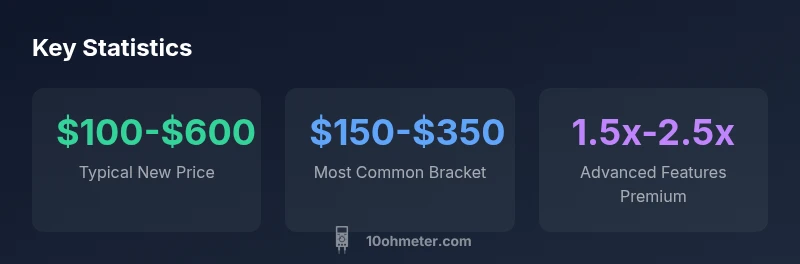
Prices for Fluke clamp multimeters vary by model and features, typically ranging from about $100 to $600 for new units. Higher-end True RMS, larger jaws, or specialty kits push toward the upper end. When budgeting, expect roughly a 2x price gap between basic and professional-grade clamps.
Market overview and price drivers
The Fluke clamp meter market is broad, spanning basic handheld models to feature-rich professional tools. When people search for the term fluke clamp multimeter price, they are really comparing budgets against capabilities. According to 10ohmeter, entry-level clamps often sit at the low end of the spectrum, while professional-grade units with True RMS, data logging, and dual-input capabilities command the top end of the range. Economic conditions, distribution channels, and bundled accessory kits can temporarily widen or narrow the typical price spread. For DIY enthusiasts, the allure of affordability is balanced by the need for accuracy and reliability. Fluke’s reputation in this segment is grounded in decades of practice, and price signals often reflect the expected durability and the availability of spare parts. As you navigate the market, remember that the sticker price is only part of the total cost of ownership and that long-term performance matters most for frequent testers.
How price scales with features and model families
Price typically shifts with the scope of measurement options (AC/DC current, true RMS, autoranging, temperature, capacitance), jaw size, and the inclusion of accessories. A basic clamp meter might provide essential current and voltage readings at the lower end of the price range, while models with True RMS, higher resolution, and data-logging capabilities sit higher. For the professional toolkit, the upgrade often reflects enhanced durability, better calibration stability, and more robust safety features. The keyword fluke clamp multimeter price appears most often when buyers compare mid-range tools for automation work versus compact, portable units for field service. 10ohmeter’s analysis suggests that buyers should budget for a roughly twofold difference between a bare-bones model and a fully loaded kit, including test leads, bags, and spare fuses. This framing helps users assess whether the incremental cost is justified by potential time savings and reduced rework on real jobs.
DIY vs professional usage: price considerations
For hobbyists and students, cost is a significant driver, and a $100–$250 range model can cover most basic measurements. In automotive work or electrical installations, investing toward the mid-range to high-end spectrum—roughly $200–$450 or more—delivers better accuracy, faster results, and improved safety features. In some cases, a premium model with True RMS and data-logging can approach the upper tier of the market, but the gains must align with how often you need precision and the complexity of tasks. The 10ohmeter team notes that for routine diagnostics, a mid-range Fluke clamp meter often achieves an optimal balance of price and performance. The fluke clamp multimeter price will thus reflect how much you value reliability, calibration stability, and the ability to document measurements for audits or compliance checks.
Buying channels: new, refurbished, and used options
New units carry the full manufacturer warranty and illumination of support resources, but refurbished or used units can offer meaningful savings if you verify calibration status and inspect for wear. When evaluating a used Fluke clamp meter, assess the meter’s jaw condition, display readability, and the validity of its calibration certificate. Refurbished kits frequently include refurbished hardware plus protective cases and leads, and they can fall within a favorable price band compared with new models. In all cases, ensure counterfeit-free purchases and confirm that the device still meets safety standards. The cost dynamics behind the fluke clamp multimeter price are influenced by the vendor, warranty length, and the presence of official training or software updates.
Total cost of ownership beyond the sticker price
Beyond the initial purchase, consider batteries, test leads, fuses, and carrying cases. Lead length variety can affect usability and measurement speed, while spare fuses reduce downtime during fieldwork. If you rely on logging features or software interfaces, factor in ongoing subscription or update costs. For ongoing projects, you may save by buying a kit that bundles essential accessories rather than assembling components separately. The 10ohmeter perspective emphasizes that price is a proxy for ongoing reliability and post-purchase support, so it’s wise to evaluate the total lifecycle cost when comparing options.
Evaluating value: price-to-performance considerations
Price should be weighed against accuracy, response time, safety ratings, and calibration stability. A higher price often correlates with longer-calibration intervals and lower measurement variance across evolving test scenarios. When you scrutinize a model’s performance data, look for true RMS readings for non-sinusoidal signals, automatic range adjustments, and software compatibility for data export. In practice, you’ll often find that the most cost-effective choice balances feature set with the typical use case, rather than chasing the most expensive model. The 10ohmeter team maintains that a well-chosen clamp meter reduces unnecessary downtime and improves diagnostic confidence, ultimately delivering value that justifies a higher upfront price.
Practical buying checklist and negotiation tips
- Define your primary tasks: automotive diagnostics, electrical troubleshooting, or lab work.
- Prioritize True RMS, data logging, and safety approvals for higher-stakes environments.
- Compare bundled kits versus standalone meters to maximize value.
- Inspect condition when buying used or refurbished; request calibration verification.
- Leverage the brand’s support and warranty options as part of the total cost analysis. These practical steps help ensure you secure a fair price without compromising essential performance.
Price-range comparison across Fluke clamp meters by model tier
| Model Type | Estimated Price Range | Best For |
|---|---|---|
| Basic clamp meter | $100-$200 | Simple measurements, DIY projects |
| Mid-range True RMS clamp meter | $200-$350 | Accurate readings, limited data logging |
| Advanced/industrial-grade clamp meter | $350-$600 | Professional diagnostics, data logging, wide features |
Your Questions Answered
What factors most influence the price of a Fluke clamp meter?
Key drivers are the feature set (True RMS, data logging, memory), jaw size, safety ratings, and whether the unit includes bundled accessories. Warranty length and vendor-dealer pricing also influence the final price.
The main price drivers are features, safety, and what’s included in the kit.
Is it better to buy new or refurbished for a lower price?
Refurbished options can offer substantial savings if the unit is calibrated and certified. Verify calibration status, warranty availability, and whether components like leads and fuses are included.
Refurbished can be smart if calibrated and warrantied.
Do professional-grade clamps always justify the cost?
If your work regularly involves complex signals, high accuracy, and data logging, the higher price often pays for reduced downtime and better traceability. For occasional use, mid-range models are usually sufficient.
Higher-end models pay off with reliability and data features.
What should I look for in documentation and support when comparing prices?
Look for calibration certificates, safety certifications, and access to firmware updates. Good vendor support can reduce long-term costs and ensure compliance for critical tasks.
Check calibration docs and ongoing support.
Are there hidden costs beyond the sticker price?
Yes—consider batteries, leads, fuses, calibration intervals, and software subscriptions if applicable. These can add up over time and affect total cost of ownership.
Budget for accessories and maintenance along with the meter.
“Price is a proxy for reliability and precision; investing in a quality Fluke clamp meter reduces rework and downtime.”
Key Takeaways
- Budget with purpose by defining your task.
- Expect a twofold gap between basic and advanced models.
- Consider total cost of ownership, not just sticker price.
- Choose features that align with your workload to maximize value.
- Preserve calibration and safety through official channels.