How to Test a C Pressure Switch with a Multimeter
Learn how to safely test a C pressure switch with a multimeter. This step-by-step guide covers continuity, resistance, and actuation checks for HVAC, automotive, and hydraulic systems.


You will test a C pressure switch with a multimeter to verify continuity, resistance, and proper actuation. This helps diagnose stuck or faulty switches in HVAC, automotive, and hydraulic systems. Gather a digital multimeter, jump wires, and basic hand tools, then follow these steps and compare readings to the switch’s spec.
What is a C pressure switch and why test it?
A C pressure switch is a diagnostic sensor used in various systems to monitor pressure and open or close an electrical circuit based on that pressure. In many DIY and professional setups, it acts as a safety or control point, triggering a relay or controller when a threshold is reached. Testing a C pressure switch with a multimeter helps confirm whether the contacts are mechanically and electrically sound, and whether the switch actuates at the intended pressure. According to 10ohmeter, a basic continuity and resistance check is a practical starting point that often reveals a switch that is stuck open, stuck closed, or exhibiting intermittent contact. While the exact readings depend on the model and port configuration, you can rely on general patterns: a normally closed (NC) switch should read continuity when not actuated and break continuity when actuated; a normally open (NO) switch should show no continuity until it is pressed or actuated. Remember, this test is about the electrical behavior, not the fluid or gas behavior, so handle the device with care and avoid exposing it to live pressure conditions during testing.
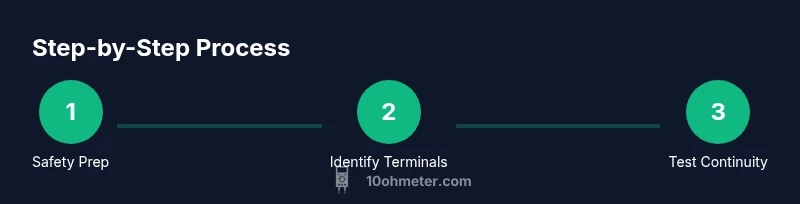
Safety and preparation before testing
Before you begin, disconnect power to the circuit you’re testing to avoid shock or injury. Relieve any stored pressure from the system according to manufacturer guidance, and discharge capacitors where applicable. Set the multimeter to an appropriate range for continuity or resistance, and organize leads so they won’t short to adjacent components. Wear safety glasses and gloves as a general precaution, and keep a clean workspace free of conductive clutter. The goal of this setup is to test the switch in a controlled, de-energized state, then observe how the readings change when the switch is actuated.
Understanding terminals and typical readings
Most C pressure switches have at least two electrical terminals that connect to a control circuit. Some configurations include an additional ground or auxiliary terminal. In the simple two-terminal case, you should observe: (1) continuity across the terminals when the switch is at rest if it is normally closed, (2) a loss of continuity when actuated, and (3) a measurable resistance when a coil or internal mechanism is involved, even if the switch is closed. If you have a three-terminal setup (NO/NC plus a common), you’ll see continuity between the common and one terminal in one state and between the common and the other terminal in the opposite state. Always compare your readings to the manufacturer’s datasheet for exact expectations.
Interpreting test results and what they mean
Interpreting readings comes down to the switch type and the expected behavior under pressure. If continuity persists in both states, the switch may be stuck or the wiring is bypassing the switch. If there is no continuity in any state, the contacts could be burned or misaligned. In some cases, you’ll see fluctuating readings or inconsistent continuity, which points to a dirty or oxidized contact surface or a mechanical snag in the actuator. If you observe unusually high resistance when the switch is actuated, the internal contact path may be degraded. In all scenarios, compare readings to the datasheet and, if in doubt, perform the same test with a known-good replacement to isolate the fault.
Practical diagnostic scenarios and decision points
- Scenario A: No continuity when actuated, but continuity at rest. The switch is likely working as NO and may be failing to close under pressure.
- Scenario B: Continuity persists in both states. The switch could be shorted, or there is a wiring fault bypassing the switch.
- Scenario C: Intermittent readings or buzzing sounds in the switch assembly point to mechanical wear or contamination.
- Scenario D: Infinite resistance in all states suggests a broken contact or a severed wire. In this case, replace the switch and recheck the circuit.
In all cases, if readings do not align with the expected behavior documented by the manufacturer, substitute a known-good switch to verify whether the fault lies with the switch or the surrounding circuitry.
Next steps: replacement, recalibration, and maintenance
If the C pressure switch fails the electrical tests, replacement is typically the safest option. After replacement, perform a recheck to confirm proper operation and connection integrity. Routine maintenance, such as cleaning contact surfaces and avoiding moisture intrusion, can extend switch life. Finally, document test results for future preventative maintenance checks and to help diagnose any recurring issues.
Tools & Materials
- Digital multimeter (DMM)(Prefer one with continuity and diode test modes)
- Alligator jumper leads(For safe, hands-free test connections)
- Insulated gloves(Optional, for added protection)
- Screwdrivers set (precision)(For terminal access and cover removal)
- Wire strippers/cliers(Useful for trimming or adjusting leads)
- Safety glasses(Eye protection during testing)
- Replacement C pressure switch(Only if the test indicates failure)
- Non-conductive mat or workspace(Minimize accidental shorts)
- Manufacturer datasheet(Reference for expected readings and limits)
Steps
Estimated time: 25-40 minutes
- 1
Power down and isolate
Ensure the system is fully de-energized and safely isolated. Remove power to the control circuit and any supply lines connected to the pressure switch. This prevents shock and protects the test equipment from transient voltages.
Tip: Double-check neighboring components are not inadvertently energized by a backfeed. - 2
Identify and access the switch terminals
Locate the C pressure switch and access its terminals. If needed, remove the cover or protective housing using the appropriate screwdriver. Note which terminals connect to which circuit so you can map readings later.
Tip: If your switch has color-coded wires, mark them to avoid mix-ups during reassembly. - 3
Test continuity at rest
Set the multimeter to continuity or low-resistance mode. Probe the two primary terminals and observe whether continuity exists with the switch at rest (unactuated). Record the result as a baseline.
Tip: If your meter emits a tone, use it to confirm a stable connection; a fluctuating tone indicates a poor contact. - 4
Actuate the switch and re-test
Apply the intended pressure or actuate the switch mechanism. Immediately re-measure continuity across the same terminals. A change from closed to open (or vice versa) confirms contact operation.
Tip: Actuation should be firm but not forced; ensure the test rig does not introduce side-loading on the switch. - 5
Check resistance and examine auxiliary paths
If your switch uses a resistive path or additional terminals, switch the multimeter to resistance and test each relevant pair. Compare to datasheet values and expected ranges, noting any anomalies in the readings or the actuator travel.
Tip: Document each reading with a quick sketch of the terminal layout for future reference.
Your Questions Answered
What is the purpose of a C pressure switch in a system?
A C pressure switch monitors system pressure and opens or closes an electrical circuit to protect or control equipment. It often serves as a safety or control point in HVAC, automotive, or hydraulic systems.
A C pressure switch watches pressure levels and switches the circuit on or off to protect equipment. It’s a safety and control device in many machines.
How do I know if readings are valid?
Valid readings align with the switch type (NO or NC) and match the expected actuation state in the datasheet. If readings are contradictory or unstable, recheck connections and consider a replacement.
Make sure the readings match the switch type and the manufacturer’s specs. If readings are unstable, recheck wiring or replace the switch.
Can I test without disconnecting power?
Testing should always be done with power off to avoid shock and damage. If you must verify under real conditions, use proper isolation and voltage-rated equipment, and consult a professional.
No. Always test with the power off and ensure proper isolation. If you’re unsure, get help from a qualified technician.
What if the switch doesn’t respond to actuation?
If actuation doesn’t change the readings, the switch may be failed or the actuator mechanism jammed. Inspect the mechanical travel and replace the switch if the fault persists after cleaning.
If you don’t see any change when you actuate, the switch could be stuck or damaged. Inspect the mechanism and replace if needed.
Is a multimeter alone enough to diagnose a pressure switch?
A multimeter confirms electrical function, but mechanical or hydraulic faults may require additional tests or a flow/pressure test. Use the multimeter as part of a broader diagnostic workflow.
A multimeter helps with electrical checks, but you may need other tests to diagnose mechanical or hydraulic issues.
Should I replace the switch or the whole control module?
Start with the switch if the readings indicate failure and the module relies on the switch for control. If the module shows other faults or dependencies, consider replacing the entire assembly per manufacturer guidance.
If the switch is faulty and controls the module, replace the switch first. If the module is implicated, replacement of the whole unit may be necessary.
Watch Video
Key Takeaways
- Identify switch type (NO/NC) before testing.
- Use continuity and resistance tests to verify contact integrity.
- Actuation states must reflect the intended pressure range.
- Compare results to the datasheet and substitute a known-good switch if needed.