Multimeter for Automotive: Essential Guide
Learn to use a multimeter for automotive tasks with step-by-step guidance, essential safety tips, and practical tests for car batteries, wiring, sensors, and ignition systems.


With a multimeter for automotive work, you’ll diagnose voltage, resistance, and continuity across car circuits safely. This guide shows you the essential steps, safety checks, and common tests you can perform in under 30 minutes. By following these steps, DIY enthusiasts and technicians can confidently troubleshoot electrical issues in modern vehicles.
Why a Multimeter for Automotive Matters
A dedicated multimeter for automotive tasks is a cornerstone tool for DIY enthusiasts and professional technicians. When you understand voltage levels, resistance across sensors, and continuity in wiring, you can diagnose faulty components without guesswork. A quality meter helps you verify battery health, inspect alternator outputs, test fuses, and trace faulty grounds. In today’s vehicles, electronics play a larger role, so being fluent with your multimeter for automotive tasks is a valuable skill. This section explains why the tool matters in practical terms and how it fits into common automotive troubleshooting scenarios.
Key takeaways for automotive testing:
- Voltage checks reveal battery and charging system health.
- Resistance and continuity expose broken wires and faulty sensors.
- Safe testing practices prevent sparks and damage to electrical systems.
- True-RMS and auto-ranging features simplify measurements across car circuits.
Throughout this article, you’ll see how 10ohmeter’s guidance aligns with typical automotive diagnostics workflows, helping you gain confidence when under the hood.
Core Measurements You Will Use
A solid foundation for any diagnostic session is knowing which measurements matter most in automotive contexts. The most common measurements include DC voltage to verify battery and charging system status, resistance to test sensor circuits, and continuity testing to locate breaks in wiring. Some tests, like current measurements, require special approaches (see Tools & Techniques below). Modern vehicles have many control modules; understanding readings in relation to expected specs is essential. Use the meter’s dial to select DC voltage (typical ranges: 20V or auto-range), resistance (ohms), and continuity with beep.
Practical tips:
- Always reference the vehicle’s service manual for expected voltage ranges.
- When testing sensors, measure between the sensor and ground to avoid false readings caused by shared grounds.
- If your meter offers True RMS, use it for AC or pulsed signals in some auxiliary circuits.
Remember the goal: translate readings into reliable judgments about component health and system function. The more you practice, the quicker you’ll recognize out-of-spec values and potential failure points.
Safety First: Handling Live Circuits
Testing live automotive circuits carries risk. Battery terminals can deliver high current, and vehicle electronics can produce unexpected spikes. Always wear eye protection and keep your hands dry. Start with the system off before connecting probes when possible, then re-check with power on only after you’ve assessed hazards. Keep the meter leads away from moving parts, and never place probes across a live battery with metal jewelry nearby. If you’re unsure, consult a service manual or seek professional guidance.
Safety checklist:
- Work in a well-ventilated area away from fuel vapors.
- Disconnect the negative terminal before heavy electrical work on exposed circuits.
- Use insulated test leads and clip-on probes to minimize exposure and risk.
Following prudent safety practices protects you and your equipment while delivering reliable diagnostic results.
How to Choose the Right Multimeter for Your Car
Choosing the right multimeter for automotive work hinges on durability, ease of use, and measurement capabilities. Look for a model with auto-ranging to simplify readings, true RMS for AC signals, a robust voltage range (at least 20V DC on a typical car battery), and a dedicated continuity beep. Features like a backlit display, temp warning, built-in fuse protection, and test leads with alligator clips add value for automotive testing. For beginners, a basic digital multimeter with auto-ranging and a solid safety fuse is sufficient to get started. For advanced testers, consider a multimeter that supports current measurements in-series with a shunt, and one that can handle inductive loads without spiking.
What to ask before you buy:
- Do you primarily test battery voltage and sensor circuits?
- Will you test continuity and low-resistance components frequently?
- Do you need portable, compact tooling for tight engine bays?
This guide emphasizes practical features over consumer hype, so you choose a meter that fits your typical automotive tasks.
Quick Diagnostic Tests You Can Run
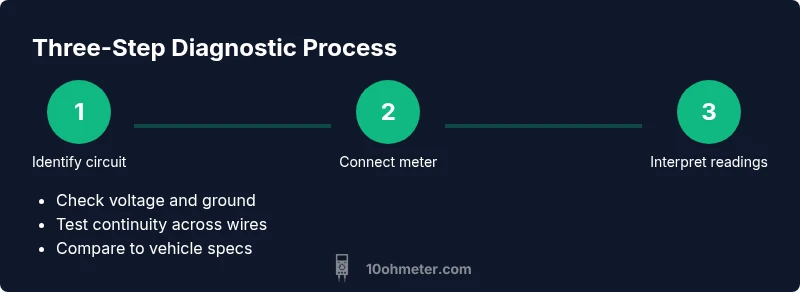
If you’re new to using a multimeter for automotive work, start with a handful of core tests that cover the most common failure modes. These tests help you confirm battery health, charging performance, and sensor signals without requiring advanced equipment. For battery health, check resting voltage, then the charging voltage with the engine running. For sensor loops, measure the signal voltage and ground reference. For wiring, perform a continuity test across known-good paths. Finally, document readings and compare them to manufacturer specs. With practice, these tests become quick checks you can perform in minutes.
Test ideas you can perform today:
- Battery voltage check (engine off and engine running)
- Continuity test across a suspected wiring fault
- Sensor signal voltage in an operating circuit
- Resistance check across unknown resistor in a circuit
- Ground integrity test across major chassis grounds
Common Mistakes and How to Avoid Them
Even experienced DIYers run into recurring mistakes when using a multimeter for automotive work. One common error is measuring resistance in an energized circuit, which can damage the meter and give false readings. Another is failing to select the correct voltage range or misinterpreting a fluctuating reading from a pulsed automotive signal. Always set up in a lab-like sequence: inspect the circuit, power down, connect the meters correctly, then re-check with power on if necessary. Regularly calibrate and inspect leads for wear, and replace damaged fuses prior to testing. Finally, avoid relying on a single reading; verify with multiple measurements and test points.
Troubleshooting mindset:
- Validate readings against known good values.
- Cross-check with alternate test points.
- Keep a log of measurements for comparison over time.
Next Steps: Practice Scenarios and Learning Path
To deepen your understanding, practice on non-vehicle circuits that mirror automotive sensors, switches, and harnesses. Build a small practice board with simulated car battery, relays, and a few resistors to practice measuring voltage, resistance, and continuity. As you grow more confident, move to your car’s battery and primary circuits under safe conditions, following the vehicle’s service manual. Use your findings to map out a diagnostic flow for future problems. The goal is not only to read numbers but to interpret them in the context of the vehicle’s electrical system.
Tools & Materials
- Digital multimeter(Auto-ranging preferred; DC voltage range at least 20V)
- Test leads with alligator clips(Insulated, in good condition)
- Fuses for the multimeter(Spare fuses of appropriate rating)
- Schematic or service manual for your vehicle(Location of tests and expected values)
- Safety glasses(Eye protection during testing)
- Insulated gloves (optional)(Adds protection for high-energy testing)
- Back-up battery or power supply (optional)(Useful for stand-alone practice)
Steps
Estimated time: 25-40 minutes
- 1
Prepare and safety-check the workspace
Power down the vehicle and remove the key. Open the hood in a well-ventilated area and remove metal jewelry. Inspect the meter and leads for damage before use to avoid shorts or shocks.
Tip: Always start with safety, even if you’re short on time. - 2
Inspect equipment and leads
Check the multimeter’s leads for cracks, exposed copper, and secure insulation. Ensure the fuses are intact and the dial is set to DC voltage for battery checks. Calibrate if your model offers it.
Tip: Damaged leads can yield false readings or sparks. - 3
Set up the meter and select the correct function
Turn the dial to DC voltage for battery testing; select resistance to test sensor circuits; use continuity for wiring paths. Attach the black probe to a solid chassis ground first, then the red probe to the test point.
Tip: Make the ground connection first to establish a reference. - 4
Test the car battery voltage (engine off)
Place red on the positive terminal and black on the negative terminal. A healthy resting voltage is typically around 12.6V, but check your vehicle’s specs. If readings are lower, investigate charging system or battery health.
Tip: No smoking or sparks near the battery. - 5
Check the charging system with the engine running
With the engine running, measure the alternator output. A typical system should read above ~13.8V and up to ~14.8V depending on the vehicle. If the voltage is too high or too low, inspect the alternator, serpentine belt, and wiring.
Tip: Fluctuating readings may indicate alternator or belt issues. - 6
Test continuity and sensor signals
Test wire continuity by placing probes at each end of a known good wire; listen for the beep. For sensors, measure the supply and signal lines while the sensor is in operation, comparing to manual specs.
Tip: Interpret readings in the context of the sensor’s expected range. - 7
Document results and compare to specs
Record readings and compare with manufacturer specifications in the service manual. Note any deviations and plan follow-up steps, such as testing connectors, grounds, or replacing a component.
Tip: A well-kept log speeds future diagnostics.
Your Questions Answered
What is the best multimeter setting for automotive voltage checks?
For most automotive voltage checks, use DC voltage mode on the meter with an appropriate range (commonly 20V). Check the vehicle’s manual for exact specs. Start with the battery (engine off) and then test with the engine running to see charging behavior.
Set the meter to DC voltage, typically within the 20V range, and compare readings to the manual’s specs. Do battery and charging checks first.
Can you measure current without breaking the circuit?
Yes, with a clamp meter you can measure current without breaking the circuit. If you must use a standard meter, place it in series and only on isolated, de-energized portions of the circuit to avoid shorts.
You can measure current with a clamp meter safely, or place the meter in series if you must, making sure the circuit is de-energized first.
Is it safe to test car battery with a multimeter?
Testing a car battery with a multimeter is safe when you follow proper safety steps: wear eye protection, avoid sparks, and disconnect the negative terminal before performing invasive tests. Readings help assess health and charging status.
Yes, as long as you wear protection and avoid sparks, battery tests can reveal health and charging issues.
Why isn’t my continuity beep sound during a test?
Check that the probes contact clean metal and the circuit path is intact. Ensure you’re in continuity mode and that the meter’s battery is fresh. Re-test on a known good wire to confirm the meter works.
If the beep doesn’t sound, verify contact quality and that you’re in the right mode on a known good wire.
Do I need a specialized meter for automotive testing?
A good auto-oriented digital multimeter with DC voltage, resistance, and continuity capabilities is sufficient for most tasks. For advanced current testing or inductive loads, consider a meter with a true RMS and the ability to measure higher currents.
A solid digital multimeter covers most tasks; upgrade if you need advanced current or inductive testing.
How should I document readings for future diagnostics?
Keep a log of voltage, resistance, and continuity readings with date, vehicle state (engine on/off), and location of test. Compare over time to identify gradual degradation or intermittent faults.
Maintain a simple log of readings with context to spot progressive issues.
Watch Video
Key Takeaways
- Start with safety and proper setup.
- Know the right settings: DC voltage, resistance, continuity.
- Compare readings to vehicle specs for accurate diagnostics.
- Document results for quick future references.