How to Check Current with a Multimeter
Learn how to check current with a multimeter across electronics and automotive tasks. Step-by-step guidance, safety tips, and common mistakes to avoid. By 10ohmeter Team.


In this guide, you’ll learn how to safely check current with a multimeter by selecting the proper current range, inserting the meter in series with the load, and verifying the reading. Start with safety checks, connect the meter correctly, and read the current value.
Understanding current measurements and safety
Current is the flow of electric charge through a circuit. To understand how to check current with multimeter, you must recognize that current must be measured in series with the load, not across it. This fundamental concept applies to both electronics projects and automotive diagnostics. The 10ohmeter team emphasizes safety first: always de-energize the circuit before inserting your meter, use the correct current range, and verify that the meter is fused for the expected current level. In AC circuits, be aware that many meters measure RMS current, and not all readings are true RMS; if you need accurate AC current readings, consider a meter with True RMS capability. For beginners, start with low-current, low-risk circuits like a small LED circuit before attempting higher-power projects. Always read the meter’s manual to understand which ports and fuses power your current measurements. Understanding these basics helps prevent damage to the meter and the circuit. According to 10ohmeter, safety starts with planning and using the right tool for the job.
Choosing the right meter mode and range
A multimeter can measure current in two principal ways: using a dedicated current input (amp or mA) jack, or, for higher currents, through a separate high-current input. Some meters also offer a clamp function that measures AC or DC current without opening the circuit. When learning how to check current with multimeter, pick the correct mode: DC current for DC circuits and AC current for AC circuits. Start with the highest available range to avoid blowing the fuse, then work downward until the display stabilizes. Always insert the red test lead into the current terminal suited for the expected range, and keep the black lead in the COM terminal. If your circuit carries larger loads, a clamp meter is often safer and easier; it can capture peak currents without breaking the circuit. Never attempt to measure current by placing the meter across a live power source; this will short the circuit and could be dangerous. In practice, a true RMS-enabled meter helps when dealing with non-sinusoidal waveforms common in modern electronics.
Preparing the circuit and safety steps
Before you begin, ensure you have a safe, dry work area and clear space around the test area. Disconnect power, unplug power supplies, and discharge capacitors where appropriate. Put on safety glasses and insulated gloves if you are working with potentially hazardous voltages. Identify a logical point in the circuit to insert the meter in series; label the path so you know how current flows. Remove the stock connections gently, and have the replacement leads ready. Keep one hand behind your back if possible to reduce the chance of accidental contact. Check that test leads are rated for the voltage and current you expect; use insulated probes and keep fingers away from exposed contacts. Finally, consult the meter’s fuse status; a blown fuse is a common cause of measurement failure. With safety covered, you can proceed to the next steps with confidence.
Step-by-step context: how to check current with multimeter in series
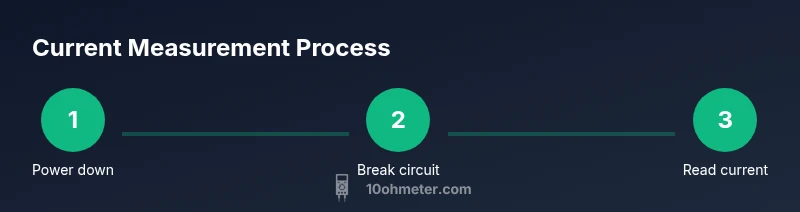
In practice, you insert the meter in series with the load. Begin by powering down the circuit and confirming there is no residual energy. Set the meter to the appropriate current range and select the correct port. Break the circuit at a convenient point, then connect the meter so that the current flows through the meter itself. After securing the connections, restore power and observe the meter display. Let the reading stabilize before recording it, and if you see extremes or fluctuations, verify by rechecking the connections or trying a higher or lower range. When finished, switch the circuit back to its normal configuration and remove the meter in the reverse order of connection. This method provides an accurate measure of current through the path under test, and using a clamp meter as a cross-check can further improve confidence.
Troubleshooting common issues and mistakes
Common mistakes include placing the meter in parallel with the load, which effectively shorts the circuit, or using the wrong terminal for the expected current, which can blow the fuse or damage the meter. A reading of overload (OL) typically means the current is beyond the selected range; adjust to a higher current setting if your meter allows it. Loose or misaligned test leads can produce erratic readings; always ensure solid connections. Ambient conditions such as temperature, vibration, and electromagnetic interference can affect measurements, especially with sensitive electronics. If readings seem inconsistent, re-check the circuit, measure a known reference current, and verify the meter’s fuse integrity. For automotive measurements, always wear eye protection and be mindful of the battery and charging system; automotive environments are harsher and present higher risks.
Care, maintenance, and calibration tips
Store your multimeter in a protective case to protect from dust and impact. Regularly inspect test leads for cracks and insulation wear; replace damaged leads immediately. Replace the meter’s fuse if it has blown; never bypass a fuse to extend range. Calibrate the meter or have it calibrated periodically according to the manufacturer’s instructions; if your device is used for critical measurements, consider professional calibration services. Keep the battery fresh, and remove it during long-term storage to prevent corrosion. Finally, practice in low-risk circuits to build confidence before tackling automotive electrical work.
Authority sources
- OSHA electrical safety guidelines: https://www.osha.gov
- NIST measurement principles for electrical currents: https://www.nist.gov
- IEEE standards and articles: https://ieeexplore.ieee.org
Automotive current checks: differences and tips
Automotive circuits pose different challenges: higher energy systems, battery presence, and electrical noise. When measuring current in vehicles, prefer a dedicated DC current range and avoid exposing yourself to live connections. Clamp meters can be particularly useful for measuring large loads like starter motors or alternators without breaking the circuit. Always consult the vehicle service manual for recommended procedures and safety cautions. Do not rely on consumer-grade devices for high-current measurements; those tasks are best handled with proper automotive diagnostic tools. Take care to protect your meter from engine heat and vibration, and consider performing measurements with the engine off if possible. When you must measure under load, keep your hands away from belts and fans.
Practical tips to improve accuracy
To improve accuracy, take multiple readings and average them; ensure stable connections; use low-inductance leads; try to measure at the point closest to the load to reduce stray resistance; Keep the meter on True RMS for AC current when available; always verify results with a second method if the circuit is critical. Document the conditions of the test, including ambient temperature and power state, for future reference. The goal is to develop a repeatable method that yields consistent results in electronics and automotive environments.
Tools & Materials
- Digital multimeter with current measurement input (amp/mA) and proper test leads(Ensure the meter has both mA and A inputs and a fused current range)
- Test leads with probes(Prefer leads with alligator clips for secure in-series connections)
- Breakable circuit segment or detachable load path(A safe point to insert the meter in series without shorting anything)
- Safety PPE (safety glasses, insulated gloves)(Recommended for experiments with higher voltages or automotive work)
- Clamp meter (optional)(Use to cross-check current without breaking the circuit)
- Insulated tools (pliers, wire cutters)(Helpful for arranging wires and preparing the test path)
- Meter documentation/manual(Reference for fuse ratings and port usage)
Steps
Estimated time: 15-25 minutes
- 1
Power down and isolate the circuit
Turn off power to the circuit and unplug power sources. Confirm there is no residual energy in capacitors that could shock you or damage the meter. This is a foundational safety step before you insert the meter in series.
Tip: Always test with a non-contact tester if available to verify no voltage before touching conductors. - 2
Identify the test point and plan series insertion
Select a convenient point where you can interrupt the current path without creating a short. Plan how to route the meter leads so they stay clear of moving parts or hot surfaces.
Tip: Mark the point with tape or a label to avoid accidentally re‑shorting the circuit. - 3
Select the right current range and connect in series
Set the meter to the appropriate current range (DC or AC as needed) and insert the test leads into the correct jack. Break the circuit and place the meter so that the current flows through it rather than across it.
Tip: If the current is unknown, start at a higher range and step down until the reading stabilizes. - 4
Restore power and observe the reading
Power the circuit back on and watch the meter display. Allow the reading to stabilize and note the value. If the reading spikes or flickers, stop and recheck connections.
Tip: Take at least three readings over a short interval to ensure consistency. - 5
Remove the meter safely and restore the circuit
Power down again, remove the meter in the reverse order of connection, and reconnect the circuit. Verify the circuit returns to its normal operation.
Tip: Inspect the leads for any heat damage after measurement; replace if any wear is evident. - 6
Document the reading and compare
Record the observed current and compare it to expected values from the design or datasheet. If discrepancy exists, recheck setup or try a different method for cross‑validation.
Tip: Document ambient conditions and circuit state to help reproduce results later.
Your Questions Answered
Can I use a regular voltmeter to measure current?
No. A voltmeter measures voltage, not current. To measure current, you must use the current input on a multimeter or a clamp meter. Attempting to measure current by placing a voltmeter in series can damage the meter and the circuit.
Use the meter’s current input or a clamp meter; voltmeters measure voltage, not current.
Is it safe to measure current in automotive circuits?
Yes, with proper precautions. Use a DC current setting, wear eye protection, and avoid contact with hot or rotating parts. Automotive systems can deliver high energy and produce dangerous arcs.
Yes, but follow safety steps and use a clamp meter for easier checks when possible.
What if the meter shows OL or overload?
OL means the current exceeds the selected range. Move to a higher current range if your meter allows it, or verify that the circuit path is correct and the leads are connected to the right ports.
If you see OL, switch to a higher current range and recheck connections.
Should I measure AC and DC current the same way?
The method is similar, but choose DC or AC current mode depending on the circuit. True RMS meters provide more accurate AC current readings in non-sinusoidal circuits.
Use DC current mode for DC circuits, and AC current mode for AC circuits; True RMS helps with complex waveforms.
Do I need to disconnect power when testing a passive device?
If possible, yes, especially for beginners. Some tests require live measurements, but this should only be performed with proper training and safety steps.
Power off when possible; only test live with proper training and precautions.
What’s the best way to verify current readings?
Cross-check with a clamp meter or measure the same path with a different range. Reproduce measurements in steady conditions to confirm consistency.
Cross-check with a clamp meter and re-test to confirm accuracy.
Key Takeaways
- Always power down before inserting the meter in series.
- Choose the correct current range and port to protect the meter.
- Measure current in series, not across a load.
- Cross‑check readings with a secondary method when possible.
- Document and compare results for repeatability.