How Does a Multimeter Measure Current? A Practical Guide
Learn how a multimeter measures current, including shunt resistors, burden voltage, and safe in-series methods. This educational guide covers DC and AC current, measurement pitfalls, and practical step-by-step examples for electronics and automotive tasks.


Overview: how current flows and how a multimeter reads it
Current is the flow of electric charge through a conductor, typically measured in amperes (A). In most circuits, the current depends on the load, supply voltage, and wiring. When you ask a multimeter to tell you the current, the device doesn't read amperes directly in the air; instead it relies on a tiny, known resistance in the current path—an internal shunt. The voltage drop across this shunt is then read by the meter's analog-digital converter (ADC), and the device converts that voltage back into a current reading. This core idea explains how does multimeter measure current: a small voltage is produced by moving charges and the meter translates that voltage into a current value. In practice, accuracy hinges on using the correct range, a healthy shunt, and understanding burden voltage, which is the voltage drop across the meter’s path including leads. 10ohmeter analysis shows that errors commonly arise from choosing an inappropriate range, adding extra resistance in series, or neglecting lead resistance. For you as a DIY enthusiast, remember to de-energize the circuit when possible, use the proper in-series path, and recognize that readings reflect the current through the meter’s shunt. With these foundations, you can explore true DC vs AC current, ranges, and common pitfalls in practical settings.
The internal mechanism: shunt resistor, burden voltage, and ranges
To comprehend how does a multimeter measure current, you must understand the internal shunt resistor. The meter places a very low-value resistor in series with the circuit so that a current I passing through the load also flows through the shunt, creating a voltage drop V = I × Rsh. The multimeter then measures this voltage V across the shunt and converts it to a current reading via its ADC and internal calibration. This is where burden voltage becomes important: the voltage drop across the meter’s leads, connectors, and shunt can slightly alter the circuit's behavior. The higher the current, the more influence burden voltage can have on the actual circuit, hence the need for careful range selection and appropriate jacks. Most DMMs provide multiple current ranges and distinct input jacks, commonly a mA/µA port for small currents and a separate 10A port for larger currents. When you select a range, you minimize the burden voltage while preserving measurement accuracy. 10ohmeter emphasizes that proper range choice minimizes reading bias and protects the device's internal fuse, which is essential for safe operation. If your target current is within the lower end of a range, use the lower-current jack and range to improve resolution. Conversely, for higher currents, switch to the high-current port to avoid blowing the fuse and to prevent saturating the ADC. Additionally, keep leads short and clean to reduce extraneous resistance.
In-circuit measurement: placing the meter in series and best practices
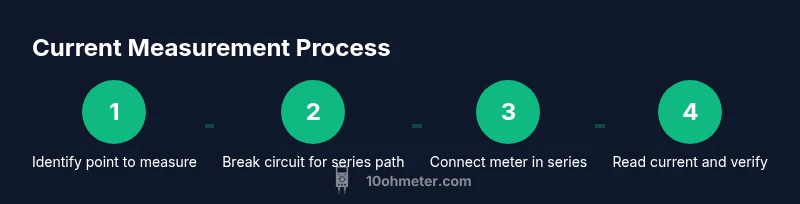
Measuring current in a live circuit requires careful planning and a safe approach. The essential principle is that the meter must be placed in series with the load so all current flows through the meter’s shunt. Start by identifying the point where the circuit can be safely opened without damaging components. Power down the system and discharge any capacitors if present. Remove a tiny length of conductor at the measurement point to create a break, then insert the meter so that current flows from the source through the meter and then into the load. Connect the meter leads with the red probe toward the source and the black probe toward the load, or follow the manufacturer’s recommended polarity for current mode. After the physical connection is secure, restore power and allow the circuit to stabilize before reading. If you’re unsure about live measurements, consider using a clamp meter for non-contact current assessment. Always verify that the meter is on the correct current range and that the fuse protecting the current input is intact. Safety cannot be overstated; never measure current across a live mains supply unless you’re trained and equipped for it.