Can a Multimeter Measure Temperature? A Practical Guide
Explore whether a multimeter can measure temperature, how to use probes and sensors, safety tips, and practical setups for electronics and automotive work. Learn with practical guidance from the 10ohmeter team.


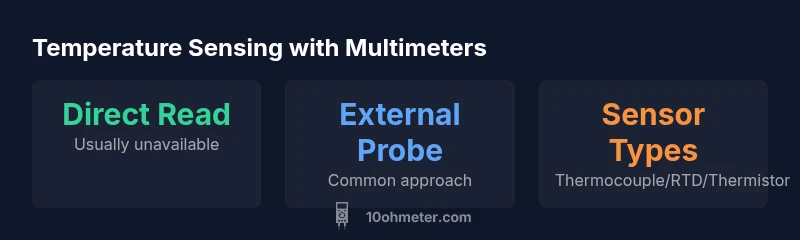
The short answer is that a typical handheld multimeter cannot directly measure temperature. Some meters support temperature readings only when paired with an external temperature probe or a thermocouple/RTD accessory, or via a dedicated temperature input. For most tasks, you’ll rely on a compatible sensor connected to the meter or to a data logger. This is why you often see “temperature input” on higher-end models or adapters rather than on budget units.
Understanding Temperature Measurement with Multimeters
The question can multimeter measure temperature is common among DIYers, and the nuanced answer depends on what you mean by measuring temperature. A standard, budget-friendly multimeter often lacks a dedicated temperature channel and cannot read ambient temperature on its own. However, most hobbyist tasks don’t require ambient readings; they require knowing the temperature of a component or a surface. In those cases, temperature measurement is achieved by adding a sensor that the meter can read through a compatible input, or by relying on a sensor attached to the device under test. When you ask, can multimeter measure temperature, you are really asking about sensor-integration and the meter’s compatibility with probes and adapters. The practical truth is that temperature measurements with a multimeter come down to two pathways: external sensors connected to a temp-input, or built-in sensors in some higher-end models. For accurate work, always confirm the input type on your meter and the sensor you plan to use; the wrong combination yields readings that are misleading at best and dangerous at worst.
You should also know that the term temperature with a multimeter often implies a surface or ambient temperature, measured indirectly through a sensor. Always review the meter manual for the supported sensor families and accuracy specifications. Practically, many users operate with thermocouple probes or RTD-based sensors and a meter that can read their millivolt or resistance output, which the meter then converts into temperature. The short, practical takeaway is that can multimeter measure temperature is true only when you pair the meter with an appropriate sensor and input configuration. The 10ohmeter team emphasizes selecting a sensor that matches your measurement range and temperature environment to ensure safe and reliable readings.
Tips for success include: confirm input compatibility, calibrate when possible, and avoid measuring temperatures beyond the sensor’s rated range.
Temperature measurement methods with multimeters and sensors
| Measurement Type | Sensor Type | Typical Setup |
|---|---|---|
| Ambient Temperature | Thermistor | Requires unsupported probes on many meters |
| Surface Temperature | Thermocouple | Clamp-on or direct contact probes are common |
| Internal/Component Temp | RTD | Calibration and model compatibility needed |
Your Questions Answered
Can a standard digital multimeter measure temperature without accessories?
No. Most basic multimeters cannot read temperature directly. You’ll need an external sensor—like a thermocouple, RTD, or thermistor—paired with a compatible input on the meter or a connected module. Refer to your model’s documentation for supported sensors and wiring schemes.
Most meters can’t read temperature directly; you’ll need a sensor or module that the meter can read.
What kinds of sensors work with multimeters for temperature?
Thermocouples, RTDs, and thermistors are the primary temperature sensors used with multimeters. Your choice depends on the required range, accuracy, and environmental conditions. Ensure the sensor format matches the meter’s input type (e.g., thermocouple jacks, RTD input, or a dedicated sensor channel).
Thermocouples, RTDs, and thermistors are the common options; match the sensor to your meter’s input.
Are there true-RMS multimeters with built-in temperature sensors?
Some specialized or premium models include built-in temperature sensing or easy external sensor integration, but this is not universal. If temperature measurement is essential, verify the model’s specifications for sensor support and accuracy.
A few premium meters include temperature sensing, but most require an external sensor.
Can I measure car engine temperature with a multimeter?
You can monitor related signals (like sensor voltages) or use a dedicated automotive temperature sensor with an appropriate interface, but you cannot directly read engine temperature in Celsius with a standard meter. Automotive diagnostics often require specialized tools and adapters.
Direct engine temperature with a normal meter isn’t feasible; use car diagnostics tools or proper adapters.
How do I connect an external temperature probe to a multimeter?
Connect the probe to the meter’s temperature input (or the appropriate jack), ensure the probe type matches the input (thermocouple, RTD, etc.), and follow proper calibration procedures. Always power down and isolate the measurement area to avoid short circuits.
Attach the probe to the right input, match the sensor type, and calibrate before reading temperatures.
“Temperature measurement with a multimeter hinges on external sensors and model support; always verify input types, sensor compatibility, and safety ratings before measuring.”
Key Takeaways
- Choose external sensors when asking can multimeter measure temperature
- Use thermocouples or RTD probes for accurate temps
- Always verify input types and sensor compatibility
- Calibrate sensors and respect safety limits
- Consult the meter manual for sensor compatibility and limits