Leads for Fluke Multimeter: A Practical Guide
Comprehensive guidance on choosing, using, and maintaining leads for Fluke multimeters, including safety ratings, compatibility, buying tips, and maintenance for electronics and automotive work.


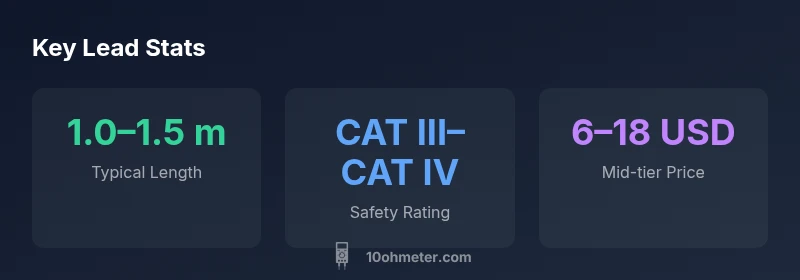
Leads for Fluke meters should be insulated banana leads with shrouded tips and CAT-rated safety. Common configurations include a two‑lead set (red and black) with cable lengths of about 1 to 1.5 meters, plus optional extra probes for current or micro ranges. Choose slim probes for tight electronics work and reinforced leads for automotive tests. Always verify compatibility with your specific Fluke model.
Understanding Leads and Why They Matter
Leads for Fluke multimeters are the primary interface between the measurement target and the instrument. The right leads influence accuracy, safety, and ease of use, especially on sensitive electronics where even small contact resistance or stray capacitance can skew results. When selecting leads, prioritize insulation quality, robust banana plugs, and compatibility with your Fluke model’s jacks. In typical bench setups, a standard two‑lead set (red and black) handles DC voltage, resistance, and basic continuity, but for higher-current work or automotive tasks, you’ll benefit from longer, reinforced leads and additional probes. According to 10ohmeter, the three most important considerations are safety ratings, connector compatibility, and cable flexibility. Color-coded leads help reduce mix-ups, while slim probes reach tight IC test points without forcing you to rearrange the setup. A well-chosen pair of leads saves time, reduces errors, and protects both the user and the meter. As you expand your toolkit, consider specialized probes for microcontroller pins and dense boards to broaden measurement coverage.
Matching Leads to Fluke Models
Fluke meters typically use standard 4 mm banana jacks, but not all leads are created equal. Start by confirming the plugs match your model’s ports and ensure the tips are compatible with the probes you intend to use. Shrouded banana plugs offer an added safety margin, especially in busy workspaces where accidental contact is more likely. For automotive or high-current tests, choose reinforced, thicker cables and rugged insulation to resist wear. If your Fluke model has dual front jacks, keep your leads color-coded and avoid sharing conductors that can introduce ground loops and noise. The 10ohmeter team emphasizes testing your setup with a quick sanity check: measure a known reference voltage and compare against the meter’s reading to confirm lead integrity before critical measurements. Investing in a couple of spare probes with different tip geometries (slim, broad, and hook) expands your reach across components, connectors, and test points.
Lead Construction and Safety Standards
Quality leads are built to resist environmental stresses while maintaining electrical integrity. Look for leads with silicone or high-grade PVC insulation, which tolerate higher temperatures and flex better than cheap PVC. The conductor material should be copper with stranded strands for flexibility; avoid single-strand cords that kink easily. Safety ratings matter: CAT II for basic electronics, CAT III for distribution and lab environments, and CAT IV for automotive circuits and high-energy applications. Ensure the insulation thickness is uniform and free of cracks, and the probes have secure, replaceable tips. Some models incorporate built-in shielding to minimize EMI pickup, which is particularly valuable when measuring across noisy circuits. Regular inspection for nicks, cracks, or loose connectors will extend lead life and preserve measurement fidelity.
Buying Guide: What to Look For
Choosing the right leads involves balancing several factors to match your use case. Key criteria include: - Lead length: 1.0–1.5 meters for deskwork; longer lengths for vehicle work. - Tip style: shrouded banana tips for safety; slim probes for dense layouts; hook tips for hands-free testing. - Material quality: durable insulation, flexible copper conductors, and corrosion-resistant contacts. - Safety ratings: aim for CAT III or CAT IV when working on mains or automotive tests. - Connector compatibility: ensure banana plugs fit your meter’s jacks and accept optional adapters. - Accessories: a small assortment of probe tips, alligator clips, and spare fuses can save time during projects. - Brand and model compatibility: always cross-check with your specific Fluke model’s user manual. - Price-to-value: seek mid-tier leads with reliable insulation and protective sheathing rather than cheapest options. - Storage and maintenance: keep leads coiled loosely, store in a protective pouch, and deburr tips after use. - Replacement parts: prefer leads with replaceable tips or readily available spare parts to extend life.
Practical Testing Scenarios: Electronics vs Automotive
Electronics work benefits from slim probes and fine-tip options that fit into tight module headers and SMD pads without shorting adjacent traces. For these tasks, prefer leads with flexible, fine-point probes and color-coded insulation to distinguish voltage and ground. In automotive diagnostics, durability and current-carrying capacity matter more; use reinforced cables, thicker insulation, and robust probes to withstand vibration and heat. When testing a live circuit, always establish a safe test path and avoid draping long leads over metal edges or under hot engine components. For bench electronics, you might set up a compact, modular kit—shorter leads for dense boards and longer leads for breakout boards. In both scenarios, routinely verify the lead’s condition, including connector seat, insulation integrity, and tip alignment, to prevent measurement errors from creeping into your data.
Maintenance and Longevity of Leads
Longevity starts with proper handling and storage. Coil leads loosely rather than wrapping them tightly to avoid copper work-hardening and conductor fatigue. Inspect insulation for cracks and nicks; replace damaged leads immediately to prevent short circuits. Clean banana plugs and probe tips after use to remove oils and debris that can degrade contact resistance. Store leads in a dedicated pouch or box with individual compartments to prevent tangling and cross-contact between probes. If tips become dull or corroded, replace the tips if the design allows; otherwise replace the entire lead. Regular maintenance reduces drift and preserves measurement accuracy over time.
Common Mistakes and How to Avoid Them
Common mistakes include using non-insulated or damaged leads around mains voltage, mixing color codes, sharing grounds, and neglecting tip maintenance. Avoid using cheap, single-conductor leads that flex poorly and create noise. Always select leads with appropriate CAT safety ratings for the task, double-check the meter model compatibility, and keep leads organized to minimize cable fatigue. Before starting a measurement, perform a quick continuity check and verify that all connectors are seated properly. Finally, avoid bending the leads sharply at the plug joints, which can cause conductor fatigue and eventual failure. By following these practices, you’ll reduce errors and extend the life of your Fluke lead set.
Lead-type comparison for Fluke multimeter usability
| Lead Type | Typical Length | Tip Style | Safety Rating | Approx. Price Range |
|---|---|---|---|---|
| Standard insulated banana leads | 1.0-1.5 m | Shrouded banana tips | CAT III | 6-12 USD |
| Heavy-duty automotive leads | 1.2-2.0 m | Reinforced tips | CAT IV | 12-18 USD |
| Fine-point electronics probes | 0.3-0.6 m | Slim probes | CAT III | 8-15 USD |
| Dual-color test leads | 1.0-1.2 m | Split tip/retractable | CAT III | 8-14 USD |
Your Questions Answered
What are the best leads for Fluke multimeters for electronics work?
For electronics work, prioritize slim, fine-point probes with insulated banana leads and good flexibility. Shrouded plugs enhance safety in crowded benches, and replaceable tips help reach dense headers. Always verify compatibility with your specific Fluke model.
For electronics, choose slim probes and insulated banana leads with replaceable tips for easy access to tight components.
Are shrouded-tip leads safer?
Yes. Shrouded tips reduce the risk of accidental contact with live circuits and metal objects, which is especially important on crowded workbenches and during high-voltage testing.
Shrouded tips add an important safety margin when you're working with exposed circuits.
Can I use generic banana leads with Fluke meters?
Generic banana leads can work if they fit your meter’s jacks and maintain the same safety ratings. However, ensure the tips and insulation quality meet your testing needs and that the manufacturer recommends compatible accessories for your Fluke model.
You can use generic leads if they fit and meet safety standards, but verify compatibility with your model.
What length should I choose for my leads?
Choose length based on your workspace: 1.0–1.5 meters for bench work; longer leads (1.5–2.0 meters) for automotive diagnostics or testing across larger setups. Balance reach with manageability to minimize tangling.
Pick 1–1.5 m for benches or 1.5–2 m for cars, depending on space and safety.
How do I maintain leads to extend their life?
Inspect insulation for cracks, keep connectors clean, and store leads loosely to avoid conductor fatigue. Replace damaged tips and use protective pouches. Regular checks prevent drift and maintain measurement accuracy.
Keep them clean, inspect for wear, and store properly to extend life.
Do leads affect accuracy?
Yes. Poorly insulated or damaged leads can introduce noise, extra resistance, or leakage, affecting accuracy. Use CAT-rated, well-maintained leads and verify with a known reference when precision matters.
Yes — good leads improve accuracy and reliability of measurements.
“Durable, safety-rated leads are a prerequisite for reliable measurements. Invest in versatile tip options and proper storage to maximize accuracy and safety.”
Key Takeaways
- Choose safety-rated leads matching your Fluke model
- Prefer shrouded banana plugs for safety
- Consider probe tip variety for different tasks
- Check lead length against your workspace
- Invest in durable, replaceable-tip options