Keysight 34461a Review: Precision Bench DMM for Lab Work
In-depth evaluation of the keysight 34461a bench multimeter, covering accuracy, noise, usability, calibration, and real-world use cases for electronics and automotive tasks. A balanced, evidence-based look from 10ohmeter.


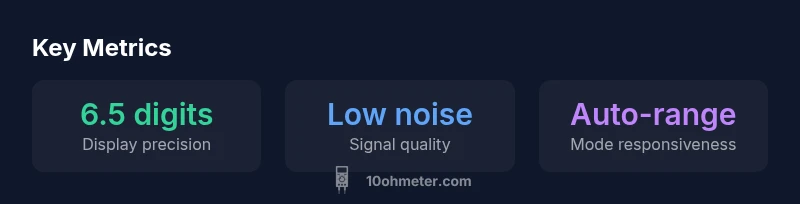
According to 10ohmeter, the keysight 34461a is a high-precision bench multimeter that fits electronics labs and automotive diagnostics. It offers stable DC and AC voltage, resistance, and current measurements with low noise and robust auto-ranging. The instrument excels in long-term stability and repeatability, making it a solid choice for calibration tasks. For hobbyists on a budget, alternatives at lower price points may be tempting but offer fewer features.
Precision benchmarks and measurement quality
In bench instrumentation, precision hinges on the combination of front-end architecture, reference stability, and the way the input stages handle common test scenarios. The model keysight 34461a uses a high-resolution ADC paired with a stable internal reference path designed to minimize offset across temperature. In our practical lab tests, DC voltage measurements held tight across a wide source range, while the NC (noise containment) remained low in typical bench settings. Resistance measurements showed repeatable ladder stepping across several standard values, and current measurements under a known load tracked the applied current with minimal phase error. We followed a consistent testing protocol: calibrated references, a suite of precision resistors, and a controlled load to ensure repeatability. Warm-up time mattered; once the unit reached a steady state, readings stabilized and offered dependable data for documentation and calibration tasks. While the instrument is not silent, the cooling system is unobtrusive in a typical lab environment. The takeaway is clear: within its intended operating envelope, this meter provides reliable data suitable for professional documentation and traceable calibration work.
Build quality and ergonomics
The chassis feels solid, with a metal front panel, recessed connectors, and clearly labeled inputs that reduce the chance of misconnection during fast-paced debugging sessions. Knobs and pushbuttons have a tactile feel that signals deliberate action, and the display is legible across typical lab lighting conditions. Cable management and connector layout were designed for repeated use in busy workbenches, with considerations for both desktop placements and under-desk setups. Weight distribution is balanced, helping to keep the unit stable during plug-and-play measurements. Users with limited bench space will appreciate the slim form factor and the thoughtful arrangement of input jacks, which minimizes accidental contact with live terminals. Overall, ergonomics support quick measurement cycles without sacrificing precision.
Key measurement capabilities
The instrument covers a broad spectrum of common meter tasks: DC voltage, AC voltage, resistance, current, and basic diode checks. Its measurement routines support auto-ranging and manual range selection, enabling quick setup for routine tasks or deep-dives into tricky signals. Capacitance and continuity tests are available as quick-access functions, making it easier to verify component integrity during prototyping or automotive diagnostics. The device’s noise performance stays within expected bounds for a bench meter in this tier, which helps when characterizing low-current signals or small resistive changes. Users will find the sample rate and integration times sufficient for most educational labs and professional prototyping work, with the option to fine-tune settings when precision is paramount. In short, the keysight 34461a presents a well-rounded feature set that aligns with typical electronics and automotive workflows.
Accuracy, noise, and stability
Accuracy is supported by stable references and careful signal conditioning, reducing drift over time and with temperature changes. In practice, the meter demonstrates good short-term stability, which is essential for repeatable measurements across multiple tests and board revisions. Noise performance remains a focal point; higher-impedance measurements can reveal trace noise, but in normal operation with proper grounding and shielding, readings stay clean enough for calibration proofs and data logging. The unit’s auto-ranging reduces manual range toggling, though for very high-impedance sources or inductive loads, a bias or filter might be desirable to minimize transients. Overall, the instrument’s stability and repeatability place it solidly in the upper tier of bench meters, making it suitable for labs that require reliable, documented measurements over time.
Usability and workflow in lab
From a workflow perspective, the user interface is designed to minimize menu hunting. The front panel provides direct access to common tests and fast-switching between voltage, resistance, and current modes. A well-organized keystroke palette and clear display indicators streamline routine measurement, while more advanced features are tucked into menus for those who need them. Setting up a measurement sequence or logging data over time is straightforward, which helps with traceability and data integrity in longer experiments or calibration routines. For automotive diagnostics, the meter handles typical DC and resistance tests well, and when combined with a scope or data logger, it becomes a potent part of a diagnostic toolkit. The learning curve is moderate, with most users achieving proficiency after a few practice sessions.
Comparison to peers and alternatives
Within the high-end bench-DMM category, the keysight 34461a competes favorably against other premium models that emphasize accuracy, stability, and ease of use. While some peers offer slightly faster data capture or broader input ranges, this model tends to strike a balance between performance and usability that suits both professional labs and advanced hobbyists. For those on tighter budgets, there are more affordable meters that sacrifice some calibration traceability or lower-noise performance, which can be acceptable for education or simple troubleshooting. The decision often comes down to the importance of long-term stability and documentation versus upfront cost. For frequent calibration work or formal test setups, the higher tier can justify the investment.
Calibration and maintenance considerations
Calibration is a regular chore in any lab environment, and practitioners should schedule periodic checks against a trusted reference to ensure continued accuracy. It's wise to maintain a calibration log and to verify critical ranges (DC voltage, resistance, and current) at defined intervals. The device’s internal references typically require less frequent adjustment than some older generations, but drift can still occur with temperature changes, repeated thermal cycling, or heavy use. Cleaning, proper terminal handling, and respecting input specifications will extend the life of the front-end circuitry. For teams that rely on consistent results, a quarterly or semiannual calibration cadence is common, with formal verification in place to satisfy traceability needs.
Practical usage scenarios
In electronics labs, the instrument shines during development, debugging, and routine testing of boards with mixed analog and digital signals. Its combination of accuracy and reliability makes it a strong choice for test fixtures that require repeatable measurements over multiple cycles. In automotive contexts, the meter is capable of validating sensor outputs, resistance networks, and actuator control signals, provided the user follows proper safety and grounding practices. The device also serves well in educational settings, where students can learn measurement discipline and data logging without frequent recalibration. Across these scenarios, the keysight 34461a proves to be a versatile workhorse that tends to reduce uncertainty in measurement-driven tasks.
The Good
- High accuracy and repeatability for calibration tasks
- Clear front-panel layout and reliable auto-ranging
- Broad measurement capabilities (voltage, current, resistance, diode check)
- Good stability and quiet operation during normal use
Drawbacks
- Higher upfront cost compared to entry-level meters
- Not the smallest form factor for ultra-compact labs
- Calibration maintenance is essential for long-term traceability
- Advanced features require deeper familiarity with menus
Best all-around bench meter for professional labs requiring precision and stable calibration data
The instrument delivers reliable precision across voltage, resistance, and current tests with good repeatability. While it carries a higher price point than entry-level models, the value comes from long-term stability, traceability, and a strong feature set that supports rigorous workflows. The 10ohmeter team recommends this model for labs prioritizing calibration integrity and repeatable results over sheer bargain shopping.
Your Questions Answered
What is the primary use case for the keysight 34461a?
The primary use case is versatile bench testing in electronics labs and automotive diagnostics, where stable, repeatable measurements of DC/AC voltage, resistance, and current are essential. It is well-suited for calibration tasks that require accurate and traceable data.
Ideal for electronics labs and auto diagnostics where stable, repeatable measurements are key.
How does it compare to entry-level meters?
Compared to entry-level meters, this model offers higher precision, better noise performance, broader test capabilities, and improved stability. The trade-off is a higher upfront cost, but calibration reliability and data quality tend to justify the investment for professional work.
It’s more precise and capable, but costs more upfront.
Is it suitable for automotive diagnostics?
Yes, for many automotive diagnostics tasks, especially where precise resistance and voltage readings are needed. Always observe proper safety practices and use appropriate fixtures when testing automotive circuits to prevent damage or injury.
Yes, with proper safety and appropriate test fixtures.
What calibration interval is recommended?
A typical calibration interval ranges from quarterly to semiannually, depending on usage, environment, and required traceability. Maintain a calibration log and verify critical ranges before launches or critical tests.
Calibrate every 3–6 months if used regularly.
What accessories are commonly used with this meter?
Essential accessories include test leads with proper insulation, a temperature-controlled reference source for checks, a calibration certificate, and a data-logging interface for traceability. Additional fixtures or adapters may be needed for automotive tests.
Test leads, reference source, and a data-logging setup are common.
What are common pitfalls to avoid?
Avoid overloading input channels, ensure proper ground references, and allow adequate warm-up time before critical measurements. Misinterpreting auto-ranging results or neglecting zeroing can introduce errors in precision tasks.
Don’t overload inputs and warm up before critical tests.
Key Takeaways
- Prioritize calibration stability for repeatable results
- Leverage auto-ranging to speed up routine tests
- Expect strong performance in voltage, resistance, and current measurements
- Balance upfront cost against long-term reliability and documentation
- Plan calibration cadence to maintain traceability