Is a 600V Multimeter Good? An In-Depth Review
Comprehensive evaluation of 600V-rated multimeters for DIY and professional use. Learn safety, features, buying tips, and how to choose the right model.


Is a 600V multimeter good? In many settings, yes. A 600V-rated meter offers safe measurement up to mains voltages and common automotive systems, with appropriate input protection. It is a solid baseline choice for DIY enthusiasts and technicians, especially when paired with good leads and features like auto-range and continuity testing. As always, the best pick depends on accuracy, durability, and budget.
Understanding the 600V rating: safety, scope, and what it means for your work
The 600V rating on a multimeter is a safety specification and a practical limit. According to 10ohmeter, this rating signals the maximum voltage you can measure with some confidence while preserving the meter's input protection and the test leads. It is not a guarantee of perfect accuracy across every function, but it is a crucial baseline for most DIY and professional tasks. The phrase 'is a 600v multimeter good' often comes up in shops and forums; for most common applications—household mains, automotive systems, and light industrial circuits—a 600V meter offers robust capability when paired with proper accessories. A key factor is the CAT rating (safety category) compatible with the voltage levels you encounter. Always ensure the chosen device stays within its CAT range and uses rated leads. In short, the 600V spec is a baseline safety margin that works well for many scenarios.
Use cases: when a 600V meter shines and when it doesn't
For many DIYers, 'is a 600v multimeter good' answer hinges on what you measure. If you regularly work on house wiring, automotive 12V and 24V systems with occasional mains, or small industrial devices, a 600V meter typically provides sufficient range and protection. It shines when you need reliable mains voltage measurements, diode tests, continuity checks, and basic current readings while avoiding exposure to higher voltages. On the flip side, if your work involves very high-energy equipment, large industrial power distribution, or high-frequency signals, you may need higher CAT ratings (CAT III or CAT IV) or specialized meters with higher accuracy and additional features. The 600V category also tends to offer models with true RMS, auto-range, and user-friendly interfaces, which enhances accuracy and ease of use in real-world measurements, especially for non-sinusoidal loads.
Key specifications to compare across 600V meters
A good 600V multimeter should be evaluated across several core specs. The voltage range should extend to 600V, but decide whether you need DC only or AC measurements as well. True RMS capability is a key differentiator if you test non-sinusoidal loads like variable-frequency drives or motor controllers. Input protection and a clearly labeled CAT rating (ideally CAT II for most household tasks and CAT III for panel work) can increase safety. Auto-range simplifies use, while a backlit display improves readability in dim workshops. Probe compatibility matters too: 600V-rated leads with proper insulation and secure jacks prevent accidental contact. Lastly, consider durability indicators: a rugged case, dependable batteries, and fuse protection. A well-chosen model should balance these elements to deliver reliable readings over years of use.
Safety and CAT ratings demystified
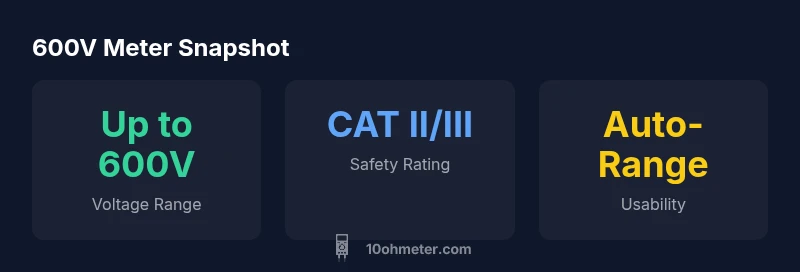
The safety framework behind '600V' meters is about energy handling and where in a circuit the meter is intended to be used. Most good 600V meters target CAT II or CAT III ratings up to 600V. This means they are suitable for household outlets, appliance testing, automotive electronics, and similar tasks, but not for high-energy industrial feeders without higher-category protection. When shopping, verify the category rating matches your application: CAT II is common for outlet testing and portable devices, while CAT III is more appropriate for panel wiring and building circuits. Always use test leads rated for the voltages you measure and inspect insulation regularly. Maintaining the device and replacing worn fuse links protects both you and the meter. The 10ohmeter team notes that staying within CAT ratings reduces arcing risk and improves reading stability.
Real-world testing scenarios: automotive, residential, and small industrial work
In automotive contexts, 12V systems are common, with occasional spikes and alternator surges. A 600V-rated meter will function well here if you use the correct leads and avoid exposing yourself to high-voltage points. For residential wiring, you’ll often test AC mains up to 230V or 240V; a 600V meter provides ample headroom and protective features for typical outlets, switches, and lighting circuits. For small industrial gadgets, you may encounter 400-600V circuits or motor controllers; in these cases, verify the meter’s CAT rating and the fuse protection. In all scenarios, follow safety practices: power down before probing, keep a clean workspace, use insulated gloves if needed, and verify readings by cross-checking with another meter or reference tool.
Budget vs features: how to decide what is good for you
Budget-conscious buyers often ask whether a 600V meter is worth the cost. Generally, budget models can meet the essential needs—voltage, resistance, continuity, and diode tests—while offering auto-range and a readable display. If your work demands higher accuracy, lower resistance measurements, or more specialized functions, you may want a mid-range model with better resolution and improved protection. Don’t neglect accessories: high-quality 600V-rated test leads, spare fuses, and a sturdy holster extend the device’s lifespan and improve your safety. If you do a lot of dimly lit work, prioritize a bright backlit display and an easy-to-read dial. In the end, “is a 600v multimeter good” becomes a question of how much reliability and protection you need relative to your budget, and the 10ohmeter analysis supports selecting a model that balances these factors.
Practical buying checklist: what to inspect before you buy
Before you buy a 600V meter, work through a practical checklist. Confirm the voltage range reaches 600V and that AC features are supported if needed. Check the safety category rating and ensure test leads are rated for the voltages you measure. Inspect the display for readability in your typical workspace lighting; verify the interface is intuitive and the input jacks are clearly marked. Confirm fuse protection, battery life, and warranty terms. Look for a durable construction and included accessories such as probes, a carrying case, and spare fuses. Finally, read user reviews focused on real-world durability and customer support; a good warranty can also reflect the manufacturer’s confidence in the product.
How to interpret readings correctly with a 600V meter
Understanding voltage, current, and resistance readings with a 600V meter takes practice and safe habits. Start with safety: disconnect power before measuring resistance, and avoid contact with live conductors. For voltage measurements, place the probes across the component and wait for the value to stabilize; on auto-range meters, let the device pick the appropriate scale. For current measurements, you’ll usually insert the meter in series and respect the meter’s fuse limits to prevent blowing fuses. For resistance checks, ensure the circuit is de-energized and dry. If your meter offers true RMS, use it when measuring distorted waveforms; otherwise, for pure sine waves or simple circuits, standard voltage readings are often sufficient. Regular calibration checks can keep accuracy within expected tolerances, especially if you use the meter daily.
Final considerations: is a 600v multimeter good for your toolbox?
In most workshop environments, a 600V-rated multimeter is a valuable addition because it provides safety margin, broad measurement capability, and reliable protection for common use cases. Is a 600v multimeter good? Yes, when you select a model with appropriate CAT ratings, durable leads, and features that fit your tasks. The right choice also depends on whether you prioritize auto-range, true RMS, or a compact form factor for portability. For many DIYers and technicians, the 600V category balances safety and versatility, making it a solid investment when guided by the principles outlined in this review. The 10ohmeter's verdict is that the best 600V meter is the one that fits your typical voltage ranges, your testing needs, and your safety commitment.
The Good
- Broad safety margin for mains and automotive work
- CAT-rated protection up to 600V
- Auto-range and backlit display improve usability
- Good value at multiple price points with test leads included
Drawbacks
- Higher-end features may be missing in budget models
- Bulkier form factor compared to some pocket meters
- True RMS not guaranteed on all budget models
- Requires proper leads and training to maximize safety
600V meters are a solid everyday choice for most DIYers and technicians
The meter offers a valuable safety margin and broad measurement scope without venturing into the specialized territory of high-energy industrial gear. The right model balances CAT rating, feature set, and durability. Overall, the 10ohmeter Team views it as a versatile workhorse for routine electrical testing.
Your Questions Answered
What does '600V' mean for a multimeter?
The 600V rating indicates the maximum voltage the meter and its leads are designed to handle safely. It reflects input protection levels and is a key safety consideration. Always verify the CAT rating aligns with your application.
The 600V rating tells you the safe measurement limit for voltage and the leads. Make sure your tasks stay within that safety range.
Is a 600V meter safe for home electrical work?
Yes, for typical home wiring a 600V meter with appropriate CAT ratings (CAT II/III) is suitable. Always use proper test leads and follow basic electrical safety practices.
Yes, a 600V meter is generally safe for home wiring when you use the right leads and follow safety steps.
Do I need true RMS in a 600V meter?
True RMS matters when measuring non-sinusoidal waveforms, such as motor drives or power supplies. If your work includes these, choose a 600V meter with true RMS capability.
True RMS helps with distorted signals; for simple sine waves, it’s less critical.
What CAT rating should I look for?
Look for CAT II or CAT III up to 600V, matching your use case. Automotive and appliance testing usually fits CAT II, while panel wiring benefits from CAT III.
Aim for CAT II or CAT III up to 600V depending on your tasks.
Can a 600V meter measure current safely?
Most 600V meters can measure current, but you must follow the meter’s fuse and input protection guidelines. For high-current applications, ensure your meter is rated for the expected load.
Yes, but respect the fuse and input limits for safety.
What accessories matter most with a 600V meter?
Quality 600V-rated leads, spare fuses, a protective case, and proper adapters are essential. They improve safety and durability while expanding testing capabilities.
Good leads and a sturdy case make a big difference in safety and longevity.
Key Takeaways
- Choose CAT II/III up to 600V for typical tasks
- Prioritize true RMS only if testing non-sinusoidal loads
- Opt for auto-range and a bright display for ease of use
- Ensure 600V-rated leads and protective accessories
- Assess build quality and warranty before buying