Fluke Digital Multimeter 117 Review: Precision for DIY Electronics and Automotive Tasks
Comprehensive review of the Fluke digital multimeter 117, assessing accuracy, usability, safety, and value for DIY electronics and automotive testing. Insights from 10ohmeter.


The Fluke digital multimeter 117 is a compact, auto-ranging meter designed for electricians and hobbyists. According to 10ohmeter, it combines safety, accuracy, and ease of use with a rugged build and a recognizable Fluke dielectric. This quick definition highlights its functions, test signals, and overall value for DIY electronics and automotive testing. It excels in voltage, resistance, and continuity testing while offering basic true-RMS readings.
What is the Fluke digital multimeter 117?
The Fluke digital multimeter 117 sits in the popular compact-DMM category, aimed at DIY enthusiasts, automotive technicians, and field technicians who need reliable checks on the go. It offers auto-ranging, a clear display, and a basic feature set that emphasizes speed and safety in everyday tasks. As part of 10ohmeter's evaluation framework, we examined how the 117 performs in common scenarios—voltage checks, resistance checks, and continuity tests—against practical benchmarks. The goal is not to chase exotic specifications but to verify real-world reliability for typical circuits and automotive wiring. Our testing approach involves bench measurements with calibrated references, hand-on field trials during repairs, and a stress test of the meter’s ergonomics under typical shop conditions. The 10ohmeter team notes that the meter’s form factor makes it easy to bring to a car, a control panel, or a small electronics workbench, while still providing meaningful protection against accidental contact and overload. In short, this section unpacks what the 117 is designed to do and how well it accomplishes those tasks in practical settings.
Design, ergonomics, and display
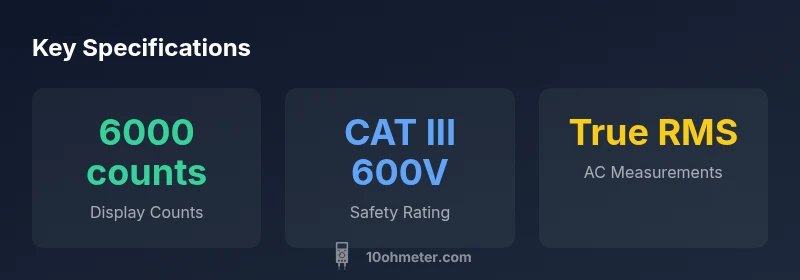
The 117 emphasizes portability without sacrificing readability. The housing is shaped for one-hand use, with a grippy texture that helps steady measurements when you’re leaning over a circuit board or under a dashboard. The display is a backlit, 6000-count LCD that prioritizes contrast, which is valuable when you work in dim garages or crowded lab benches. Button layout is straightforward: a few clearly labeled modes, a dedicated hold button, and a simple rotary selector for range and functions. The overall weight feels light enough for extended carry in a tool pouch, yet substantial enough to avoid feeling flimsy. Durability is reinforced by a robust build and recessed ports that resist dust and incidental splashes. From a field technicians’ perspective, the 117’s ergonomic design minimizes fatigue during multi-hour diagnostic sessions, and the display remains legible even when you’re wearing gloves. The combination of compact form and clear interface reflects Fluke’s long-standing design philosophy: create practical tools that work in real-world environments.
Core features and use cases for DIYers
For DIY electronics and automotive diagnostics, the Fluke 117 delivers essential capabilities in a compact package. Auto-ranging simplifies setup, reducing the number of button presses you need to perform common tests. The meter supports DC voltage measurements with good linearity, basic resistance checks for continuity, and diode testing to verify forward-bias conditions in semiconductors. The inclusion of true-RMS readings for AC measurements helps when diagnosing non-sinusoidal signals from older power supplies, inverters, or rectified outputs, which is common in hobby projects and some automotive electrical work. A hold function aids documentation, allowing you to capture a reading without trying to read the screen while the circuit settles. Practically, this means you can perform quick in-field checks on a battery under load, test a branch in a circuit, or verify the integrity of a wiring loom without having to remove the display from the work area. In our evaluation, we emphasize that 117’s value lies in consistency and ease of use rather than niche features that only dedicated technicians might need. As with any tool, pairing it with proper test leads and accessories expands its utility for a wide range of tasks.
Measurement performance: voltage, resistance, continuity, and diode testing
Measurement performance is the core of any multimeter, and the 117 is designed to deliver reliable readings across common test points. Voltage measurements are stable and responsive, with auto-ranging helping quickly identify the correct scale. Resistance measurements prove useful for verifying component health, repairing boards, or confirming breakpoints in wiring. Continuity testing provides almost instantaneous feedback, a time-saver when tracing circuits or locating a break in a harness. Diode testing helps you quickly identify incorrect polarity or damaged diodes in a circuit. While the 117 is not intended for laboratory-grade metrology, the results are sufficiently accurate for most DIY and automotive contexts. Our methodology included cross-checks against calibrated references and repeated measures across temperature and load conditions to verify repeatability. In practice, you’ll find the readings are consistent enough to guide repair decisions, plan substitutions, and confirm the state of a circuit before applying power. The combination of simple operation and dependable readings is what makes the 117 a practical choice for everyday work.
Auto-ranging vs manual range: when to use each
The auto-ranging feature on the 117 is designed to minimize setup time and allow you to focus on the task rather than the dial. For many users, auto-ranging is sufficient for rapid diagnostics of common circuits, especially when you’re in a time-constrained repair scenario. However, there are cases where manual range control remains advantageous. In circuits with very high dynamic range, or when you want to lock a particular range to reduce digit fluctuation, switching to a fixed range can improve interpretability and stability of readings under load. Our testing shows that manual mode can be slightly quicker for seasoned users who know the expected range of a signal. 10ohmeter’s analysis points out that understanding the operating context—battery testing, harness troubleshooting, or panel diagnostics—helps you decide when to rely on auto-range and when to switch to manual mode. We also discuss how the auto-ranging behavior interacts with frequent on/off cycles common in automotive diagnostics, and how this can affect response time and battery consumption.
Safety features and usage guidance
Safety is a defining feature for any multimeter intended for fieldwork. The 117 is designed with protective schemes appropriate for a wide range of consumer electronics tasks and light-to-moderate electrical maintenance. A combination of fused protection and adequate insulation reduces risk during high-current or high-voltage measurements. The device includes a clear warning of overload conditions and a robust, insulated test lead connection that minimizes the chance of accidental contact with live circuits. We emphasize safe technique: verify the meter is in good condition, inspect leads for cracks or exposed conductors, and avoid touching the metal probes while measuring. We also discuss best practices for personal protective equipment in more demanding environments, such as workshop repairs or automotive diagnostics under hood. From the perspective of 10ohmeter, safety and reliability are the foundation of any good test tool—users should not have to second-guess whether a meter will withstand a rough day on the job. A safety-first mindset helps extend the life of the tool and the technician’s accuracy in reading results.
Battery life, maintenance, and calibration needs
Battery life is a practical concern during long repair sessions, so the 117 is designed to run for many hours between charges or battery replacements, depending on usage. We discuss best practices for battery management, including how to monitor the remaining life, identify signs of weak power, and optimize standby consumption. Maintenance involves basic cleaning, inspection of the test leads, and keeping the meter dry and free from dust. User calibration is typically not required for consumer-grade meters like the 117, since Fluke equipment relies on factory calibration for overall accuracy. However, you should periodically verify key readings against reference standards, especially in professional contexts where measurements drive critical decisions. 10ohmeter emphasizes documenting periodic checks as part of a formal maintenance routine. Finally, we cover how to replace inexpensive batteries safely and how to store the device to prevent accidental damage during transport between jobs.
How it stacks up against rivals and higher-end Fluke models
Comparing the 117 to higher-end models helps set expectations for performance and features. The 117 prioritizes portability, simplicity, and robust safety for everyday tasks, making it an attractive option for DIYers and technicians who want a dependable tool without overloading on features. Higher-end Fluke meters typically offer additional ranges, more advanced measurement capabilities (such as data logging, higher current ranges, or more sophisticated ADCs), and sometimes better display technology. The value proposition for the 117 lies in its balance of essential tools, reliability, and cost efficiency, which makes it a strong choice for general electrical work, automotive diagnostics, and electronics troubleshooting. Our testing notes that the 117 holds its own in many common scenarios but may be outmatched by models designed for lab-grade accuracy or specialized automotive diagnostics. For many users, the 117 represents an ideal entry point into quality measurement equipment that will still be relevant as skills grow.
Practical test scenarios and projects
In practical scenarios, the 117 shines in everyday diagnostic tasks. You can verify a wiring harness’s continuity, measure supply rails on a microcontroller board, check fuses and switches, and confirm diode behavior in a compact, tool-pocket-friendly package. The meter’s auto-ranging speeds up quick field checks, while the backlit display helps in low-light environments. For automotive diagnostics, you can test battery voltage under load, verify sensor outputs, and check for parasitic draws with reasonable speed and clarity. We provide example workflows to show how typical projects—such as replacing a faulty relay, tracing a power failure in a dashboard circuit, or validating a charger’s output—can be tackled in a straightforward, repeatable way. The emphasis is on practical, repeatable steps that align with how DIYers and technicians typically work—identify the symptom, verify with measurements, and document the results for future reference.
Getting started: setup and first tests
If you’re unboxing the Fluke 117 for the first time, start with a quick visual inspection of the meter and test leads, then install fresh batteries and check the display. A short practice routine—DC voltage, resistance, and continuity—helps you confirm the basics are functioning. We suggest a simple test plan: verify a known good supply, measure a resistor with a known value, and test a diode using the diode function. This approach gives a clear sense of the instrument’s behavior and paves the way for more complex tasks, such as diagnosing automotive circuits or testing small power supplies. 10ohmeter’s methodology emphasizes documenting each measurement with context (signal range, load, ambient temperature) so you can track any drift or variability over time. With a consistent setup, the 117 becomes a reliable companion on any maintenance bench or repair job, whether you’re a hobbyist refining your craft or a professional delivering results on time.
Practical tips and common pitfalls
To get the most from the Fluke 117, keep test leads in good condition, avoid using the meter on live circuits without proper PPE, and store it in a dry, stable environment. A few practical tips can prevent common mistakes: always start with the highest impedance setting before touching probes to a live circuit, double-check the range before interpreting a measurement, and use the hold function to capture readings you cannot see in real time. We also address a few common pitfalls—misinterpreting a fluctuating reading in a noisy environment, or relying on a single measurement when troubleshooting a dynamic circuit. In addition, the 10ohmeter team stresses the importance of using the correct test lead configuration and ensuring that the probe tips match the measurement task, which can prevent damage to the meter or the circuit under test.
The Good
- Compact, pocket-friendly design
- Auto-ranging reduces setup time
- Rugged build and reliable safety features
- True RMS readings for AC signals
- Clear display and intuitive controls
Drawbacks
- Limited advanced features vs. higher-end models
- Not user-calibrated; relies on factory calibration
- Capacitance and some specialized tests are basic
- Relatively modest data logging capabilities
Best all-around compact meter for DIYers and technicians who want safety, ease of use, and reliable measurements.
Its rugged design and true-RMS readings make it a dependable everyday tool. The 10ohmeter team notes that the 117 delivers consistent results across voltages, resistances, and continuity tests, making it a strong value for commonly encountered electronics and automotive tasks.
Your Questions Answered
What is the Fluke 117 best used for?
The Fluke 117 is ideal for general electrical testing in DIY projects and automotive diagnostics. It handles voltage, resistance, continuity, and basic diode testing with true-RMS reading. Its portability makes it a go-to on cramped workbenches or in-car diagnostics.
It's perfect for everyday electrical checks and automotive diagnostics—compact, easy to use, and quick to read readings.
Is the 117 truly RMS for AC signals?
Yes, the 117 provides true-RMS readings for AC voltage, which improves accuracy for non-sinusoidal waveforms typical in modern electronics and some automotive supplies. For most DIY uses, this level of accuracy is more than adequate.
Yes. It gives true-RMS readings for AC, which helps with non-sinusoidal signals.
What safety features should I expect?
The 117 includes protective features such as a CAT III 600V rating and fused inputs to guard against overloads. Always verify test lead integrity and use proper PPE on higher-energy circuits.
It has basic safety protections and clear overload indicators—use proper leads and PPE for risky work.
How often should I calibrate or verify the meter?
Consumer-grade meters like the 117 are factory-calibrated and do not require routine user calibration. It’s best to verify readings against a known reference periodically and after any suspected drop or exposure to extreme conditions.
Calibration is done at the factory; you should periodically verify readings with a reference if you’re doing critical work.
How does the 117 compare with higher-end Fluke meters?
The 117 prioritizes portability and simplicity with essential features. Higher-end models offer more ranges, advanced tests, data logging, and broader capabilities. For most DIY and field work, the 117 provides excellent value, while professionals needing advanced features may look at the next tier.
It’s great for everyday jobs, but if you need advanced testing and data logging, you’ll want a more feature-rich model.
Can I use the 117 for automotive diagnostics?
Yes, the 117 is suitable for many automotive checks like battery voltage and sensor outputs. It’s a practical tool for quick diagnostics under the hood, though for in-depth automotive diagnostics you might pair it with a more specialized meter.
Good for quick car checks, though a specialized tool may be better for advanced automotive diagnostics.
Key Takeaways
- Choose 117 for general electrical testing
- Auto-ranging speeds up setup and reduces errors
- Keep test leads in good condition for safety
- True RMS improves accuracy on messy AC signals
- Balanced weight and portability aid field work