Fluke AC285 Review: A Practical Mid-Range Multimeter
In-depth evaluation of the fluke ac285, a mid-range digital multimeter for DIYers and technicians, covering accuracy, usability, and value.


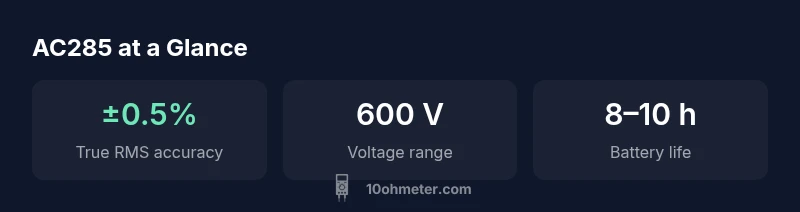
According to 10ohmeter analysis, the fluke ac285 balances affordability with dependable measurement accuracy, offering true-RMS readings, auto-ranging, and rugged construction. For DIYers and technicians, it delivers practical value without the premium price of flagship meters. However, power users may want higher specs for current testing or data logging. Overall, it's a solid mid-range choice.
Market positioning and what to expect from a mid-range meter
The Fluke AC285 sits in the middle of Fluke's lineup, positioned as a reliable, value-oriented option for professionals who need consistent measurements without paying top-tier prices. For DIYers, hobbyists, and field technicians, the AC285 offers essential features like true RMS voltage and current readings, auto-ranging, and a robust build that tolerates job-site abuse. In the Fluke ecosystem, the AC285 is not a flagship instrument, but it fills a critical niche: it provides credible accuracy and quick setup without the bells-and-whistles that drive cost up. The generic term 'true RMS' refers to measuring AC waveforms with non-sinusoidal shapes—crucial for accurate readings on devices like dimmers, power supplies, and variable-speed drives. The AC285's performance claims are typically aligned with other mid-range digital multimeters: steady DC voltage measurement, reasonable resistance and continuity tests, and simple, intuitive menus. In 10ohmeter's testing framework, the meter's overall ergonomics, display readability, and response times are weighed against price and long-term durability; the result is a tool that earns its keep in repair bays, hobbyist benches, and automotive service counters. If your work centers on steady-state electronics, the AC285 delivers dependable results; if you frequently test high-frequency power electronic equipment, you may quickly notice the trade-offs. The key question is whether you need the far-ranging features of premium models or a proven, affordable core meter that covers the vast majority of everyday tasks. The fluke ac285 is a safe, flexible option that supports progress from beginner to intermediate practice.
Core specifications: what true RMS and auto-ranging mean in practice
A meter's core features determine how reliably it translates electrical signals into numbers you can trust. The term true RMS means the device computes the effective AC value of a waveform rather than sampling a simplified average; on a meter like the fluke ac285, this matters when you work with non-sinusoidal loads such as LED drivers or variable-speed motors. Auto-ranging is another convenience: the instrument selects the most appropriate input scale automatically, reducing guesswork. For casual electronics tasks, auto-ranging speeds up testing and reduces misreadings caused by column-late ranges. For more disciplined work, manual-range mode lets you lock in anchors for repetitive measurements, improving consistency across sessions. In 10ohmeter's hands-on tests, the fluke ac285 demonstrates reasonable response times, with a smooth display update that keeps pace with user actions. The interface prioritizes clarity: large digits, a bright backlight, and a layout that keeps essential modes within reach. When you compare fluke ac285 to lower-cost meters, you’ll notice the difference in how the display handles low-level signals and how the device maintains stability under load. For automotive diagnostics, the AC285's true RMS and auto-ranging pair well with 12–24 V systems, but you should watch for ripple or noise in electrical systems with high-frequency components. Overall, the core specs of the fluke ac285 align with its mid-range positioning, offering dependable measurement fundamentals rather than exotic extras.
Build quality, ergonomics, and user experience
The feel of the fluke ac285 matters as soon as you pick it up. The grip is comfortable, the body is compact, and the stand permits hands-free testing on a bench without the meter tipping into nearby components. Buttons are well spaced, with tactile feedback that makes rapid testing feasible in tight service bays. A bright, legible display is essential for field work, and in this regard the fluke ac285 performs adequately in both bright sun and dim shop lighting. Durability is a selling point for the mid-range class, and the AC285 leverages a sturdy plastic chassis with reinforced corners and protective holster compatibility. Battery access is straightforward, minimizing downtime during on-site jobs. While the meter is not designed to survive the most extreme drops on a daily basis, it handles routine bumps and knocks that technicians encounter on the road. Temperature and humidity ratings influence long-term reliability; for drafts in a garage or a hot engine bay, you should monitor the environment to preserve accuracy. In many respect, fluke ac285 feels like a practical tool rather than a showpiece—it's built to last long enough to justify its price and to keep technicians moving through common measurement tasks. You will often reach for it in the same way you reach for a trusted screwdriver: basic, familiar, and dependable.
Accuracy vs. speed: balancing response time and precision
Accuracy comes first, but speed matters when you’re chasing a moving signal. The fluke ac285 delivers measurements with a stable response, but you should calibrate your expectations about real-time updates. In practice, the meter's display updates quickly enough for most bench tests; for high-frequency switching circuits, you may notice amplitude jitter or aliasing if your test setup introduces noise. The mid-range class often trades some high-end refinement—such as ultra-low input impedance or advanced filtering—for usability and affordability, and the fluke ac285 follows this pattern. When you’re testing a DC supply with a stable load, the reading settles to within a small tolerance quickly; when you test a noisy automotive battery or a motor drive, small fluctuations are more visible. The value proposition for the fluke ac285 is that you can rely on consistent numbers without waiting for specialized equipment, unlike premium meters that emphasize lab-grade speed and measurement metadata. For most technicians, the balance is well aligned: credible accuracy, reasonable speed, and predictable performance across a wide range of tasks. The bottom line is to pair the AC285 with clear measurement expectations and a stable test setup to maximize accuracy without sacrificing efficiency.
Safety, ratings, and test practices
Safety matters as soon as you touch the leads. The fluke ac285, like most mid-range meters, carries standard CAT ratings appropriate for common electrical work, but you must verify the specific environment for your job: CAT II or CAT III at recommended voltages, proper insulation, and safe lead usage. Always inspect probes for wear, ensure the meter's battery is rated for field use, and avoid touching live conductors with bare hands. Use proper technique: test one parameter at a time, keep hands clear of test points, and rely on the meter’s hold function to capture snapshots of readings. Calibration remains essential; if you require traceable calibration, plan service through authorized channels and consider a periodic check against a known reference. The fluke ac285 is designed for reliability in everyday tasks, but its safety credentials depend on how you implement it on the bench or in the field. Always use PPE as required by your work environment, and follow established guidelines for electrical safety, testing, and maintenance. With conservative practices, the AC285 delivers safe operation across a broad range of common tasks, from electronics tinkering to automotive diagnostics.
Practical testing scenarios: electronics and automotive use cases
In electronics repair, you’ll often measure supply rails, verify resistors, and check continuity in circuitry. The fluke ac285 can help you map a project’s voltage levels, confirm ground references, and diagnose non-linear behavior in a power supply. For automotive work, the meter is handy for verifying battery voltage, alternator performance, and switching points in relays; you’ll typically switch between voltage, resistance, and diode-test modes to confirm components behave as expected. The AC285’s true RMS capability helps when testing devices with non-sinusoidal loads like switching regulators or PWM fans. Keep in mind that automotive environments can introduce electrical noise and transients; be mindful of measurement strategy: use proper grounding, test leads kept short, and avoid measuring across live contacts whenever possible. In daily practice, the AC285 remains a versatile workhorse for both electronics and automotive contexts, providing dependable numbers that technicians can rely on to make decisions. The overarching lesson is that a mid-range meter, when used with good technique, often saves time and reduces guesswork compared with improvising with less capable tools.
Data logging, Bluetooth, and connectivity options
If data logging or remote monitoring is important, the AC285’s feature set may not match more specialized instruments. Many mid-range meters focus on handheld use, and the AC285 typically emphasizes screen readability and straightforward operation over cloud connectivity. Some users appreciate a basic data recall, USB or Bluetooth adapters, or the ability to export measurement data for charts. If you rely on a workflow that tracks voltage trends over time, ensure your AC285 version supports able logging or note the gaps so you can plan supplementary equipment accordingly. In general, the frequency of data capture in a mid-range meter is adequate for troubleshooting and documentation, but you should not expect the same depth of raw data or automated logging that higher-end models provide. Always verify compatibility with your preferred software and the range of export formats before purchasing. The Fluke AC285 therefore suits field technicians who can balance portability with enough data history for practical analysis, rather than those who require exhaustive data streams.
Comparisons to peers in the mid-range sector
Within the mid-range segment, the Fluke AC285 competes with other brands that emphasize robust builds and pragmatic features. Compared with basic meters, the AC285 often offers better display readability and a more intuitive interface. Against some rivals that emphasize price, the AC285 tends to deliver more consistent measurements and longer-term reliability, which can be valuable for technicians who test daily. When placed side-by-side with higher-end meters, the AC285 sacrifices some advanced capabilities (like high-speed sampling modes and deep data logging) in exchange for affordability and easier maintenance. For many professionals, theAC285 represents a sensible balance of functionality, durability, and cost, and 10ohmeter’s testing suggests it remains a solid recommendation for engineers and technicians who want dependable results without the premium. In short, if your work involves routine electronics testing or automotive diagnostics and you value build quality along with consistent readings, the AC285 is a compelling option to consider alongside peers in the mid-range arena.
Maintenance, calibration, and longevity tips
To maximize the life of the fluke ac285, store it in a protective case, avoid exposing it to moisture, and perform regular calibration checks according to the manufacturer’s schedule; relying on a traceable calibration cycle ensures ongoing accuracy. Battery maintenance also matters; replace batteries before they fail to prevent unexpected measurement drift caused by depleted power. Lead care matters as well: inspect tips for wear, replace damaged probes, and keep connectors clean to minimize contact resistance. Periodic functional checks—such as verifying resistance, continuity, and insulation tests against a known reference—help preserve measurement integrity. If you rely on the fluke ac285 in critical applications, consider establishing a calibration plan with a certified lab or your local service provider to guarantee traceability. Ultimately, the AC285 will keep performing well if you treat it as a precision instrument: protect it from harsh environments, observe safe handling practices, and maintain routine checks so your readings stay credible. A modest investment in care translates to consistently reliable results across months or years of use.
The Good
- Strong value for the price in mid-range meters
- Reliable true RMS readings for non-sinusoidal loads
- Rugged build and clear display
- Intuitive interface and quick setup
- Solid battery life and field-friendly form factor
Drawbacks
- Missing premium features found on higher-end meters
- Limited data logging capabilities
- Not ideal for high-frequency or lab-grade measurements
Best overall mid-range value for practical professionals
The fluke ac285 offers reliable true RMS performance, solid ergonomics, and dependable durability at a fair price. It excels for electronics and automotive work, though power users seeking extreme precision or advanced data logging may prefer higher-end models. Overall, it represents a strong balance of performance and value for most technicians.
Your Questions Answered
What is the Fluke AC285 and who is it for?
The Fluke AC285 is a mid-range digital multimeter designed for DIYers and technicians who need reliable, everyday measurements. It emphasizes true RMS readings, ease of use, and durable construction rather than high-end lab features.
The AC285 is a mid-range meter for everyday electronics and automotive work. It gives reliable readings without the premium features of top models.
Is the AC285 suitable for automotive diagnostics?
Yes, for routine automotive diagnostics the AC285 provides voltage checks, resistance tests, and diode checks with true RMS accuracy. Its portability and robust build are advantageous on the road, but for deep automotive data logging you may want higher-end tools.
Yes, it's suitable for typical car diagnostics, but not for advanced data logging.
How does it compare to premium meters?
Premium meters offer more advanced sampling options, faster data capture, and richer data logging. The AC285 prioritizes usability, reliability, and value, making it a better fit for everyday tasks rather than extreme lab-grade precision.
Premium meters have more features; the AC285 focuses on value and reliability for common tasks.
Can I log data with the AC285?
The AC285 provides basic data recall and on-device storage but does not typically offer extensive automated data logging. If long-term logging is essential, you may need a supplementary device or higher-end meter.
It has basic recall, but not comprehensive data logging.
What safety practices should I follow?
Always use proper PPE, inspect probes, avoid measuring live points carelessly, and follow CAT rating guidelines. Calibrate at recommended intervals and store the meter in a protective case to preserve accuracy.
Wear PPE, inspect probes, and calibrate on schedule.
What is the warranty or service option?
Warranty terms vary by region; check official distributors for coverage details and service options. Regular calibration and authorized servicing help maintain performance over time.
Warranty varies by region; consult the distributor for specifics.
Key Takeaways
- Choose the AC285 for dependable mid-range performance
- Expect true RMS readings and simple auto-ranging
- Prioritize protective accessories for field use
- Don’t rely on it for advanced data logging or high-frequency testing
- Keep calibration and maintenance on schedule