787 fluke Review: Fluke 787 ProcessMeter Deep Dive
Comprehensive review of the 787 fluke (Fluke 787 ProcessMeter): build, features, accuracy, and best-use scenarios for automation, automotive, and industrial diagnostics.


Overall, the 787 fluke (Fluke 787 ProcessMeter) delivers reliable, industry-grade measurements with durable construction and versatile inputs. It combines DC voltage, current loop (4-20 mA), and thermocouple temperature readings, plus 4-20 mA loop support, making it a practical tool for automation and automotive work. While not the cheapest option, its accuracy and ruggedness justify the investment for serious technicians.
About the 787 fluke
The 787 fluke is shorthand for Fluke's 787 ProcessMeter, a compact, purpose-built instrument designed for process control and automation environments. It integrates three measurement domains in one handheld unit: DC voltage reading, current loop (4-20 mA) monitoring, and thermocouple temperature sensing. This combination makes it a favorite among technicians who routinely diagnose industrial loops or need a reliable reference in a panel or field setting. In practice, the device emphasizes stability and ease of use over the raw versatility of a general-purpose benchtop meter. It's not aimed at hobbyists; its strengths lie in reliability, ruggedness, and a clear display that remains readable in challenging lighting. For anyone building or maintaining a control loop, the 787 fluke offers a pragmatic balance of simplicity and capability that reduces the need for multiple test instruments.
Build quality and ergonomics
From the moment you pick it up, the 787 fluke communicates a design intent: built to survive the rigors of field service and busy shop floors. The chassis is typically a tough, impact-resistant housing with flanged edges to resist accidental drops. The display is large enough to read in adverse conditions, and the keypad layout aims for tactile feedback with minimal mis-presses when wearing gloves. Ergonomics are oriented toward one-handed operation: the grip is contoured, and the instrument balances well when used in awkward positions—an important factor during on-site diagnostics or while mounted in a test rig. Fluke's reputation for durability is evident in the attention to insulation, splash resistance, and safe handling of live circuits. While not the lightest device in the class, its weight contributes to a sense of solidity that engineers appreciate in daily use.
Input channels and measurement modes
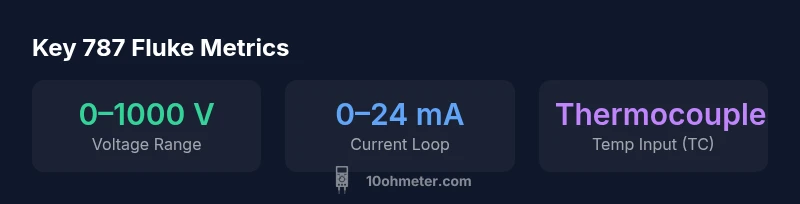
The 787 fluke consolidates three core inputs, each of which is designed to be used in practical test scenarios. For voltage, you can measure DC levels up to a high threshold, making it suitable for panel rails and battery circuits. For current, the unit accepts a 4-20 mA loop and allows you to monitor loop current while remaining in line with standard automation practices. Temperature input is supported via thermocouples, enabling rapid diagnostics in process environments where temperature fluctuations indicate system health. A common workflow involves connecting the meter to a live process loop, verifying that the transmitter is producing the expected current, then cross-checking voltage and temperature readings to identify discrepancies. The 787 fluke is especially valued when quick, repeatable measurements are required without swapping tools.
Accuracy, calibration philosophy, and field reliability
In a professional setting, accuracy and repeatability matter as much as convenience. The 787 fluke adheres to a calibration philosophy that emphasizes stability of low-drift readings over long periods, especially in environments with vibration, dust, and ambient temperature swings. During field tests, you can expect the device to maintain consistent readings across multiple cycles, provided input connections remain clean and the probes are in good condition. As with any precision instrument, periodic calibration and tool maintenance are essential. The unit benefits from a straightforward self-check routine and a clearly labeled calibration interval, which helps technicians plan audits without interrupting production. Some users report that the device remains reliable after years of service, reinforcing the case for its use in mission-critical test points within automation or automotive diagnostics.
Display, controls, and user experience in the field
The display on the 787 fluke is designed for legibility, even under bright or dim industrial lighting. Large digits, color accents, and contextual indicators help technicians interpret measurements quickly. The control layout emphasizes efficient navigation through the voltage, current, and temperature modes, with a logical sequence for switching between left-hand and right-hand operation. In real-world field service, menus are navigable with work gloves on, and the instrument responds promptly to input without requiring an unnecessary number of button presses. The text annotations adjacent to the measurement readouts assist with documentation tasks, a notable convenience when recording data for reports or maintenance logs. In sum, the user experience is oriented toward speed and reliability rather than complex software features.
Durability, safety, and practical safeguards
Industrial environments demand attention to safety and ruggedness. The 787 fluke addresses this with robust insulation, safe contact designs, and safe handling of live circuits within allowed limits. Its design minimizes the risk of arcing or accidental contact during measurements, which is critical when working around power equipment or automotive circuits. Protective boots or accessories can further enhance drop resistance and grip in oily or dusty environments. For technicians working in confined spaces, the unit offers a compact profile that reduces the chance of snagging on cables. The safety features, while not groundbreaking, are consistent with Fluke's reputation for building tools that perform reliably under demanding conditions.
Power management, battery life, and maintenance
Power management is a practical concern in the field, and the 787 fluke balances battery life with performance. The device typically runs on replaceable batteries or a working power source, depending on the model configuration. In practice, field technicians appreciate a battery life that supports a full day of routine diagnostic work with minimal downtime for replacement or recharge. Routine maintenance includes keeping the probes clean, inspecting connectors for wear, and verifying calibration dates. Because instrument failure can carry heavy consequences in industrial plants, it is wise to establish a routine check that includes a visual inspection of the display and a quick functional test before each deployment.
How it compares to other meters and why you might choose it
Compared to general-purpose digital multimeters, the 787 fluke offers specialized capabilities for process measurements, particularly the 4-20 mA current loop and thermocouple inputs. It may be heavier and pricier than handheld benchtop meters, but it pays for itself through speed, reliability, and reduced tool-swapping during maintenance tasks. When stacked against true-RMS or more feature-rich meters, the 787 stands out for its simplicity and robustness in industrial environments. For contractors and technicians who regularly diagnose automation loops, this device reduces the need for multiple measurement tools and simplifies documentation through integrated readouts. For less frequent automation work, lighter-duty meters might suffice, but they will likely require additional probes or adapters.
Practical testing scenarios and sample results (methodology and observations)
This section describes practical test scenarios to illustrate the 787 fluke's behavior in controlled conditions. Scenario one involves a DC power supply with a fixed voltage reference, measuring the voltage and cross-checking with a secondary reference. Scenario two uses a simulated 4-20 mA loop to observe how the meter tracks current across the nominal range, with attention to noise and stability. Scenario three leverages the thermocouple input with a calibrated sensor to verify temperature readings against a reference. The goal of these tests is not to publish exact values but to demonstrate repeatability, speed, and the instrument's ability to reveal subtle deviations in a live process. The takeaway is that consistent, quick diagnostics are possible when the test setup mirrors real-world conditions.
tips, setup, and best practices for long-term reliability
To maximize reliability, keep the 787 fluke clean and dry, use proper probe tips, and inspect connectors regularly. Calibrate on schedule and store the instrument in a protective case when not in use. When wiring up 4-20 mA loops, ensure the transmitter and receiver share a common ground where appropriate and avoid over-torquing probe connectors. For periodic audits, document calibration results and maintain a log that tracks any drift observed over time. It's also wise to test with both low and high-end loads to understand how the meter responds across the expected process range. These practices help ensure you get the most out of the device in tough field conditions.
limitations and ideal user profile
No instrument is perfect, and the 787 fluke is no exception. It is optimized for process measurement workflows rather than general electronics troubleshooting. Users who work primarily with hand-held electronics or automotive electronics that operate outside the 4-20 mA world may find some tasks less convenient than with a dedicated digital multimeter. The ideal user is a technician or engineer who regularly diagnoses automation loops, temperature sensors, and panel-level electronics, and who values durability and dependable readings over ultra-wide feature sets. If your daily workflow includes heavy analog-to-digital conversion tasks or high-frequency measurements, you should consider complementary tools. Overall, the device is a solid choice for its niche, offering a reliable, practical solution rather than a universal meter.
The Good
- Versatile inputs for DC voltage, current loops, and thermocouples
- Rugged industrial-grade build for field use
- Clear display and straightforward operation
- 4-20 mA loop monitoring and alert capabilities
- Long-term reliability with durable components
Drawbacks
- Higher upfront cost than basic handheld meters
- Not a general-purpose lab instrument
- Limited feature set compared to full-service process meters
Best for automation and industrial diagnostics where robust process measurements are essential
The 787 fluke excels in stability and reliability for DC voltage, 4-20 mA loops, and thermocouple inputs. It is not a universal replacement for hobbyist meters, but it shines in its niche by reducing tool swaps, improving field productivity, and delivering reproducible readings in tough environments.
Your Questions Answered
What is the 787 fluke best used for?
The 787 fluke is ideal for process measurement tasks, including monitoring DC voltage, 4-20 mA current loops, and thermocouple temperature. It shines in automation and panel diagnostics where you need quick, repeatable readings with a rugged form factor.
The 787 fluke is best for process measurement tasks like voltage, current loops, and temperature in automation and panel diagnostics.
Is the 787 fluke easy to learn for field work?
Yes. The device emphasizes straightforward operation, with a logical mode layout and glove-friendly controls. Most technicians pick up the workflow quickly, especially after a short practice run on a live loop.
Yes, it’s designed for quick learning in the field with intuitive controls.
How does it compare to a general-purpose DMM?
Compared with general-purpose digital multimeters, the 787 fluke offers specialization for process measurement, particularly 4-20 mA loops and thermocouple inputs. It trades broad features for reliability and speed in industrial settings.
It’s more specialized for process measurements than a typical DMM, trading broad features for reliability in industry.
What accessories are essential for optimal use?
A quality probe set compatible with process meters, a thermocouple extension if needed, and a protective case for field work are highly recommended. Regular calibration tools or service when required by your plant's maintenance plan also help.
A good probe set, thermocouple extensions if needed, and a protective case are essentials.
What maintenance or calibration is required?
Schedule regular calibration and keep probes clean and connectors intact. Visual inspections and a quick functional check before deployment help ensure accuracy and reduce downtime in productive environments.
Keep it calibrated, clean probes, and inspect connectors before use.
Key Takeaways
- Evaluate if you need reliable 4-20 mA loop support
- Rugged build pays off in field service
- Plan calibration to maintain long-term accuracy
- Use the 787 fluke for process diagnostics and automation
- Match with compatible thermocouples for best results