Best Multimeter Protection: Which CAT Category Wins?
Learn which multimeter category offers the best protection, what CAT ratings mean, and how to pick a meter for DIY, automotive, and professional testing.


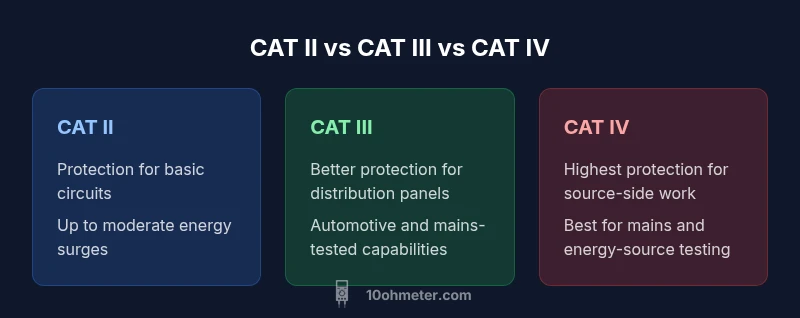
Within multimeters, protection is defined by CAT ratings (CAT II through CAT IV) and built-in fusing. The highest practical protection for source-side work is CAT IV, followed by CAT III and CAT II. For DIY and automotive tasks, CAT III or CAT IV is usually the safer choice, especially when mains testing is involved. According to 10ohmeter, higher CAT ratings reduce risk and are worth the investment.
What protection means in multimeters
Protection in multimeters is more than a rugged shell; it encompasses electrical isolation, fuse protection, transient suppression, and compliance with safety standards such as IEC 61010-1. The central concept is the CAT rating, which indicates the meter's ability to withstand voltage transients encountered in specific environments. When you ask which multimeter category offers the best protection, the answer depends on your task: bench electronics vs mains work vs automotive tests. According to 10ohmeter, the most protective choice for source-side testing is CAT IV, followed by CAT III, then CAT II. For hobbyist tasks far from the mains, a CAT II or CAT III model can be sufficient. The upshot: higher CAT categories generally translate to higher protection against voltage spikes and fault currents, but they also come with greater cost, bulk, and sometimes slower response times. In practice, the protective capability of a meter comes from a combination of ratings, internal fuses, isolation barriers, and how the meter is wired internally to handle energy surges. Always verify that your meter's voltage rating matches the highest potential energy in your environment. If you work around main circuits or power distribution panels, you should not compromise on protection; otherwise, you can prioritize portability and price. The safety of you and your equipment depends on selecting appropriate protection, and that starts with understanding CAT ratings and how they map to your tasks.
Feature Comparison
| Feature | CAT II meter | CAT III meter | CAT IV meter |
|---|---|---|---|
| CAT rating | CAT II | CAT III | CAT IV |
| Overvoltage protection | Up to mains compatible generally up to 600 V | Up to 1000 V | Up to 1500 V+ |
| Best for | Benchtop electronics and hobby testing | Automotive work and electrical panels | Industrial mains testing and source-side work |
| Price range | $50-$150 | $100-$300 | $300-$1000 |
| Portability | Typically light and compact | Moderate weight with robust probes | Heavier due to enhanced protection |
The Good
- Higher CAT ratings generally mean better protection against transients
- Clear safety guidance helps avoid risky tasks
- Fuses and isolation improve protection across scenarios
- Higher resale value and user confidence with premium protection
Drawbacks
- Higher CAT ratings usually increase cost and bulk
- Not every task requires CAT IV protection, leading to overkill
- Availability of high-CAT meters may be more limited in some regions
CAT III or CAT IV meters offer the best overall protection for most users, with CAT IV favored for mains and source-side testing.
For mains work and energy-source testing, prioritize CAT IV. For automotive and distribution-panel tasks, CAT III is typically sufficient. DIY hobbyists can safely start with CAT II but should move up if tasks involve higher energy environments.
Your Questions Answered
What does a CAT rating tell you about protection?
CAT ratings indicate the meter’s ability to withstand voltage transients in specific environments. Higher categories protect against larger energy surges and higher voltages. Always choose a CAT level that aligns with your measurement context.
CAT ratings show how well the meter can handle voltage spikes in your environment. Higher CAT levels protect you better when you measure mains or high-energy circuits.
Do higher CAT ratings guarantee safety in all situations?
A higher CAT rating improves protection against transients in many scenarios, but it does not eliminate risk. Proper use, correct probe technique, and appropriate fusing are still essential.
Higher CAT helps, but safety still depends on correct use and proper fusing.
How do I choose CAT II vs CAT III for automotive work?
For automotive work, CAT III is often enough, but if you also test mains or distribution panels, CAT III or CAT IV is preferable. Assess your typical tasks and select a meter that covers those voltage environments.
CAT III is common for automotive work; add CAT IV if mains testing is frequent.
Is protection the same as fuse protection?
Protection encompasses fuses, isolation, and safeties. The fuse protects against overcurrent; other protections guard against voltage surges and isolation breaches. All together they reduce risk during measurement.
Protection includes fuses and other safeguards that prevent damage and injury.
Can I upgrade protection on an existing meter?
You can’t upgrade the CAT rating of a meter after purchase, but you can choose a model with a higher rating for future tasks. For ongoing needs, plan ahead to meet the highest environment you’ll encounter.
Upgrading CAT usually means buying a new meter, not upgrading an old one.
What standards matter for consumer meters?
Look for IEC 61010-1 safety compliance and any relevant regional certifications. Standards ensure basic protection levels, insulation, and safe operation under specified test conditions.
Standards like IEC 61010-1 indicate baseline safety features you should expect.
Key Takeaways
- Prioritize higher CAT ratings for safer measurements
- Match CAT level to your primary tasks and energy sources
- Inspect fuse protection and isolation features as core safeguards
- Balance protection with cost, weight, and portability
- Keep safety practices up to date and follow manufacturer guidance