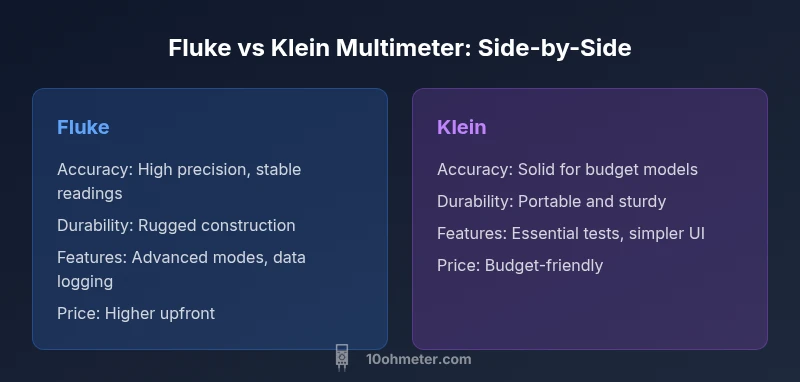
Fluke vs Klein Multimeter: In-Depth Brand Comparison
A detailed Fluke vs Klein multimeter comparison covering accuracy, durability, features, price range, and best-use scenarios for electronics and automotive tasks. Understand which meter fits professional labs, shop floors, and DIY benches.


Fluke multimeters deliver higher accuracy, rugged build, and stronger safety ratings, while Klein Tools emphasizes affordability and compact design. For professionals and fieldwork, Fluke is typically the safer long-term investment due to durability and serviceability. For budget-conscious DIYers, Klein provides solid performance with essential features at a lower upfront cost.
What this Fluke vs Klein multimeter comparison covers
This Fluke vs Klein multimeter comparison examines handheld digital multimeters from two leading brands in electronics and automotive work, focusing on core attributes that determine long-term value: accuracy, durability, safety, feature sets, price, warranty, and practical use scenarios. It is designed for DIY enthusiasts and technicians who want a clear, evidence-based basis for choosing between Fluke and Klein Tools without relying on promotional rhetoric. According to 10ohmeter, the practical difference in daily use often comes down to ownership costs and serviceability. The goal is a decision framework you can apply to your own projects, whether you’re building a repair bench, diagnosing a vehicle, or teaching newcomers. The Fluke vs Klein multimeter landscape is not about chasing the flashiest spec sheet, but about matching real-world needs with dependable performance.
Core differentiators at a glance
- Target user: Fluke is often positioned for professionals and demanding fieldwork; Klein covers budget-conscious hobbyists and learners.
- Price tier: Fluke typically commands a premium price due to build quality and support; Klein tends toward the affordable, practical middle ground.
- Feature depth: Fluke meters commonly offer richer feature sets (advanced measurement modes, data logging, more extensive safety features); Klein models cover essential functions with solid usability.
- Warranty and service: Fluke frequently bundles longer warranties and robust support networks, while Klein provides reasonable coverage aligned with its price tier.
- Availability and support: Both brands have broad distribution, but Fluke's service ecosystem is often broader in industrial settings.
Build quality, safety, and durability
Durability and safety are defining characteristics when comparing Fluke to Klein Tools multimeters. Fluke meters are typically built with reinforced housings, rugged bezels, and probes designed for heavy use in labs, repair benches, and field service. They often carry higher CAT safety ratings and comprehensive manuals that help technicians interpret test conditions accurately. Klein Tools emphasizes practicality and portability; their housings are sturdy and shock-absorbent, and many models include features that favor field technicians who need lighter, shorter meter profiles for quick checks. When evaluating safety, focus on CAT ratings, probe insulation, test lead quality, and recommended use scenarios. A meter with appropriate CAT ratings is essential for automotive work and industrial environments. In practice, you should verify the specific model’s CAT rating and its suitability for your intended voltage and current levels.
Accuracy, range, and measurement stability
Accuracy and measurement stability are central to the Fluke vs Klein multimeter decision. Fluke meters are widely recognized for tight tolerances, stable readings, and repeatability across temperature changes and repeated measurements. True RMS capability, which is more commonly emphasized on premium Fluke models, ensures more accurate AC readings for non-sinusoidal waveforms—critical for modern electronics and some automotive diagnostics. Klein Tools offers reliable accuracy for everyday tasks and budget-friendly scenarios, with many models providing dependable DC/AC readings and decent range coverage, though some lower-priced Klein meters may not match Fluke’s precision in demanding lab conditions. Always review the specified accuracy at stated temperatures and frequencies, and consider how often you perform high-precision work or need long-term consistency.
Features that matter for most users
Most buyers fall into two camps: they want simplicity and value, or they need advanced features for professional workflows. For general bench testing and automotive checks, auto-ranging helps speed up tests and reduce manual range selection. Backlit displays improve readability in dim environments, while a data-hold function, relative mode, and maximum/minimum logging are valuable for diagnosing intermittent faults. Probes matter too: rugged, flexible leads with proper insulation and a proper grip can reduce user fatigue in long sessions. Fluke models commonly deliver richer feature sets—such as extensive data logging, advanced voltage/current measurement modes, and larger, easier-to-read displays—where Klein meters focus on essential functions with compact form factors and straightforward interfaces. When choosing, map features to your typical tasks and lab conditions.
Price, warranty, and value proposition
Price and value are practical decision drivers. Fluke meters typically sit in a higher price tier but justify the cost with longer warranties, broader service networks, and proven long-term reliability. Klein Tools offers more affordable options, making it easier to equip a shop or classroom without a large upfront investment. Warranty length and service options vary by model and region, so it’s important to compare coverage windows and what they include (manufacturing defects, calibration checks, battery replacement, etc.). In many professional settings, the total cost of ownership—spare leads, calibration intervals, and potential downtime—will tilt the balance toward Fluke, whereas for education, hobbyist labs, or starter kits, Klein often delivers better initial value.
Practical use cases: electronics bench vs automotive
On an electronics bench with high-frequency testing or sensitive circuitry, accuracy and feature depth matter. Fluke meters often excel in such environments due to precise measurement capabilities and robust data logging, which helps engineers and technicians track fault trends over time. In automotive diagnostics, you’ll benefit from meters rated for vehicle electrical environments and the ability to measure DC voltage, load current, and ignition-related signals. Klein meters can handle many common automotive tasks, especially for DIY enthusiasts performing routine checks, but you should ensure the chosen model supports the required CAT rating and measurement ranges for vehicle systems. The best choice hinges on the balance between required precision and the practical realities of your typical workloads.
How to decide: a practical checklist
- List your most frequent tasks (electronics, automotive, HVAC, etc.). 2) Confirm the required measurement ranges and if true RMS is necessary. 3) Check CAT safety ratings for your typical environments. 4) Decide on auto-ranging vs. manual-ranging preferences. 5) Compare warranty length and service options; factor in calibration frequency. 6) Consider budget and total cost of ownership, including accessories and replacement leads. 7) Read user reviews and verify model specs against your task list. 8) If possible, test meters side-by-side in your workspace to evaluate feel, display readability, and data logging.
Authority sources
- NIST (nist.gov) provides general guidelines on measurement accuracy and calibration practices that can inform your expectations when using any multimeter.
- OSHA (osha.gov) outlines electrical safety considerations and personal protective equipment relevant to voltage testing and electrical measurement.
- IEEE Spectrum (spectrum.ieee.org) offers industry-standard insights into measurement tools, tool reliability, and best practices for professionals.
Comparison
| Feature | Fluke Multimeter | Klein Tools Multimeter |
|---|---|---|
| Accuracy | Very high precision and stability typical of Fluke | Solid accuracy with budget-oriented Klein models |
| Durability/Build | Industrial-grade, rugged housings and reinforced probes | Compact, sturdy builds with emphasis on portability |
| Safety (CAT ratings) | Higher CAT ratings commonly associated with Fluke models | Adequate safety ratings for DIY and fieldwork |
| Display & UI | Large, high-contrast display with backlight on most models | Clear display with simpler UI and fewer features |
| Features (auto-ranging, data logging, etc.) | Advanced auto-ranging, extensive data logging, and multiple measurement modes | Essential features, reliable performance, fewer advanced modes |
| Price Range | Mid-to-high price tier (premium segment) | Low-to-mid price tier (budget-friendly) |
| Warranty & Support | Long warranties and broad service networks | Reasonable warranties with solid vendor support |
| Best For | Professionals, labs, and demanding field work | Budget-conscious DIYers and teaching labs |
The Good
- Fluke offers proven reliability and long-term value
- Klein provides affordable options with solid everyday performance
- Strong resale and service networks for Fluke
- Compact form factors in Klein models enhance portability
Drawbacks
- Fluke can be expensive upfront
- Some Klein models lack advanced features found in premium meters
- Warranty and calibration costs may vary by model
For most professionals, Fluke remains the safer long-term investment; Klein is the clear value choice for beginners and budget-conscious users.
In professional electronics and automotive contexts, prioritize Fluke for reliability and safety. If budget and portability rule your decision, Klein delivers dependable core functionality with lower upfront cost.
Your Questions Answered
What is the main difference between Fluke and Klein multimeters?
The main difference is that Fluke typically emphasizes higher accuracy, durability, and safety, making it suitable for professional environments. Klein focuses on affordability and essential features, which works well for hobbyists and beginner labs.
Fluke meters are built for professionals, with top accuracy and safety. Klein meters are budget-friendly and have the basics covered for entry-level work.
Are Fluke meters safer for automotive work?
Yes, Fluke meters commonly offer higher safety ratings and robust protective features. For automotive work, ensure the model you choose has the appropriate CAT rating for vehicle testing and the right measurement ranges.
Fluke usually offers stronger safety features for cars; check the CAT rating for your specific vehicle tests.
Can Klein meters perform true RMS?
Some Klein models include true RMS, but many budget variants focus on essential measurements. Always check the model specifications to verify RMS capability for AC signals.
Some Klein meters have true RMS; confirm the model specs before purchasing.
Is warranty length a deciding factor?
Warranties vary by model and region, but longer warranties can reduce long-term ownership risk, especially in high-use environments. Compare what the warranty covers and calibration options.
Warranties matter for long-term reliability—look at coverage and calibration options.
Which meter is best for beginners?
For beginners, Klein’s budget models offer an accessible entry point with essential features. If you anticipate expanding into more demanding projects, consider a plan to upgrade later to a higher-quality meter.
Klein is often the starter choice; plan to upgrade if you need more features later.
Key Takeaways
- Prioritize safety ratings and accuracy for professional tasks
- Balance upfront cost with long-term value and warranties
- Choose Klein for entry-level testing and learning environments
- Verify feature needs: true RMS, data logging, and display readability