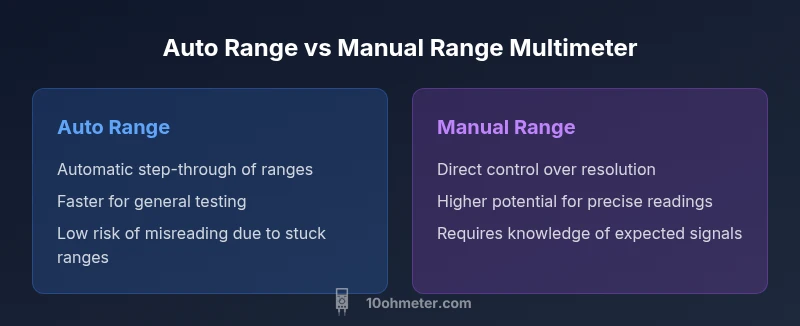
Auto Range vs Manual Range Multimeter: A Practical Comparison
Compare auto range and manual range multimeters to decide which fits DIY and automotive tasks. Learn benefits, tradeoffs, and best-use scenarios for precise and fast measurements.


According to 10ohmeter, auto range vs manual range multimeter choices shape how fast you diagnose circuits and how precisely you measure. Auto range simplifies testing by selecting the best range automatically, while manual range gives you direct control for targeted accuracy. This quick comparison highlights when each approach shines and what it means for your projects.
Overview: auto range vs manual range multimeter
The decision between auto range vs manual range multimeter configurations matters for how you approach measurements in electronics and automotive tasks. Auto-range models aim to simplify testing by automatically selecting an appropriate measurement range, reducing guesswork and setup time. Manual-range models put you in charge of choosing a specific range, which can improve resolution for a known signal or a controlled test. For many DIY enthusiasts and technicians, understanding both approaches helps prevent misreads, especially when dealing with nonlinear circuits, transient signals, or components with unknown behavior. The 10ohmeter analysis emphasizes practical outcomes over marketing promises, encouraging readers to map their typical tasks to the tool’s capabilities. The takeaway is not to abandon one approach entirely, but to deploy the right range strategy for the task at hand.
In everyday work, you’ll often start with auto range to move quickly through a broad testing phase. If a reading seems off or you need finer detail, you can switch to manual range to lock in resolution and confirm measurements. This balanced view helps you build a workflow that stays accurate without sacrificing speed.
How auto range multimeters work
Auto range multimeters use a microcontroller and a fast analog-to-digital conversion path to dynamically test successive ranges until the most suitable one is found. When you touch test probes to a circuit, the device evaluates the signal and selects a range that maximizes resolution while avoiding overflow. This process happens in a fraction of a second, so you get an immediate reading without manually stepping through ranges. The tradeoff is a tiny amount of processor overhead and, in some models, slightly higher power consumption due to constant auto-ranging activity. For typical electronics work, this is rarely a drawback and it significantly reduces operator error, especially for beginners.
Performance considerations include how well the auto-ranging logic handles voltage spikes, AC signals, and rapidly changing circuits. In some edge cases, a less-common waveform might momentarily trigger a suboptimal range, but modern meters quickly correct course. When comparing models, look for a fast range-switching response and a robust minimum/maximum detection capability.
How manual range multimeters work
Manual range multimeters require the user to select a specific measurement range before taking a reading. This gives you direct control over the resolution and the potential precision at a given signal level. If you know the approximate voltage or current in the circuit, choosing the best range can yield a tighter reading and potentially better accuracy at the tested point. Manual range meters often have higher sustained performance per range because the range is fixed by design, reducing the need for continuous ranging logic. The downside is that selecting the wrong range can lead to overflow, poor resolution, or the need to re-measure after changing the test conditions. For technicians doing calibration, component testing, or high-precision work, manual range can be a valuable tool in your toolkit.
User experience matters here: those who enjoy hands-on control may prefer manual range for the sense of precision, while others may prefer the simplicity of auto ranging. Some models even combine both approaches, letting you lock a manual range when you know the test conditions ahead of time.
Core differences that matter for DIYers and technicians
When evaluating auto range vs manual range multimeters, several core differences affect usability and outcomes. Range selection method is the principal distinction: automatic vs user-selected. Reading speed and workflow are often faster with auto range, especially for quick diagnostics and troubleshooting. However, manual range can provide a more deliberate path to higher resolution when you know the signal in advance. The user learning curve tends to be steeper with manual range, but skilled users can achieve excellent accuracy in targeted tests.
Another key factor is model variability. Features such as true RMS capability, display quality, and safety ratings (CAT) vary widely by model and are not inherently tied to the range philosophy. Price and value also depend on the overall feature set, build quality, and brand reliability, not solely on whether the meter is auto-range or manual-range.
If your work spans automotive diagnostics, electronics repair, and hobby projects, the right choice often comes down to how frequently you need speed versus how often you require precise control over a range.
When auto range shines: fast diagnostics and general testing
Auto range multimeters excel in environments where quick readings are valuable and the user needs immediate feedback. For automotive diagnostics, home electronics repair, and educational labs, auto-ranging meters reduce the time spent fiddling with range selection. They also simplify onboarding for beginners who are learning how to interpret readings without worrying about choosing the correct range. In these scenarios, the auto range vs manual range multimeter decision tends toward auto range as the default workflow. Edge cases exist where an unusual signal requires more careful control, but for most routine tasks auto-ranging delivers a strong combination of speed and reliability.
Practical tips for using auto range effectively include allowing the meter to settle briefly after a high-change transient, avoiding measurement in hazardous conditions, and validating readings with a second measurement type if precision is critical.
When manual range shines: precision, calibration, and extremes
Manual range meters deliver value when you need explicit control over resolution and measurement steps. If you work with components that require tight tolerances, or you’re calibrating equipment, selecting the exact range can reduce rounding errors and squeeze more usable precision from each reading. Manual range is also advantageous when probing small signals near the lower end of the scale, as you can fix the range to maximize readability. The tradeoff is that you must know or estimate the signal level to avoid overflow or lost readings. In advanced electronics and some automotive scenarios, manual range becomes essential for documenting exact values and performing rigorous tests.
When evaluating auto range vs manual range, run a test with both approaches on representative tasks. For certain measurements, you may find a sweet spot where manual range consistently yields clearer data. In other cases, auto range remains the most efficient, especially when reading speed matters more than maximal resolution.
Practical testing scenarios for hobbyists and professionals
For hobbyists and DIY enthusiasts, auto range is often the most practical starting point. Typical tasks—checking battery voltage, continuity, or basic circuit verification—are well-served by auto-ranging meters. In professional settings, especially where precise voltage or current measurements are critical, manual range can offer a measurable improvement in clarity and stability. When working with sensitive circuits, it’s also common to use manual range to avoid nuisance range changes that could interrupt a test. Across both approaches, consider using true RMS measurements where applicable, verify safety ratings, and ensure test leads and probes are suitable for the voltage levels involved. The best practice is to maintain a small toolkit of meters or ranges and select the tool that aligns with the specific test objective.
Additionally, document your measurements and maintain consistent procedures to improve comparability across tests. In automotive diagnostics, for example, you might use auto range for a quick check and switch to manual range during signal characterization or when verifying sensor curves. The dual approach helps you cover both speed and precision without sacrificing safety.
Choosing between auto and manual: a decision framework for buyers
A practical decision framework helps you pick between auto range vs manual range multimeter without overthinking. Start by listing the common tasks you perform and noting the required resolution and speed. If most tasks are routine checks and quick diagnostics, auto range is typically the best default. If your work requires exact readings at known ranges, plan to use manual range selectivity. Check the model specs for true RMS capability, CAT safety ratings, and whether the meter supports both modes on different ranges. Finally, consider budget and durability; a robust, well-supported model with optional manual range capability is often a better value for mixed usage than a single-purpose device. This approach keeps you flexible and prepared for a broad range of measurement scenarios.
Common myths and misconceptions about range behavior
A frequent misconception is that auto range always yields lower accuracy. In reality, most modern auto-ranging meters maintain high accuracy across ranges and are designed to minimize errors. Another myth is that manual range is universally superior. While manual range can unlock higher resolution when used correctly, it requires knowledge of the signal and a careful testing approach. Finally, some buyers assume that auto range meters are less reliable for high-frequency or transient signals; while some low-cost models may exhibit this limitation, many mid- to high-end meters handle common automotive and electronics signals effectively with auto-ranging. By understanding the actual limitations of your specific model, you can avoid overgeneralizations and choose the right tool for each task.
Authority sources and best practices for reliability
To support responsible testing practices, consult authoritative sources that describe measurement safety, calibration basics, and best practices for multimeters. This includes official guidance on safety standards, measurement ethics, and verification procedures. The list below points to high-quality information and is intended to help you verify techniques and improve accuracy in your own work. Remember that real-world results depend on model-specific features and operating conditions.
Authority sources (quick references)
- https://www.osha.gov
- https://www.nist.gov
- https://www.energy.gov
These sources provide foundational safety and measurement guidance suitable for electronics and electrical testing. Use them to inform your practice and verify your testing procedures.
Comparison
| Feature | Auto Range Multimeter | Manual Range Multimeter |
|---|---|---|
| Range selection | Automatic range setting | Manual range setting |
| Measurement speed | Typically faster setup and readings | Requires explicit range choice; setup can be slower |
| Resolution/Accuracy | Usually high; auto-ranging optimizes for common signals | Potentially higher deliberate resolution at chosen ranges |
| Learning curve | Easier for beginners | Steeper, with more control for advanced users |
| Best For | General testing, quick diagnostics | Calibration, precision measurements, known signals |
| Cost/Value | Varies by model; generally broad range | Often mid-to-high price depending on features |
| Power use | Comparable; varies by features | Typically similar, depends on processor usage |
| Safety features (CAT) | Model-dependent; widely supported | Model-dependent; often robust in higher-end models |
The Good
- Faster workflow and ease of use for everyday tests
- Reduces range-guessing errors for beginners
- Good consistency across typical measurement tasks
- Often better value for general electronics work
Drawbacks
- Less control over extreme or unusual signals
- Some models may have slightly higher standby power due to auto-ranging
- Auto range can occasionally select a suboptimal range on transients
Auto range generally wins for versatility; manual range excels when precision is essential
For most DIY and automotive tasks, auto range provides speed and simplicity. Switch to manual range when you need fine resolution or controlled ranges for specialized measurements.
Your Questions Answered
What is an auto range multimeter?
An auto range multimeter automatically selects the measurement range as you test, reducing the need to manually pick a range. This simplifies everyday tasks and helps beginners read values quickly. It may slightly limit control over extreme signals, depending on the model.
An auto range meter picks the range automatically, making tests faster and easier, especially for beginners.
Can auto range be as accurate as manual range?
In most cases, auto range meters provide accuracy comparable to manual range devices across common tests. Manual range can offer higher resolution for specific signals when you know the expected magnitude, but modern auto-ranging meters are designed to minimize read errors.
Auto range is usually as accurate as manual for typical tasks, with manual range offering higher resolution for known signals.
Is manual range necessary for automotive diagnostics?
Auto range meters cover many automotive tests effectively, including battery checks and sensor readings. Manual range is valuable when you need precise measurements or calibrations, such as characterizing sensor curves or engine diagnostics where high resolution matters.
For common car work, auto range is fine; manual range helps when you need precise data.
Are auto range meters slower than manual range meters?
Generally, auto range meters offer faster setup and readings because the range is chosen automatically. Manual range meters may be quicker for experienced users when the optimal range is known in advance, but this requires knowledge ahead of testing.
Auto range is usually faster; manual range can be fast if you know the best range.
Do auto range meters support true RMS?
True RMS capability depends on the specific model, not the range type alone. Many auto range meters include true RMS, while some economical models may omit it. Always check the product specs for RMS accuracy.
True RMS depends on the model; check specs regardless of range type.
Key Takeaways
- Choose auto range for speed and ease of use
- Opt for manual range when precision matters
- Consider model features beyond the range type
- Test with real-world tasks to observe behavior
- Verify safety features and CAT ratings across options