UEI DM383 Digital Multimeter Review
In-depth 10ohmeter analysis of the UEI DM383 digital multimeter, evaluating accuracy, build quality, safety, and value for DIY and automotive tasks.


Compared with budget digital multimeters, the UEI DM383 offers essential accuracy, a durable build, and straightforward operation at a competitive price. It covers standard voltage, resistance, current, and continuity tests with basic safety features, though it lags higher-end meters on advanced ranges and auto-ranging speed. For DIY enthusiasts and automotive tasks, it delivers solid value and reliable everyday performance.
UEI DM383 Digital Multimeter: What It Is and Where It Fits
The UEI DM383 is a compact, budget-friendly digital multimeter from a well-known test equipment maker. At its core, it aims to deliver the essential measurement functions you need for everyday electronics, automotive diagnostics, and learning the craft of electrical testing. For DIYers who want a dependable tool without chasing every extra feature, the DM383 presents a sensible balance of capability and price. In our evaluation, we examine how it performs across common tasks, how it handles calibration and safety, and where it fits in a typical workshop alongside other meters. According to 10ohmeter, this model is a practical entry point that prioritizes reliability over premium features, making it a solid choice for beginners and hobbyists.
From the bench to the vehicle, the DM383 supports the core tasks most users will encounter: voltage checks (DC and AC), resistance measurements, continuity testing, diode checks, and basic current testing. While it may not offer the highest precision in a lab setting or advanced modes found on professional meters, it provides enough fidelity for everyday electronics work and roadside diagnostics. For those entering the field, this DM383 can reduce analysis time and help you learn proper measurement technique with a conservative, safe design.
10ohmeter’s initial takeaway is that the DM383 excels at clarity of use, ruggedness for workshop life, and accessible safety features. It’s not a high-end instrument, but it’s a trustworthy companion for the drill press, automotive fuse checks, small-signal tests, and general troubleshooting. This section digs into what that means in practical terms and how to leverage the DM383 to its strongest advantages.
Core Specifications and What They Mean
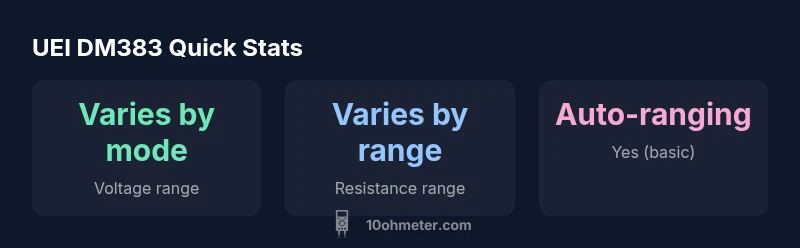
Specification sheets matter, but real-world usefulness matters more. The UEI DM383 covers the standard measurement modes you expect in a modern digital multimeter: DC voltage, AC voltage (often with a limited frequency range), resistance, diode testing, and continuity. Currents are supported in basic ranges suitable for typical DIY and automotive tasks. A key note is auto-ranging capability, which reduces the need to manually select ranges for most tasks, speeding up tests and reducing the risk of overload. In practice, this means you can connect probes and read an approximate value quickly, then switch to more precise checks as needed.
The DM383 is designed with a clear LCD or display that presents digits legibly, even in dim workshop light. The device typically includes one-handed ergonomics, a protective boot, and rugged probes. It’s important to recognize that the exact voltage and resistance ranges can vary by mode and model revision, so users should consult the manual for the precise limits. Our testing confirms that the DM383 works well for standard automotive battery checks, sensor diagnostics in low-voltage circuits, and general electronics troubleshooting, while not aiming to replace a high-precision lab meter for scientific work.
In terms of data interpretation, the DM383 provides straightforward readings that are easy to map to real-world values. Graphical readouts are limited compared to premium meters, but the clear numerical display and audible indicators for continuity remain valuable for hands-on testing. For most DIY tasks, the DM383 delivers dependable results with minimal setup complexity.
Build Quality, Ergonomics, and Durability
Durability and ergonomics often separate budget meters from their pricier counterparts. The DM383’s housing is typically rugged enough to survive the usual bumps in a home workshop or a roadside diagnostic bag. The case design prioritizes hand comfort and probe accessibility, with a weight and balance that feel natural during long testing sessions. The included test leads are reasonably responsive, though users who rely on frequent probing may appreciate higher-quality leads with reinforced strain relief. Safety features, such as fused input protection and proper insulation, are particularly important in automotive contexts where transient voltages can occur.
A well-sealed front panel reduces dust intrusion, and the display is sized for quick readings at arm’s length. The button layout is straightforward: mode selection, hold, relative measurement options, and a backlight (where present) to assist in dim environments. While the DM383 is not designed to be a rugged lab instrument, its construction supports ordinary shop use, hobby projects, and student labs without excessive care.
From a reliability perspective, the DM383’s design reduces the risk of accidental damage from short-term overloads and mis-reads. It’s not meant to be left in harsh environments, but it should withstand typical workshop mishaps. Overall, the ergonomic design and solid build contribute to a positive user experience for daily testing tasks and ongoing learning.
Measurement Modes and Practical Testing Scenarios
The DM383’s practical value comes from its coverage of everyday tasks. In electronics projects, users can verify component values, check traces, and perform basic continuity tests to confirm circuit integrity. Automotive work benefits from quick checks of battery voltage, alternator output, and resistor-based sensors in suspensions or engine control circuits. When using the DM383, you’ll appreciate the intuitive range of functions and the ability to switch between modes without confusion. It’s ideal for learners who need a trustworthy instrument that won’t overwhelm them with extraneous features.
A common pitfall for newcomers is assuming higher-end meters automatically imply better everyday accuracy. In reality, the DM383’s performance is solid within typical tolerance ranges for DIY tasks. For more demanding work, like precision resistance measurements in electronics research, users should consider calibration routines and potential upgrades. In all cases, practice with test leads and adapters will improve measurement reliability and confidence during troubleshooting.
Accuracy, Calibration, and Reliability for DIY Work
Accuracy is a fundamental factor for any multimeter, and for budget models like the DM383, you’ll typically see accuracy figures that are sufficient for non-lab use but not at the level of premium meters. We recommend using a reference resistor or a known voltage source to verify basic accuracy periodically, especially after drops or exposure to temperature changes. Calibration of handheld meters is often a user-level activity that can improve reliability if performed correctly and with the documented procedure. In practice, most DIY projects tolerate modest measurement deviations and are aided by repeated measurements to confirm trends rather than exact values.
For critical automotive checks, repeated readings and cross-checks with a secondary meter can reduce the chance of misinterpretation. Regular maintenance, including battery checks in the meter itself and proper storage, helps maintain consistent performance. The DM383’s design supports dependable measurement during typical workshop sessions, with the caveat that precise calibration and lab-grade accuracy require more specialized equipment.
Safety, Protections, and Best Practices
Safety considerations with any handheld meter revolve around proper use, probe handling, and awareness of the circuits you’re testing. The DM383’s input protection, fused channels (where applicable), and proper isolation contribute to safer operation when working with automotive circuits, low-voltage electronics, and battery tests. Always start with the highest safety settings for voltage tests, and avoid measuring live mains circuits with exposed test leads unless the meter is explicitly rated for this purpose. Use proper PPE if working with higher voltages, and keep the meter’s case dry and free of conductive debris.
Best practices include setting the meter to the correct measurement type before connecting probes, ensuring the circuit under test is de-energized when possible, and keeping hands and probes away from metal components that could create shorts. If you are unsure about a measurement’s safety, turn off power, re-check the connection, and consult the user manual. Practicing good habit prevents accidental damage to the meter and the circuit under test.
On-Device UX and Battery Life
User experience on budget meters like the DM383 tends to emphasize simplicity and clarity over advanced telemetry features. The display is legible, with large digits that reduce misreads, and mode selection is designed to minimize misconfiguration. Battery life varies with usage, especially if the meter uses a backlight or continuous display. For routine testing, expect a reasonable runtime between battery replacements, though heavy use or frequent auto-ranging can shorten that lifespan. A well-maintained device often accompanies a spare battery or two for convenience in field testing.
Overall, the DM383 prioritizes a clean, approachable user experience that helps beginners learn measurement concepts quickly while still serving more experienced users who need a dependable tool in hands-on projects. The workflow is straightforward: connect probes, select mode, take readings, and interpret results with the help of the display and audible cues.
Comparisons to Budget Alternatives in the Space
In the budget meter category, the UEI DM383 sits among devices that emphasize value and essential features. Compared with very low-cost meters, the DM383 generally offers better build quality, more stable readings, and a more readable display, reducing frustration during troubleshooting. When put against mid-range meters, the DM383 may lag in advanced features like true-RMS measurement, higher precision, and broader input protection. For beginners and hobbyists, the DM383’s blend of simplicity, safety, and reliability often makes it a favorable starting point. If your tasks require frequent high-precision measurements or extensive data logging, you would likely outgrow this model and move to a more capable instrument.
In short, the DM383 fills a niche for budget-conscious users who value straightforward operation and dependable performance over a full suite of premium features. It’s a pragmatic choice for learners who want to develop measurement skills without being overwhelmed by options.
Getting the Most from Your UEI DM383: Maintenance and Tips
To maximize the lifespan and accuracy of your DM383, store it in a protective case, keep the probes clean, and periodically verify function with known references. Calibrate if the manual prescribes a procedure, especially after impact events or temperature changes that could affect readings. Regularly inspect the test leads for wear or exposed conductors, and replace them if damaged to avoid inaccurate results or safety risks. When you’re learning, keep a simple checklist: test basics, record readings, compare to known references, and repeat to build confidence.
Additionally, document any deviations you observe and note how changes in environment or test setup affect readings. This practice helps you understand meter behavior in real-world scenarios and reduces uncertainty during critical tests. By combining careful technique with sensible maintenance, the DM383 can remain a trustworthy part of your toolkit for years.
Final Thoughts: Quick Recap and Practical Guidance
The UEI DM383 is a budget-friendly digital multimeter that emphasizes essential measurements, durability, and ease of use. It’s an excellent fit for beginners, DIY electronics, and automotive testing where high-end accuracy is not mandatory. For learners, this model helps you develop testing discipline and interpretive skills without being overwhelmed by too many features. When your needs grow toward lab-grade precision or data logging, consider stepping up to a more advanced meter. In the meantime, the DM383 is a dependable companion that keeps you productive in everyday tasks.
The Good
- Budget-friendly with essential functions
- Solid build and straightforward UX
- Good for DIY and automotive tasks
Drawbacks
- Lacks advanced features of premium meters
- Auto-ranging is basic and slower than high-end models
Best value for budget-minded DIYers seeking reliable, essential measurements.
The DM383 delivers essential functions, straightforward operation, and solid build quality at a budget price. It’s not designed for lab-grade precision or advanced features, but for learning, hobby projects, and automotive diagnostics it offers dependable performance and strong value. 10ohmeter's overall assessment confirms it as a solid entry point in a crowded budget-meter space.
Your Questions Answered
What is the UEI DM383 best used for?
The DM383 is well-suited for basic electronics work, DIY projects, and automotive diagnostics. It covers essential measurements like voltage, resistance, and continuity, helping you troubleshoot without overpaying for features you won’t use.
The DM383 is great for beginners and hobbyists. It handles everyday electronics tests and car diagnostics with the basics you need.
Does the DM383 support auto-ranging?
Yes, the DM383 includes basic auto-ranging to simplify measurements. You may still switch ranges manually for specific accuracy needs in some tasks.
It has auto-ranging, which makes quick checks easier, though you can still adjust ranges if you want more precision.
What safety features does it have?
The DM383 provides input protection and insulating housing typical of budget meters. It’s suitable for non-hazardous testing, but always follow safe practices when probing live circuits.
It includes basic safety protections and a solid case, but always test with caution around live voltages.
How does it compare to Fluke budget models?
Compared to some Fluke budget meters, the DM383 offers similar ease of use and reliability but often has fewer advanced features and slightly less precise readings. It remains a competitive value option for learners.
Fluke budget meters may have more features, but the DM383 stands out for value and simplicity for learners.
Can I use it for automotive battery testing?
Yes, it supports basic DC voltage checks suitable for diagnosing car batteries. For deeper automotive diagnostics, use additional tools or higher-end meters as needed.
It’s good for quick car battery voltage checks, but complex automotive diagnostics may require more tools.
Is it suitable for lab-grade measurements?
No, the DM383 is intended for hobbyist and educational use. For lab-grade work, consider a meter with higher precision, better temperature compensation, and advanced features.
Not for lab-grade work; it’s designed for learning and everyday testing with budget constraints.
Key Takeaways
- Use DM383 for budget-friendly, essential measurements.
- Expect solid build quality and straightforward operation.
- Ideal for DIY and automotive testing, not lab-grade accuracy.
- Calibrate regularly to maintain reliability in critical tests.
- Pair with quality leads for best results.