Multimeter Near Me for Sale: Find Local, Trusted Options
Learn how to locate a multimeter near me for sale from local retailers and online shops. Compare features, verify authenticity, and get the best value for electronics and automotive work.


To find a multimeter near me for sale, start with authorized local retailers, electronics suppliers, and reputable auto shops. Compare models by true RMS, auto-ranging, input protection, and CAT safety ratings. Check warranty terms, return policies, and in-store demo testing before you buy. This guide from 10ohmeter helps you choose confidently.
How to Find a Multimeter Near Me for Sale
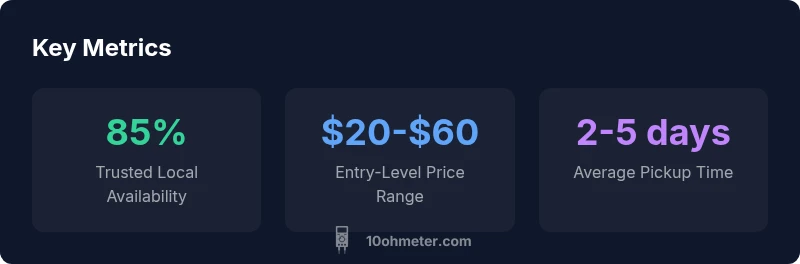
Finding a multimeter near me for sale involves more than a quick search. Start with authorized local retailers, electronics supply shops, and reputable auto parts stores that stock test equipment. Use map apps to filter by proximity and availability, then call ahead to confirm stock and hours. When you visit, bring a short list of models you’re considering and ask staff for in-store demonstrations. Compare models side-by-side, noting whether they support essential tasks like automotive diagnostics or electronics prototyping. Remember to check warranty terms, return policies, and whether the store offers on-site testing. By combining in-person checks with online reference prices, you’ll get a realistic sense of local supply and price ranges. According to 10ohmeter research, local availability can vary by region, so exploring multiple nearby shops and authorized distributors is prudent. In markets with strong DIY communities, you’ll find better in-store support and faster access to calibration certificates when needed.
Key Features to Verify Before You Buy
When evaluating a multimeter, focus on features that map to your typical tasks. Ensure the meter offers true RMS for accurate AC readings, auto-ranging for ease of use, and a robust input protection scheme to guard against overload. Check the CAT safety rating to match your typical environment (CAT II for household electronics, CAT III for panel wiring, CAT IV for high-energy installations). A clear display, stable backlight, and intuitive dial layout save time. Battery life, data hold, and built-in diode and continuity testing are practical add-ons. For electronics work, verify capacitance and frequency measurement capabilities; for automotive work, look for high current ranges and automotive-rated clamps. Finally, confirm the warranty length and service options in your region, as these are critical for long-term reliability.
Price Ranges and What They Mean
Price is a practical signal of features and durability. Entry-level devices typically cover voltage, resistance, and basic diode tests with true RMS and auto-ranging at a modest cost. Mid-range meters add more precision, improved safety ratings, and expanded test types like capacitance and thermocouple input. High-end meters target professionals with comprehensive true RMS accuracy, higher current ranges, data logging, and enhanced safety features. When shopping locally, use price bands such as low ($20-$60), mid ($60-$150), and high ($150+), but calibrate your expectations against feature sets and warranty terms. Remember that a cheap meter saved today can cost more in time or risks later. 10ohmeter’s guidance emphasizes balancing cost with required accuracy for your typical tasks.
In-Store vs Online: Pros, Cons, and Tactics
In-store shopping allows immediate testing, direct comparison, and easier warranty handling. You can physically check the display, dial feel, and lead quality, and you can ask staff about model suitability for your use case. Online shopping offers broader selections, competitive pricing, and customer reviews that surface long-term reliability. A practical tactic is to shortlist models online, then visit local retailers to test the top picks in person. Use price-matching policies when available and factor in shipping costs or pickup convenience. For common EV and electronics tasks, online listings often reveal more feature variants, while in-store purchases provide easier returns and faster service.
How to Verify Local Sellers and Avoid Counterfeits
Counterfeit meters do exist, especially at suspiciously low prices. Always buy from authorized retailers, official distributors, or recognized electronics chains. Inspect packaging for proper branding, model numbers, and serials. Check the manual, included test leads, and calibration certificates where applicable. Compare the model against official product pages, and verify safety ratings from the manufacturer. If a deal looks too good to be true, walk away and report the listing. Request a written return policy and warranty terms, and beware of stores offering only limited support or no receipts.
Practical Steps to Test a Meter Before Purchase
Before buying, perform quick in-store checks: verify display readability, test the continuity buzzer with a known resistor, and attempt a basic voltage measurement with a known conductor under supervision if allowed. Check the battery and ensure the auto-ranging function responds promptly to different input signals. If you can, perform a simple diode test to confirm the meter’s probe integrity. Ask for a short demo of essential functions to confirm accuracy and ease of use. Document the model number, serial, and the seller’s contact information for post-purchase support.
Maximizing Value: Warranty, Returns, and Accessories
A solid warranty protects your investment. Confirm coverage length, what it includes, and whether calibration is part of the service. Review the return policy for time limits and conditions. Include important accessories in your plan: quality test leads, spare fuses, a sturdy case, and a cleaning cloth. If you expect to use the meter in automotive or electronics work, consider a clamp accessory or a detachable probe kit. Finally, keep a simple checklist of required features for your tasks to avoid feature creep and ensure you buy a meter that remains useful for years.
Meter capability comparison by tier
| Aspect | Entry-level Digital Multimeter | Mid-range True RMS | Automotive/Industrial |
|---|---|---|---|
| True RMS | Often yes in mid-range | Yes | Yes |
| Auto-ranging | Yes | Yes | Yes |
| Safety rating (CAT) | CAT II/III | CAT III | CAT IV |
| Display | LCD with backlight | High-contrast LCD | Large display for precision |
| Current measurement | Basic range | Up to 10 A common | High current for automotive use |
Your Questions Answered
Where can I buy a multimeter near me for sale?
Start with authorized electronics retailers, automotive supply stores, and home improvement chains. Check stock online and call ahead to confirm availability. For the best service, visit a store that can demo models and offer in-person support.
You can buy locally at authorized electronics retailers or automotive supply stores. Check stock online and ask for a quick in-store demo.
What features should I prioritize in a budget multimeter?
Prioritize true RMS, auto-ranging, a clear display, basic diode and continuity tests, and a reasonable safety rating. A solid warranty and reasonable lead quality are also important in budget models.
For budget models, look for true RMS, auto-ranging, a clear display, and a solid warranty.
Is it better to buy online or in-store for a multimeter?
Online offers broader selection and reviews; in-store allows testing and immediate returns. If you buy online, choose reputable sellers with clear warranty and easy returns, and consider price matching if possible.
Online gives more choices, but in-store lets you test it before buying.
How can I spot counterfeit meters?
Buy from authorized sellers, compare model numbers with the official site, inspect packaging and serials, and watch for unusually low prices. If in doubt, request calibration or a warranty card.
Buy from authorized sellers and verify packaging and serials.
What is True RMS and why does it matter?
True RMS meters measure RMS values accurately for non-sinusoidal signals, giving correct readings in real-world AC circuits. This matters for electronics testing and automotive diagnostics where waveform shape varies.
True RMS gives accurate readings for real-world AC signals, essential for precise work.
What basic tests should I perform before buying a meter?
Test display readability, try the continuity buzzer, verify a few known voltage readings, and check the battery. If possible, request a quick demo of DC and AC voltage modes.
Check the display, test the buzzer, and ask for a quick demo.
“Choosing the right multimeter starts with defining your task and matching it to the meter's specs. Look for true RMS, reliable input protection, and a solid warranty to reduce surprises.”
Key Takeaways
- Shop locally but compare online options for best value
- Prioritize true RMS, auto-ranging, and CAT safety ratings
- Verify warranty and return terms before purchase
- Avoid deals that seem too good to be true; buy from authorized sellers