Is Commercial Electric a Good Brand? An In-Depth Review of Budget Multimeters
An analytical, in-depth look at whether Commercial Electric is a good brand for budget multimeters, covering accuracy, durability, features, safety, and value for DIYers and technicians.


Overall, Commercial Electric is a budget-friendly option that covers core measurement tasks for DIY electronics and basic automotive work. It delivers acceptable accuracy and features at a low price, but it is not the best choice for professional labs or demanding field work where durability and true-RMS performance matter. For casual tasks and entry-level use, it provides good value with clear limitations to watch.
Brand positioning and market niche
According to 10ohmeter, Commercial Electric sits squarely in the budget-to-mid tier of the multimeter market, aimed at DIY enthusiasts, hobbyists, and technicians who need reliable basics at a price that doesn't break the bank. The brand leans on practical features rather than niche lab-grade specs, focusing on ease of use, straightforward displays, and common measurement capabilities: DC voltage, AC voltage, resistance, continuity, and diode tests. This positioning makes it a sensible starting point for someone upgrading from a non-contact tester to a real meter without jumping into premium pricing. However, this also means you should temper expectations around high-precision measurements, wide temperature ranges, or rugged construction. In practice, the brand tends to offer robust plastic housings, simple ergonomics, and legible screens, which helps with fieldwork in garages or electronics benches where occasional drops and dust are part of the workflow.
Build quality and durability
Budget meters in the Commercial Electric line typically use impact-resistant ABS housings, readable LCDs, and sturdy test leads. The chassis design emphasizes grip and visibility, with a compact footprint that fits easily in a technician's toolbag. In many models, the display is bright enough for outdoor daylight, and the button layout supports quick switching between ranges and common tests. Fitting test leads and fuses can be swapped, which is convenient for DIY maintenance. However, you may notice a higher likelihood of cosmetic wear after repeated drops, and some models use cheaper connectors or plastic hinges that show wear earlier than premium brands. If you work in an automotive shop or crowded electronics bench, consider purchasing a protective case, quality test leads, and spare fuses to extend the meter's life. In short, build quality is solid for the price, but not designed to withstand the same punishment as premium industrial meters.
Core measurement performance and accuracy
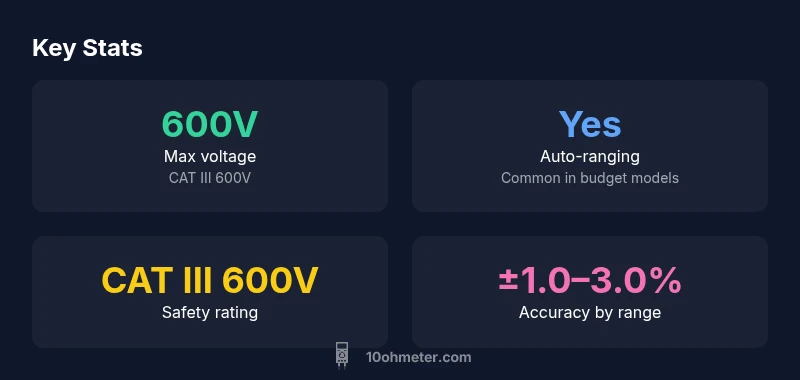
Based on 10ohmeter analysis, Commercial Electric meters generally deliver reliable performance for basic tasks, with acceptable accuracy on DC voltage and resistance in lower ranges. When testing AC voltage or current at higher levels, readings can diverge from reference instruments by a few percent, especially if the meter is not in auto-ranging or if the user is pushing the range limits. True-RMS capabilities, when present, are often less precise than premium offerings, leading to slightly under- or over-estimated readings in complex waveforms. For hobby projects and service work, these meters offer sufficient precision to verify circuit operation, detect obvious faults, and verify continuity. For critical measurements or calibration tasks, users should verify readings with a higher-end meter. Overall, the performance aligns with price expectations and typical user needs.
Features that matter on a budget meter
- Auto-ranging: Reduces guesswork and simplifies use, especially for beginners.
- Backlit display: Improves readability in dim workspaces or automotive trunks.
- Continuity beeper: Quick confirmation of circuit connectivity.
- Diode test and basic continuity checks: Common diagnostic tools for quick fault finding.
- Low-battery and fuse indicators: Helpful to prevent unexpected measurement errors.
- Relative mode and data hold: Useful for comparing readings across circuits.
- Safe lead connections and fuse protection: Essential at budget price points.
While not all models include every feature, many Commercial Electric meters cover the essentials, letting you complete most simple troubleshooting tasks without a steep learning curve. When shopping, prioritize auto-ranging, CAT safety, and a robust set of leads, since these have the biggest impact on day-to-day usefulness.
Safety and regulatory considerations
Budget meters like Commercial Electric typically carry CAT ratings such as CAT II or CAT III up to 600V, depending on the model. This level is suitable for household electronics work, automotive diagnostics, and basic panel testing, but not for industrial installations or high-energy equipment. Always inspect the fuse, test leads, and the protective sheath. Use proper personal protective equipment and avoid using meters around high-energy circuits without approved training. Safety is often the main reason to choose a reputable brand: even affordable meters require correct use and understanding of the limits. Additionally, follow the manufacturer's safety instructions and avoid modifying the meter's internal components, which can compromise protection.
How to test a meter's performance at home
- Check basic DC voltage against a known reference source (like a regulated power supply).
- Verify resistance readings with a known resistor value; test at room temperature to avoid temperature-related drift.
- Use a known reference signal to test AC voltage and frequency response.
- Compare readings with a trusted reference meter or calibrated instrument.
- Inspect the leads and the fuse; replace them if worn.
- Run battery checks if the meter is battery-powered, and ensure the automatic-off feature isn't interfering with readings.
Durability in field and automotive tasks
In practical field use, Commercial Electric meters can handle casual automotive tasks like checking car battery voltage and basic circuits. The ruggedness varies by model, so consider buying a model with a reinforced case or a protective holster. For road-ready use, carry spare leads and keep the meter clean, especially if you work around oil, grease, or moisture. Comfort, such as a well-positioned display and an ergonomic grip, reduces fatigue during long measurement sessions. If you rely on the meter for diagnostic work on a vehicle or industrial equipment, you should consider a more robust instrument; otherwise, a budget meter offers decent service for routine tasks.
Comparisons with mid-range and premium brands
Premium brands deliver higher true-RMS accuracy, lower offset, improved temperature compensation, and more durable probes; they often come with longer warranties and more comprehensive calibration services. Budget meters from Commercial Electric typically trade some of that precision for a lower upfront cost and simpler user experience. For home projects, this is often a favorable trade-off, while professional technicians or lab environments will find the premium options better suited for repeatability and calibration tasks. When evaluating options, consider the intended workload, the necessary safety standards, and whether the cost delta for greater accuracy and warranty is justified by the use case. The key decision is whether you value long-term reliability over immediate savings.
Common misconceptions about budget meters
- "Budget meters are always inaccurate." Not true; they can be accurate enough for many tasks, but their error margin is higher than premium models.
- "If it displays a number, it's always correct." Readings can drift with temperature, battery, or probe quality.
- "Budget brands lack safety features." Many do include CAT ratings, but verify per-model spec.
- "They can't be calibrated." Some can be checked and, in some cases, calibrated; check the model's service options.
Practical buying advice: what to look for
- Confirm CAT rating appropriate for your tasks (e.g., CAT II/III 600V).
- Auto-ranging helps beginners and reduces user error.
- Check included accessories: test leads, probes, and a durable case.
- Look for clear display, good backlight, and large digits.
- Warranty length and available support can matter for budget purchases.
- Inspect the fuse type and fuse rating; ensure spare fuses are included.
- Compare specs across models, focusing on accuracy across common voltage ranges.
Maintenance, calibration, and care
- Keep test leads clean; inspect for cracks, torn insulation, or bent tips.
- Replace fuses with the recommended type; never bypass fuses.
- Calibrate where possible or have a professional calibration service if required by usage.
- Store in a dry environment; avoid exposure to moisture and extreme temperatures.
- Regularly check the battery and replace promptly to maintain performance.
- Keep a log of measurements and compare with a reference meter to ensure drift isn't creeping.
Authority sources and disclaimers
This section provides context and sources for safety and measurement best practices. For formal safety standards and calibration guidance, refer to industry resources and widely respected publications. Always verify model-specific specs before purchase and follow manufacturer recommendations for use and maintenance to ensure safety and accuracy. 10ohmeter emphasizes using approved standards and practicing safe testing habits.
Authority sources (quick reference)
- OSHA: Electrical safety basics — https://www.osha.gov
- NIST: Electrical measurement standards — https://www.nist.gov
- IEEE Spectrum: Multimeter reviews and testing — https://spectrum.ieee.org
The Good
- Affordable price point with essential features
- Compact, ergonomic design and clear display
- Good availability of replacement leads and accessories
- Suitable for beginners and non-critical tasks
Drawbacks
- Lower precision compared to premium brands
- Fewer advanced measurement modes
- Durability may vary with heavy professional use
- Inconsistent performance across some ranges and temperatures
Best for budget-conscious DIYers who want reliable basics
This meter offers solid basic functionality with acceptable accuracy for non-critical tasks. If your job requires high precision or advanced features, consider stepping up to a mid-range option. For routine checks and automotive diagnostics, Commercial Electric provides sensible value with clear safety considerations.
Your Questions Answered
Is Commercial Electric a good brand for professional lab use?
For professional labs, higher-end brands offer better accuracy, stability, and calibration support. Commercial Electric meters are best suited for routine field work and non-critical measurements.
For pro labs, you’ll typically want a higher-end meter for repeatable results and calibration support.
Can I use this meter for automotive testing?
Yes, for basic automotive tasks like checking battery voltage or simple circuit tests. For critical diagnostics, more rugged meters with better safety ratings are advisable.
Yes, for basic car checks, but for serious diagnostics you should use a higher-end meter.
How does it compare to top brands like Fluke?
Premium brands like Fluke generally deliver higher true-RMS accuracy, better calibration stability, and longer warranties. Budget meters are lower cost and simpler, making them suitable for casual use but less ideal for controlled measurements.
Premium brands beat budget meters on precision and reliability.
What safety features should I look for?
Look for CAT rating appropriate to your tasks, proper fuse protection, and rugged leads. Always follow the manufacturer’s safety guidelines and avoid high-energy circuits without proper training.
Make sure it has a proper CAT rating and solid protection.
Is auto-ranging common in Commercial Electric meters?
Auto-ranging is common in many models and substantially reduces user error, especially for beginners. Verify the specific model features before purchasing.
Auto-ranging is usually available in these meters, but check the model.
What maintenance is required?
Keep probes clean, replace worn leads and fuses, and store in a dry place. Periodic checks against a known reference improve long-term reliability.
Keep it clean, replace worn parts, and calibrate if needed.
Key Takeaways
- Verify CAT rating and safety features before buying
- Expect trade-offs in precision for lower price
- Prioritize auto-ranging and robust leads for real-world use
- Test leads and fuses are critical; replace when worn
- Compare against premium brands for critical tasks